
Join Our JEE Preparation Group
Prep with like-minded aspirants; Get access to free daily tests and study material.
Sign in
Please select an account to continue using cracku.in
↓ →
Join Our JEE Preparation Group
Prep with like-minded aspirants; Get access to free daily tests and study material.
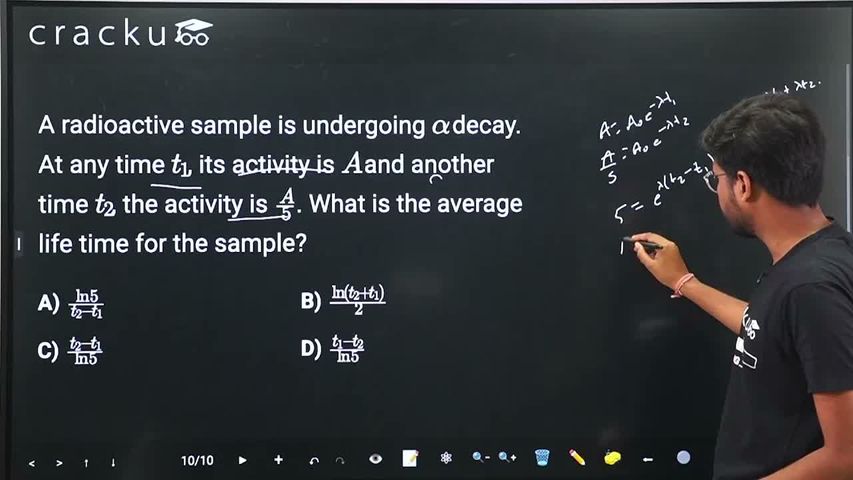
A radioactive sample is undergoing $$\alpha$$ decay. At any time $$t_1$$, its activity is $$A$$ and another time $$t_2$$, the activity is $$\frac{A}{5}$$. What is the average life time for the sample?
The activity of a radioactive sample decays exponentially as $$A(t) = A_0 e^{-\lambda t}$$, where $$\lambda$$ is the decay constant.
At time $$t_1$$, the activity is $$A$$: $$A = A_0 e^{-\lambda t_1}$$ ... (i).
At time $$t_2$$, the activity is $$\frac{A}{5}$$: $$\frac{A}{5} = A_0 e^{-\lambda t_2}$$ ... (ii).
Dividing equation (i) by equation (ii): $$\frac{A}{A/5} = \frac{e^{-\lambda t_1}}{e^{-\lambda t_2}}$$, which gives $$5 = e^{\lambda(t_2 - t_1)}$$.
Taking the natural logarithm: $$\ln 5 = \lambda(t_2 - t_1)$$, so $$\lambda = \frac{\ln 5}{t_2 - t_1}$$.
The average life time is $$\tau = \frac{1}{\lambda} = \frac{t_2 - t_1}{\ln 5}$$.
Was this solution helpful?
Click on the Email ☝️ to Watch the Video Solution
Create a FREE account and get:
_1.webp)

Educational materials for JEE preparation

Ask our AI anything

AI can make mistakes. Please verify important information.
AI can make mistakes. Please verify important information.


