NTA JEE Main 25th January 2023 Shift 2
For the following questions answer them individually
NTA JEE Main 25th January 2023 Shift 2 - Question 11
Match List I with List II
A. Troposphere I. Approximate 65-75 km over Earth's surface
B. E-Part of Stratosphere II. Approximate 300 km over Earth's surface
C. F$$_2$$-Part of Thermosphere III. Approximate 10 km over Earth's surface
D. D-Part of Stratosphere IV. Approximate 100 km over Earth's surface
Choose the correct answer from the options given below :
NTA JEE Main 25th January 2023 Shift 2 - Question 12
A point charge of 10 $$\mu$$C is placed at the origin. At what location on the X-axis should a point charge of 40 $$\mu$$C be placed so that the net electric field is zero at $$x = 2$$ cm on the X-axis?
NTA JEE Main 25th January 2023 Shift 2 - Question 13
The resistance of a wire is 5 $$\Omega$$. Its new resistance in ohm, if stretched to 5 times of its original length will be:

NTA JEE Main 25th January 2023 Shift 2 - Question 14
For a moving coil galvanometer, the deflection in the coil is 0.05 rad when a current of 10 mA is passed through it. If the torsional constant of suspension wire is $$4.0 \times 10^{-5}$$ N m rad$$^{-1}$$, the magnetic field is 0.01 T and the number of turns in the coil is 200, the area of each turn (in cm$$^2$$) is:
NTA JEE Main 25th January 2023 Shift 2 - Question 15
A wire of length 1 m moving with velocity 8 m s$$^{-1}$$ at right angles to a magnetic field of 2 T. The magnitude of induced emf, between the ends of wire will be _____.
NTA JEE Main 25th January 2023 Shift 2 - Question 16
Match List I and List II
A. Gauss's Law in Electrostatics I. $$\oint \vec{E} \cdot d\vec{l} = -\frac{d\phi_B}{dt}$$
B. Faraday's Law II. $$\oint \vec{B} \cdot d\vec{A} = 0$$
C. Gauss's Law in Magnetism III. $$\oint \vec{B} \cdot d\vec{l} = \mu_0 i_c + \mu_0 \epsilon_0 \frac{d\phi_E}{dt}$$
D. Ampere-Maxwell Law IV. $$\oint \vec{E} \cdot d\vec{s} = \frac{q}{\epsilon_0}$$
Choose the correct answer from the options given below :
NTA JEE Main 25th January 2023 Shift 2 - Question 17
The light rays from an object have been reflected towards an observer from a standard flat mirror, the image observed by the observer are:-
A. Real
B. Erect
C. Smaller in size than object
D. Laterally inverted
Choose the most appropriate answer from the options below:
NTA JEE Main 25th January 2023 Shift 2 - Question 18
Given below are two statements:
Statement I: Stopping potential in photoelectric effect does not depend on the power of the light source.
Statement II: For a given metal, the maximum kinetic energy of the photoelectron depends on the wavelength of the incident light.
In the light of above statements, choose the most appropriate answer from the options given below.
NTA JEE Main 25th January 2023 Shift 2 - Question 19
The energy levels of an atom is shown in figure.
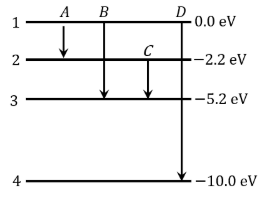
Which one of these transitions will result in the emission of a photon of wavelength 124.1 nm?
Given ($$h = 6.62 \times 10^{-34}$$ J s)
NTA JEE Main 25th January 2023 Shift 2 - Question 20
Statement I: When a Si sample is doped with Boron, it becomes P type and when doped by Arsenic it becomes N-type semi conductor such that P-type has excess holes and N-type has excess electrons.
Statement II: When such P-type and N-type semi-conductors, are fused to make a junction, a current will automatically flow which can be detected with an externally connected ammeter.
In the light of above statements, choose the most appropriate answer from the options given below.