Group
Group
 Group
Group

JEE Friction PYQ
Solving JEE Friction PYQ problems helps students understand how friction affects the motion and equilibrium of objects. Questions from this chapter commonly involve static friction, limiting friction, kinetic friction, rough inclined planes, connected bodies, blocks placed one above another and rolling without slipping.
Friction is a contact force that opposes relative motion or the tendency of relative motion between two surfaces. Its direction cannot be determined only from the direction of an applied force. Students must first identify how one surface would move relative to the other if friction were absent.
Friction questions are closely connected with Newton’s laws of motion, circular motion, work and energy, and rotational mechanics. Regular practice of JEE Mains PYQ problems helps students recognise different physical situations and draw correct free-body diagrams.
JEE Friction Important PYQ PDF
The JEE Friction Important PYQ PDF provided below contains selected previous-year questions for structured chapter-wise practice. It covers static and kinetic friction, limiting equilibrium, rough horizontal surfaces, inclined planes, pulleys, stacked blocks, acceleration constraints and rolling motion.
Attempt every question independently before checking the answer or explanation. Begin by isolating each body and drawing all the forces acting on it. Determine the possible direction of motion before assigning the direction of friction.
While reviewing your attempt, identify whether the mistake occurred while calculating the normal reaction, deciding the direction of friction, selecting the correct type of friction or applying Newton’s laws. Include the PDF in your JEE Study Material and reattempt difficult questions after revising the related concepts.
Important Topics Covered in Friction PYQs
Friction PYQs include direct conceptual questions as well as multi-body problems. Important topics include:
- Static, limiting and kinetic friction
- Coefficient of friction
- Normal reaction
- Friction on horizontal surfaces
- Friction on inclined planes
- Angle of friction
- Angle of repose
- Limiting equilibrium
- Minimum force required to move a block
- Pulling and pushing a block
- Connected blocks on rough surfaces
- Block-on-block problems
- Acceleration without slipping
- Friction in elevators
- Friction in circular motion
- Banking of roads
- Work done by friction
- Rolling without slipping
- Pure rolling on an inclined plane
- Variable applied-force problems
Static friction is self-adjusting. Its value changes according to the applied force until it reaches the limiting value. Therefore, students should not automatically assume that static friction is always at its maximum.
Kinetic friction acts when two surfaces slide relative to each other. In most standard JEE problems, kinetic friction is treated as smaller than limiting friction. However, students should use the information provided in the question rather than relying on assumptions.
The normal reaction is not always equal to the weight of an object. It can change when an external force acts at an angle, when the object is on an inclined plane or when vertical acceleration is present.
In stacked-block problems, friction may accelerate the upper block and oppose slipping between the surfaces. Students must analyse each block separately and then apply the no-slipping condition.
How to Solve Friction PYQs Effectively
Begin by drawing a separate free-body diagram for every object. Mark weight, normal reaction, applied force, tension and friction clearly. Then identify the possible relative motion between the surfaces.
Follow these steps while solving JEE Mains Questions on friction:
- Isolate each object involved in the problem.
- Draw all forces acting on every object.
- Identify the tendency of relative motion.
- Assign friction opposite to that tendency.
- Calculate the normal reaction carefully.
- Check whether the object remains at rest or begins to slide.
- Use static friction when no slipping occurs.
- Use kinetic friction only after sliding begins.
- Apply the same acceleration condition to bodies moving together.
- Verify whether the calculated friction lies within its permitted limit.
A common mistake is assigning friction opposite to the motion of the object rather than opposite to the relative motion between surfaces. For example, friction can sometimes act in the same direction as the motion of an object.
Students also lose marks by using maximum static friction in every equilibrium problem. First calculate the friction required to maintain equilibrium, and then check whether the available static friction can provide that value.
After completing chapter-wise practice, attempt a JEE Mains Mock Test to evaluate speed, accuracy and question selection. During analysis, review problems in which the direction of friction or the normal reaction was determined incorrectly. Maintain an error log for recurring mistakes.
List of JEE Friction PYQs
The questions listed below can be attempted as a timed chapter-wise test. They cover static and kinetic friction, inclined planes, connected bodies, stacked blocks and rolling motion.
Solve the questions without checking the answers. After completing the test, review every incorrect, guessed and skipped problem. Revise the underlying concept using your JEE Study Material and attempt the question again.
Question 1
A block of mass $$m$$ is placed on a surface having vertical cross section given by $$y = \frac{x^2}{4}$$. If coefficient of friction is 0.5, the maximum height above the ground at which block can be placed without slipping is:
correct answer:- 1
Question 2
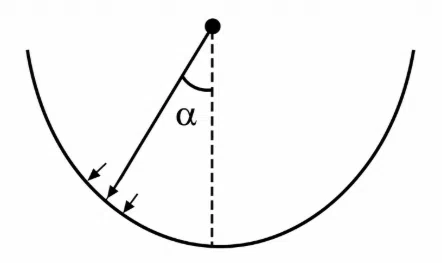
An insect crawls up a hemispherical surface very slowly. The coefficient of friction between the insect and the surface is $$1/3$$. If the line joining the centre of the hemispherical surface to the insect makes an angle $$\alpha$$ with the vertical, the maximum possible value of $$\alpha$$ so that the insect does not slip is given by
correct answer:- 1
Question 3
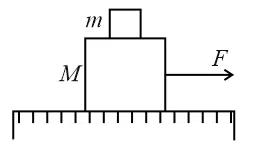
A system of two blocks of masses $$m = 2$$ kg and $$M = 8$$ kg is placed on a smooth table as shown in figure. The coefficient of static friction between two blocks is $$0.5$$. The maximum horizontal force $$F$$ that can be applied to the block of mass $$M$$ so that the blocks move together will be $$(g = 9.8$$ m s$$^{-2})$$
correct answer:- 3
Question 4
A bag is gently dropped on a conveyor belt moving at a speed of $$2 \text{ m s}^{-1}$$. The coefficient of friction between the conveyor belt and bag is $$0.4$$. Initially, the bag slips on the belt before it stops due to friction. The distance travelled by the bag on the belt during slipping motion is: [Take $$g = 10 \text{ m s}^{-2}$$]
correct answer:- 2
Question 5
A block of mass $$M$$ slides down on a rough inclined plane with constant velocity. The angle made by the incline plane with horizontal is $$\theta$$. The magnitude of the contact force will be :
correct answer:- 1

Question 6
The velocity of a small ball of mass 0.3 g and density 8 g cc$$^{-1}$$ when dropped in a container filled with glycerine becomes constant after some time. If the density of glycerine is 1.3 g cc$$^{-1}$$, then the value of viscous force acting on the ball will be $$x \times 10^{-4}$$ N, the value of x is _____ [use $$g = 10$$ m s$$^{-2}$$]
correct answer:- 25
Question 7
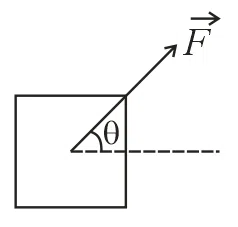
A block of mass $$m$$ slides along a floor while a force of magnitude $$F$$ is applied to it at an angle $$\theta$$ as shown in figure. The coefficient of kinetic friction is $$\mu_K$$. Then, the block's acceleration $$a$$ is given by: ($$g$$ is acceleration due to gravity)
correct answer:- 2
Question 8
When a body slides down from rest along a smooth inclined plane making an angle of 30° with the horizontal, it takes time $$T$$. When the same body slides down from rest along a rough inclined plane making the same angle and through the same distance, it takes time $$\alpha T$$, where $$\alpha$$ is a constant greater than 1. The co-efficient of friction between the body and the rough plane is $$\frac{1}{\sqrt{x}} \cdot \frac{\alpha^2-1}{\alpha^2}$$ where $$x$$ = _________.
correct answer:- 3
Question 9
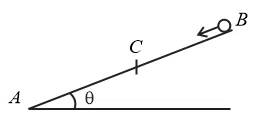
A small block starts slipping down from a point B on an inclined plane AB, which is making an angle $$\theta$$ with the horizontal section BC is smooth and the remaining section CA is rough with a coefficient of friction $$\mu$$. It is found that the block comes to rest as it reaches the bottom (point A) of the inclined plane. If $$BC = 2AC$$, the coefficient of friction is given by $$\mu = k \tan\theta$$. The value of $$k$$ is ___________.
correct answer:- 3
Question 10
A block A of mass 4 kg is placed on another block B of mass 5 kg, and the block B rests on a smooth horizontal table. If the minimum force that can be applied on A so that both the blocks move together is 12 N, the maximum force that can be applied on B for the blocks to move together will be:
correct answer:- 4
.webp)
Question 11
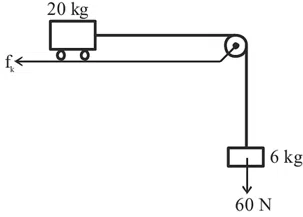
Consider a block and trolley system as shown in figure. If the coefficient of kinetic friction between the trolley and the surface is $$0.04$$, the acceleration of the system in m s$$^{-2}$$ is: (Consider that the string is massless and unstretchable and the pulley is also massless and frictionless):
correct answer:- 3
Question 12
Given below are two statements :
Statement (I) : The limiting force of static friction depends on the area of contact and independent of materials.
Statement (II) : The limiting force of kinetic friction is independent of the area of contact and depends on materials.
In the light of the above statements, choose the most appropriate answer from the options given below :
correct answer:- 2
Question 13
A block of mass $$100$$ kg slides over a distance of $$10$$ m on a horizontal surface. If the co-efficient of friction between the surfaces is $$0.4$$, then the work done against friction (in J) is:
correct answer:- 3
Question 14
A small ball of mass $$m$$ and density $$\rho$$ is dropped in a viscous liquid of density $$\rho_0$$. After sometime, the ball falls with constant velocity. The viscous force on the ball is :
correct answer:- 4
Question 15
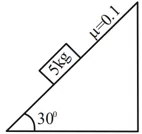
A block of mass 5 kg is placed on a rough inclined surface as shown in the figure. If $$\vec{F_1}$$ is the force required to just move the block up the inclined plane and $$\vec{F_2}$$ is the force required to just prevent the block from sliding down, then the value of $$|\vec{F_1}| - |\vec{F_2}|$$ is: [Use $$g = 10$$ m s$$^{-2}$$]
correct answer:- 2
.webp)
Question 16
An object of mass $$5$$ kg is thrown vertically upwards from the ground. The air resistance produces a constant retarding force of $$10$$ N throughout the motion. The ratio of time of ascent to the time of descent will be equal to : [Use $$g = 10$$ m s$$^{-2}$$]
correct answer:- 2
Question 17
A block of mass $$10$$ kg starts sliding on a surface with an initial velocity of $$9.8$$ ms$$^{-1}$$. The coefficient of friction between the surface and block is $$0.5$$. The distance covered by the block before coming to rest is : [use $$g = 9.8$$ ms$$^{-2}$$]
correct answer:- 1
Question 18
A water drop of radius $$1 \mu$$m falls in a situation where the effect of buoyant force is negligible. Co-efficient of viscosity of air is $$1.8 \times 10^{-5}$$ N s m$$^{-2}$$ and its density is negligible as compared to that of water $$10^6$$ g m$$^{-3}$$. Terminal velocity of the water drop is
(Take acceleration due to gravity $$= 10$$ m s$$^{-2}$$)
correct answer:- 2
Question 19
A block of mass 5 kg is placed at rest on a table of rough surface. Now, if a force of 30 N is applied in the direction parallel to surface of the table, the block slides through a distance of 50 m in an interval of time 10 s. Coefficient of kinetic friction is (given, $$g = 10$$ m s$$^{-2}$$):
correct answer:- 3
Question 20
A block of mass $$10 \,\, \text{kg}$$ is placed on a rough horizontal surface having a coefficient of static friction $$\mu_s = 0.6$$ and a coefficient of kinetic friction $$\mu_k = 0.4$$. If a horizontal force of $$50 \,\, \text{N}$$ is applied to the block, the magnitude of the frictional force acting on the block is:
(Take acceleration due to gravity $$g = 10 \,\, \text{m s}^{-2}$$)
correct answer:- 2
.webp)
Question 21
A block takes $$t$$ time to slide down a plane inclined at 45° to the horizontal. If the surface is made smooth (frictionless), the block takes time $$\dfrac{t}{2}$$ to slide down the plane. The coefficient of friction between the block and the inclined plane is $$\left(\dfrac{\alpha}{100}\right)$$. The value of $$\alpha$$ is __________.
correct answer:- 75
Question 22
A smooth block is released at rest on a $$45^\circ$$ incline and then slides a distance $$d$$. The time taken to slide is $$n$$ times as much to slide on rough incline than on a smooth incline. The coefficient of friction is
correct answer:- 1
Question 23
A given object takes n times the time to slide down $$45°$$ rough inclined plane as it takes the time to slide down an identical perfectly smooth $$45°$$ inclined plane. The coefficient of kinetic friction between the object and the surface of inclined plane is :
correct answer:- 3
Question 24
A block starts moving up an inclined plane of inclination 30° with an initial velocity of $$v_0$$. It comes back to its initial position with velocity $$\frac{v_0}{2}$$. The value of the coefficient of kinetic friction between the block and the inclined plane is close to $$\frac{I}{1000}$$. The nearest integer to I is:
correct answer:- 346
Question 25
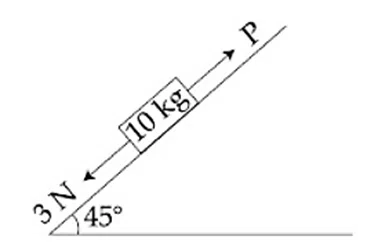
A block of mass 10 kg is kept on a rough inclined plane as shown in the figure. A force of 3 N is applied on the block. The coefficient of static friction between the plane and the block is 0.6. What should be the minimum value of force P, such that the block does not move downward? (take $$g = 10 \; ms^{-2}$$)
correct answer:- 4
Question 26
A block of mass 5 kg is moving on an inclined plane which makes an angle of 30° with the horizontal. Friction coefficient between the block and inclined plane surface is $$\frac{\sqrt{3}}{2}$$. The force to be applied on the block so that the block will move down without acceleration is _______N
$$(g=10m/s^{2})$$
correct answer:- 2
Question 27
An inclined plane is bent in such a way that the vertical cross-section is given by $$y = \frac{x^2}{4}$$ where $$y$$ is in vertical and $$x$$ in horizontal direction. If the upper surface of this curved plane is rough with coefficient of friction $$\mu = 0.5$$, the maximum height in cm at which a stationary block will not slip downward is ______ cm.
correct answer:- 25
Question 28
A particle of mass m falls from rest through a resistive medium having resistive force, F = -kv, where v is the velocity of the particle and k is a constant. Which of the following graphs represents velocity (v) versus time (t)?
correct answer:- 4
Question 29
Given below are two statements :
Statement (I) : The limiting force of static friction depends on the area of contact and independent of materials.
Statement (II) : The limiting force of kinetic friction is independent of the area of contact and depends on materials.
In the light of the above statements, choose the most appropriate answer from the options given below :
correct answer:- 2
Question 30
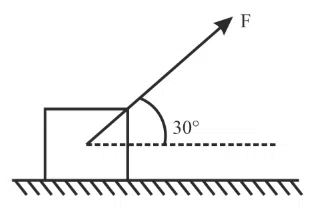
As shown in the figure a block of mass 10 kg lying on a horizontal surface is pulled by a force F acting at an angle $$30°$$, with horizontal. For $$\mu_s = 0.25$$, the block will just start to move for the value of $$F$$: [Given $$g = 10 \text{ m} \cdot \text{s}^{-2}$$]
correct answer:- 2