
Join Our JEE Preparation Group
Prep with like-minded aspirants; Get access to free daily tests and study material.
Sign in
Please select an account to continue using cracku.in
↓ →
Join Our JEE Preparation Group
Prep with like-minded aspirants; Get access to free daily tests and study material.
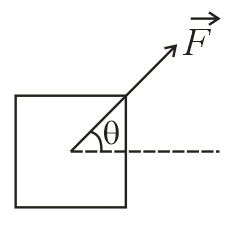
A block of mass $$m$$ slides along a floor while a force of magnitude $$F$$ is applied to it at an angle $$\theta$$ as shown in figure. The coefficient of kinetic friction is $$\mu_K$$. Then, the block's acceleration $$a$$ is given by: ($$g$$ is acceleration due to gravity)
```html
Let us resolve the applied force $$F$$ acting on the block of mass $$m$$ into its orthogonal vector components. The force is applied at an angle $$\theta$$ relative to the horizontal surface:
$$F_x = F \cos\theta$$
$$F_y = F \sin\theta$$
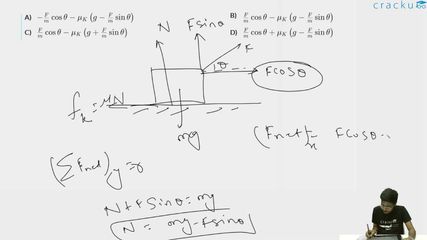
To find the normal reaction force ($$N$$) exerted by the ground, we set up the static equilibrium equation along the vertical axis where there is no net motion:
$$\Sigma F_{\text{vertical}} = 0 \implies N - mg - F_y = 0$$
$$N = mg + F \sin\theta$$
The kinetic friction force ($$f_K$$) opposing the forward sliding motion of the block depends directly on this normal reaction force:
$$f_K = \mu_K N$$
$$f_K = \mu_K (mg + F \sin\theta)$$
Applying Newton's Second Law along the horizontal axis of motion yields the net force equation:
$$F_{\text{net}} = F_x - f_K = ma$$
$$F \cos\theta - \mu_K (mg + F \sin\theta) = ma$$
To explicitly solve for the block's acceleration ($$a$$), divide the entire expression by the mass $$m$$:
$$a = \frac{F \cos\theta - \mu_K (mg + F \sin\theta)}{m}$$
$$a = \frac{F}{m} \cos\theta - \mu_K \left(g + \frac{F}{m} \sin\theta\right)$$
Concept Check: Because the external force pushes downward at an angle, it actively presses the block tighter into the floor. This structural alignment augments the standard normal force from $$mg$$ to $$mg + F\sin\theta$$, ramping up the kinetic friction drag and reducing the net forward acceleration to exactly $$\frac{F}{m} \cos\theta - \mu_K \left(g + \frac{F}{m} \sin\theta\right)$$.
Correct Option Choice: Option C $$\left(\frac{F}{m} \cos\theta - \mu_K \left(g + \frac{F}{m} \sin\theta\right)\right)$$
```
Was this solution helpful?
Click on the Email ☝️ to Watch the Video Solution
Create a FREE account and get:
_1.webp)

Educational materials for JEE preparation

Ask our AI anything

AI can make mistakes. Please verify important information.
AI can make mistakes. Please verify important information.
