
Join Our JEE Preparation Group
Prep with like-minded aspirants; Get access to free daily tests and study material.
Sign in
Please select an account to continue using cracku.in
↓ →
Join Our JEE Preparation Group
Prep with like-minded aspirants; Get access to free daily tests and study material.
The maximum and minimum distances of a comet from the Sun are $$1.6 \times 10^{12}$$ m and $$8.0 \times 10^{10}$$ m respectively. If the speed of the comet at the nearest point is $$6 \times 10^{4}$$ m s$$^{-1}$$, the speed at the farthest point is:
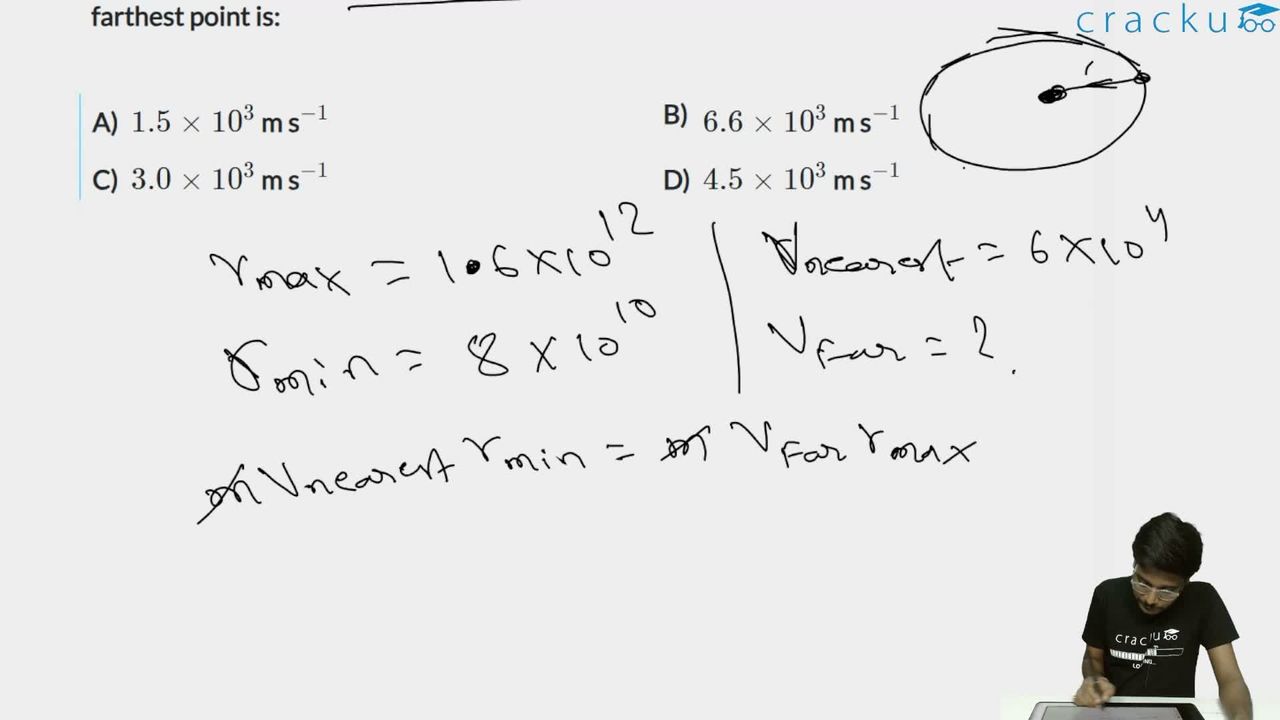
We are given a comet orbiting the Sun with maximum distance (aphelion) $$r_{\text{max}} = 1.6 \times 10^{12} \text{ m}$$, minimum distance (perihelion) $$r_{\text{min}} = 8.0 \times 10^{10} \text{ m}$$, and speed at the nearest point $$v_{\text{near}} = 6 \times 10^4 \text{ m/s}$$.
By conservation of angular momentum about the Sun, at the nearest and farthest points the velocity is perpendicular to the radius vector, so $$m \, v_{\text{near}} \, r_{\text{min}} = m \, v_{\text{far}} \, r_{\text{max}}$$.
Solving for $$v_{\text{far}}$$: $$v_{\text{far}} = \frac{v_{\text{near}} \, r_{\text{min}}}{r_{\text{max}}} = \frac{6 \times 10^4 \times 8.0 \times 10^{10}}{1.6 \times 10^{12}}$$.
Computing: $$v_{\text{far}} = \frac{48 \times 10^{14}}{1.6 \times 10^{12}} = 30 \times 10^{2} = 3.0 \times 10^3 \text{ m/s}$$.
Was this solution helpful?
Click on the Email ☝️ to Watch the Video Solution
Create a FREE account and get:
_1.webp)

Educational materials for JEE preparation

Ask our AI anything

AI can make mistakes. Please verify important information.
AI can make mistakes. Please verify important information.
