
Join Our JEE Preparation Group
Prep with like-minded aspirants; Get access to free daily tests and study material.
Sign in
Please select an account to continue using cracku.in
↓ →
Join Our JEE Preparation Group
Prep with like-minded aspirants; Get access to free daily tests and study material.
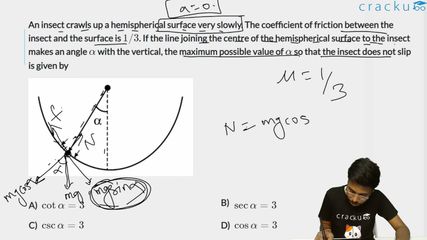
An insect crawls up a hemispherical surface very slowly. The coefficient of friction between the insect and the surface is $$1/3$$. If the line joining the centre of the hemispherical surface to the insect makes an angle $$\alpha$$ with the vertical, the maximum possible value of $$\alpha$$ so that the insect does not slip is given by
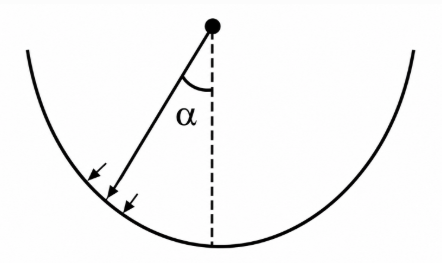
Let the insect be at a point on the hemispherical surface where the radius vector from the center makes an angle $$\alpha$$ with the vertical. Let us resolve the forces acting on the insect along and perpendicular to the tangential surface at that point:
$$N = mg \cdot \cos\alpha$$
$$f_s = mg \cdot \sin\alpha$$
For the insect to climb safely without slipping, the required static friction force must be less than or equal to the maximum available limiting friction ($$f_{\text{max}} = \mu \cdot N$$):
$$f_s \le \mu \cdot N$$
Substitute our expressions for $$f_s$$ and $$N$$ into the inequality:
mg \cdot \sin\alpha \le \mu \cdot (mg \cdot \cos\alpha)
Canceling out the weight ($$mg$$) from both sides gives:
$$\sin\alpha \le \mu \cdot \cos\alpha$$
$$\frac{\sin\alpha}{\cos\alpha} \le \mu \implies \tan\alpha \le \mu$$
The maximum possible angle $$\alpha$$ before slipping occurs happens at the limiting condition where $$\tan\alpha = \mu$$. We are given the coefficient of friction as $$\mu = \frac{1}{3}$$:
$$\tan\alpha = \frac{1}{3}$$
Since $$\cot\alpha = \frac{1}{\tan\alpha}$$, we invert both sides of the equation:
$$\cot\alpha = 3$$
Concept Check: As the insect crawls higher up the dome, the incline gets steeper, which causes the destabilizing parallel component ($$mg \cdot \sin\alpha$$) to increase while the stabilizing normal grip force ($$mg \cdot \cos\alpha$$) simultaneously decreases. The threshold where these opposing changes cross over is strictly limited by the traction coefficient ($$\mu$$).
Correct Option Key: Option A ($$\cot\alpha = 3$$)
Was this solution helpful?
Click on the Email ☝️ to Watch the Video Solution
Create a FREE account and get:
_1.webp)

Educational materials for JEE preparation

Ask our AI anything

AI can make mistakes. Please verify important information.
AI can make mistakes. Please verify important information.
