
Join Our JEE Preparation Group
Prep with like-minded aspirants; Get access to free daily tests and study material.
Sign in
Please select an account to continue using cracku.in
↓ →
Join Our JEE Preparation Group
Prep with like-minded aspirants; Get access to free daily tests and study material.
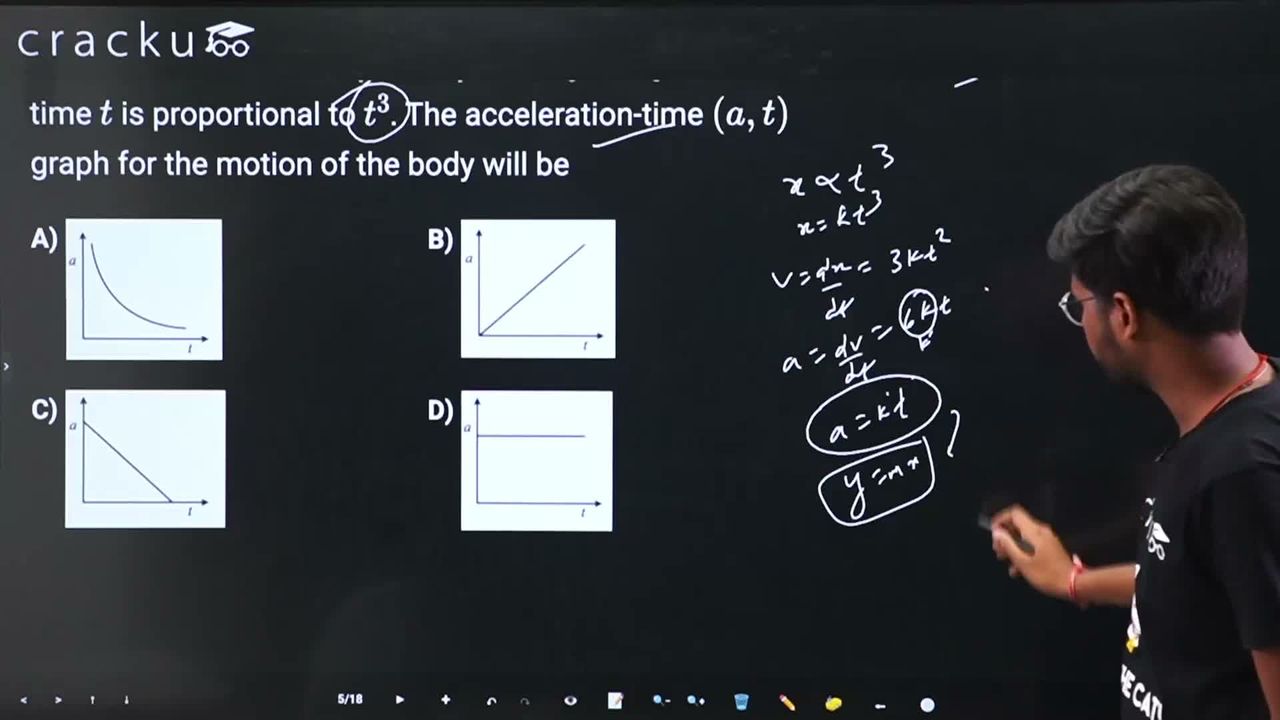
The distance travelled by a body moving along a line in time $$t$$ is proportional to $$t^3$$. The acceleration-time $$(a, t)$$ graph for the motion of the body will be
The problem states that the distance travelled ($$s$$) by the body is directly proportional to the cube of time ($$t^3$$). We can express this relationship mathematically by introducing a proportionality constant ($$k$$):
$$s = k \cdot t^3$$
To find the velocity ($$v$$) of the body as a function of time, we take the first derivative of distance with respect to time ($$v = \frac{ds}{dt}$$):
$$v = \frac{d}{dt}(k \cdot t^3) = 3 \cdot k \cdot t^2$$
To find the acceleration ($$a$$) of the body, we take the derivative of velocity with respect to time ($$a = \frac{dv}{dt}$$):
$$a = \frac{d}{dt}(3 \cdot k \cdot t^2) = 2 \cdot (3 \cdot k) \cdot t$$
$$a = 6 \cdot k \cdot t$$
Since $$6$$ and $$k$$ are constants, we can simplify this relation back into a direct proportionality statement:
$$a \propto t$$
The linear equation $$a = (6k) \cdot t$$ matches the slope-intercept form of a straight line passing through the origin ($$y = m \cdot x$$), where:
Therefore, the acceleration-time ($$a - t$$) graph of this body is a straight line passing through the origin with a positive slope.
Correct Option Key: A straight line passing through the origin with a positive slope.
Was this solution helpful?
Click on the Email ☝️ to Watch the Video Solution
Create a FREE account and get:
_1.webp)

Educational materials for JEE preparation

Ask our AI anything

AI can make mistakes. Please verify important information.
AI can make mistakes. Please verify important information.
