
Join Our JEE Preparation Group
Prep with like-minded aspirants; Get access to free daily tests and study material.
Sign in
Please select an account to continue using cracku.in
↓ →
Join Our JEE Preparation Group
Prep with like-minded aspirants; Get access to free daily tests and study material.
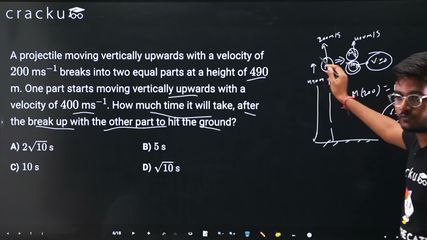
A projectile moving vertically upwards with a velocity of $$200$$ ms$$^{-1}$$ breaks into two equal parts at a height of $$490$$ m. One part starts moving vertically upwards with a velocity of $$400$$ ms$$^{-1}$$. How much time it will take, after the break up with the other part to hit the ground?
An explosion is driven completely by internal forces, meaning the net external force during the instantaneous break-up interval is negligible. Therefore, linear momentum along the vertical axis must be fully conserved:
$$P_{\text{initial}} = P_{\text{final}}$$
Let the total initial mass of the projectile be $$M$$. It splits into two equal fragments, each having a mass of $$\frac{M}{2}$$. Taking the upward direction as positive ($$+$$):
Setting up the momentum balance equation:
$$M \cdot v = \left(\frac{M}{2}\right) \cdot v_1 + \left(\frac{M}{2}\right) \cdot v_2$$
Cancel out the mass variable $$M$$ from all terms:
$$v = \frac{v_1 + v_2}{2}$$
$$200 = \frac{400 + v_2}{2}$$
$$400 = 400 + v_2 \implies v_2 = 0 \,\, \text{ms}^{-1}$$
This means that immediately after the mid-air explosion, the second fragment loses all its forward upward momentum and is left momentarily stationary at that height.
Now we analyze the motion of this second piece as it falls from its position at the explosion height down to the earth's surface:
Using the second equation of motion ($$s = u \cdot t + \frac{1}{2} \cdot a \cdot t^2$$) taking downwards as the positive direction of displacement:
$$490 = 0 \cdot t + \frac{1}{2} \cdot (9.8) \cdot t^2$$
$$490 = 4.9 \cdot t^2$$
$$t^2 = \frac{490}{4.9} = 100$$
Taking the positive square root to determine the flight time duration:
$$t = \sqrt{100} = 10 \,\, \text{s}$$
Concept Check: Because the first half took away twice the velocity vector ($$400 \,\, \text{ms}^{-1}$$), it completely drained the kinetic energy allocations of the second half. This brings the second part to a dead stop in mid-air, making its subsequent journey back to earth a pure free-fall from a height of $$490 \,\, \text{m}$$.
Correct Option Key: Option C ($$10 \,\, \text{s}$$)
Was this solution helpful?
Click on the Email ☝️ to Watch the Video Solution
Create a FREE account and get:
_1.webp)

Educational materials for JEE preparation

Ask our AI anything

AI can make mistakes. Please verify important information.
AI can make mistakes. Please verify important information.
