
Join Our JEE Preparation Group
Prep with like-minded aspirants; Get access to free daily tests and study material.
Sign in
Please select an account to continue using cracku.in
↓ →
Join Our JEE Preparation Group
Prep with like-minded aspirants; Get access to free daily tests and study material.
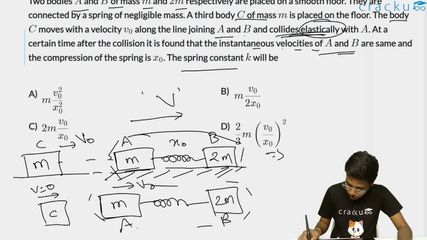
Two bodies $$A$$ and $$B$$ of mass $$m$$ and $$2m$$ respectively are placed on a smooth floor. They are connected by a spring of negligible mass. A third body $$C$$ of mass $$m$$ is placed on the floor. The body $$C$$ moves with a velocity $$v_0$$ along the line joining $$A$$ and $$B$$ and collides elastically with $$A$$. At a certain time after the collision it is found that the instantaneous velocities of $$A$$ and $$B$$ are same and the compression of the spring is $$x_0$$. The spring constant $$k$$ will be
Body $$C$$ (mass $$m$$) moves with an initial velocity $$v_0$$ and collides elastically with body $$A$$ (mass $$m$$), which is initially at rest. Since both bodies have identical masses ($$m_C = m_A = m$$) and the collision is perfectly elastic ($$e = 1$$), they completely swap their velocities:
$$v_C = 0$$
$$v_A = v_0$$
Immediately after this collision, body $$A$$ begins moving forward with velocity $$v_0$$, while body $$B$$ remains momentarily at rest ($$v_B = 0$$).
Now, let us consider the connected system consisting of body $$A$$ ($$m$$) and body $$B$$ ($$2m$$). As the spring compresses, it transfers momentum between the blocks. At the instant of maximum compression ($$x_0$$), both blocks move with the same common velocity ($$v_c$$).
Since no external horizontal forces act on the $$A-B$$ system, total linear momentum is conserved:
$$P_{\text{initial}} = P_{\text{final}}$$
$$m \cdot v_0 + 2m \cdot (0) = (m + 2m) \cdot v_c$$
$$m \cdot v_0 = 3m \cdot v_c$$
$$v_c = \frac{v_0}{3}$$
The total mechanical energy of the $$A-B$$ spring system is conserved throughout the interaction. The kinetic energy lost by the blocks during compression is stored entirely as elastic potential energy within the spring:
$$E_{\text{initial}} = E_{\text{final}}$$
$$\frac{1}{2} \cdot m \cdot v_0^2 = \frac{1}{2} \cdot (m + 2m) \cdot v_c^2 + \frac{1}{2} \cdot k \cdot x_0^2$$
Cancel out the common factor of $$\frac{1}{2}$$ from all terms:
$$m \cdot v_0^2 = 3m \cdot v_c^2 + k \cdot x_0^2$$
Substitute the value of common velocity $$v_c = \frac{v_0}{3}$$ into the energy balance equation:
$$m \cdot v_0^2 = 3m \cdot \left(\frac{v_0}{3}\right)^2 + k \cdot x_0^2$$
$$m \cdot v_0^2 = 3m \cdot \left(\frac{v_0^2}{9}\right) + k \cdot x_0^2$$
$$m \cdot v_0^2 = \frac{m \cdot v_0^2}{3} + k \cdot x_0^2$$
Rearrange the terms to solve explicitly for the spring constant variable:
$$k \cdot x_0^2 = m \cdot v_0^2 - \frac{m \cdot v_0^2}{3}$$
$$k \cdot x_0^2 = \frac{2}{3} \cdot m \cdot v_0^2$$
$$k = \frac{2}{3} \cdot m \cdot \left(\frac{v_0}{x_0}\right)^2$$
Correct Option Key: Option D ($$\frac{2}{3} \cdot m \cdot \left(\frac{v_0}{x_0}\right)^2$$)
Was this solution helpful?
Click on the Email ☝️ to Watch the Video Solution
Create a FREE account and get:
_1.webp)

Educational materials for JEE preparation

Ask our AI anything

AI can make mistakes. Please verify important information.
AI can make mistakes. Please verify important information.
