
Join Our JEE Preparation Group
Prep with like-minded aspirants; Get access to free daily tests and study material.
Sign in
Please select an account to continue using cracku.in
↓ →
Join Our JEE Preparation Group
Prep with like-minded aspirants; Get access to free daily tests and study material.
A spring is compressed between two blocks of masses $$m_1$$ and $$m_2$$ placed on a horizontal frictionless surface as shown in the figure. When the blocks are released, they have initial velocity of $$v_1$$ and $$v_2$$ as shown. The blocks travel distances $$x_1$$ and $$x_2$$ respectively before coming to rest. The ratio $$\left(\dfrac{x_1}{x_2}\right)$$ is
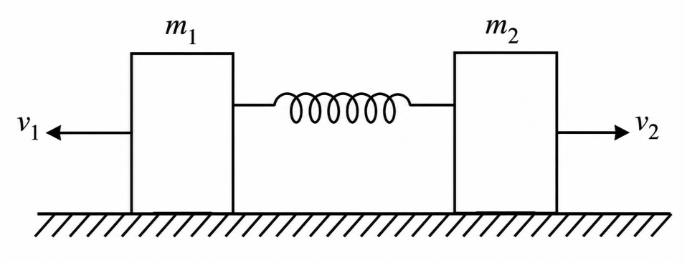
If the surface is entirely frictionless, but both blocks are brought to rest by an identical external retarding force ($F$) acting against their motion, the problem can be solved using the Work-Energy Theorem directly.
The work done by the constant retarding force $F$ over the respective stopping distances $x_1$ and $x_2$ must equal the initial kinetic energy of each block:
$$F \cdot x_1 = \frac{1}{2}m_1 v_1^2$$ $$F \cdot x_2 = \frac{1}{2}m_2 v_2^2$$Dividing the two equations gives the ratio of their stopping distances:
$$\frac{x_1}{x_2} = \frac{m_1 v_1^2}{m_2 v_2^2}$$By the Law of Conservation of Linear Momentum, the magnitude of momentum for both blocks immediately after release is equal:
$$m_1 v_1 = m_2 v_2$$We can rewrite the distance ratio equation to explicitly separate out these momentum terms:
$$\frac{x_1}{x_2} = \frac{(m_1 v_1) \cdot v_1}{(m_2 v_2) \cdot v_2}$$Since $m_1 v_1 = m_2 v_2$, these terms cancel out, simplifying the expression to a ratio of their velocities:
$$\frac{x_1}{x_2} = \frac{v_1}{v_2}$$From the momentum equation, we know that the velocity ratio is inversely proportional to the mass ratio ($\frac{v_1}{v_2} = \frac{m_2}{m_1}$). Substituting this back into our simplified distance ratio yields:
$$\frac{x_1}{x_2} = \frac{m_2}{m_1}$$Was this solution helpful?
Click on the Email ☝️ to Watch the Video Solution
Create a FREE account and get:
_1.webp)

Educational materials for JEE preparation

Ask our AI anything

AI can make mistakes. Please verify important information.
AI can make mistakes. Please verify important information.
