
Join Our JEE Preparation Group
Prep with like-minded aspirants; Get access to free daily tests and study material.
Sign in
Please select an account to continue using cracku.in
↓ →
Join Our JEE Preparation Group
Prep with like-minded aspirants; Get access to free daily tests and study material.
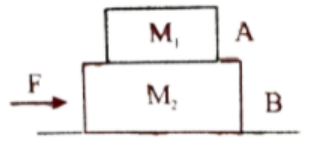
A block A of mass 4 kg is placed on another block B of mass 5 kg, and the block B rests on a smooth horizontal table. If the minimum force that can be applied on A so that both the blocks move together is 12 N, the maximum force that can be applied on B for the blocks to move together will be:
$$f = f_k = \mu_k R = \mu_k m_1\text{ }g$$
$$12 = f_k = \mu_k \times 4\text{ }g$$
$$\therefore \mu_k = \frac{12}{4\text{ }g} = \frac{3}{g}$$
As block $$B$$ is on smooth surface, therefore to move $$A$$ and $$B$$ together, maximum force $$F$$ required to be applied on $$B = $$ frictional force applied on A by B
$$F = \frac{3}{g}(4 + 5)\text{ }g = 27\text{ }N$$
Was this solution helpful?
Create a FREE account and get:
_1.webp)

Educational materials for JEE preparation

Ask our AI anything

AI can make mistakes. Please verify important information.
AI can make mistakes. Please verify important information.


