
Join Our JEE Preparation Group
Prep with like-minded aspirants; Get access to free daily tests and study material.
Sign in
Please select an account to continue using cracku.in
↓ →
Join Our JEE Preparation Group
Prep with like-minded aspirants; Get access to free daily tests and study material.
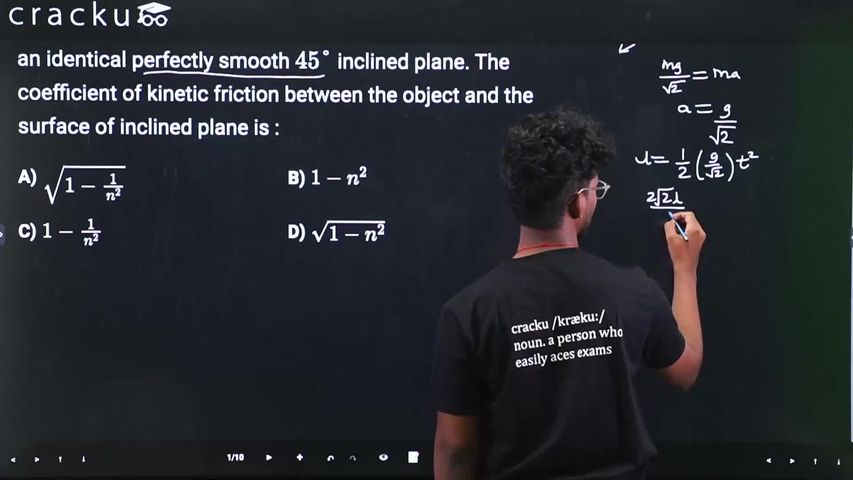
A given object takes n times the time to slide down $$45°$$ rough inclined plane as it takes the time to slide down an identical perfectly smooth $$45°$$ inclined plane. The coefficient of kinetic friction between the object and the surface of inclined plane is :
We compare the descent of an object along a smooth incline with that along a rough incline, both inclined at 45° and covering the same distance s. In the absence of friction, the component of gravitational acceleration along the plane is $$a_s = g\sin 45° = \frac{g}{\sqrt{2}}$$, so that from $$s = \tfrac{1}{2}a_s t_s^2$$ it follows that $$t_s = \sqrt{\frac{2s}{a_s}}\,. $$
When kinetic friction is present, the net acceleration down the plane becomes $$a_r = g\sin 45° - \mu_k g\cos 45° = \frac{g}{\sqrt{2}}\,(1 - \mu_k)\,, $$ and the time to travel the same distance s satisfies $$t_r = \sqrt{\frac{2s}{a_r}}\,. $$
Because the object takes n times as long on the rough incline, we have $$\frac{t_r}{t_s} = n\,. $$ Squaring both sides yields $$\frac{t_r^2}{t_s^2} = n^2\quad\Longrightarrow\quad \frac{a_s}{a_r} = n^2\,. $$ Substituting the expressions for $$a_s$$ and $$a_r$$ gives
$$\frac{g/\sqrt{2}}{(g/\sqrt{2})(1-\mu_k)} = \frac{1}{1-\mu_k} = n^2\,, $$
from which $$1 - \mu_k = \frac{1}{n^2}\quad\Longrightarrow\quad \mu_k = 1 - \frac{1}{n^2}\,. $$
Therefore, the coefficient of kinetic friction is $$\mu_k = 1 - \frac{1}{n^2}\,.$$
Was this solution helpful?
Click on the Email ☝️ to Watch the Video Solution
Create a FREE account and get:
_1.webp)

Educational materials for JEE preparation

Ask our AI anything

AI can make mistakes. Please verify important information.
AI can make mistakes. Please verify important information.
