
Join Our JEE Preparation Group
Prep with like-minded aspirants; Get access to free daily tests and study material.
Sign in
Please select an account to continue using cracku.in
↓ →
Join Our JEE Preparation Group
Prep with like-minded aspirants; Get access to free daily tests and study material.
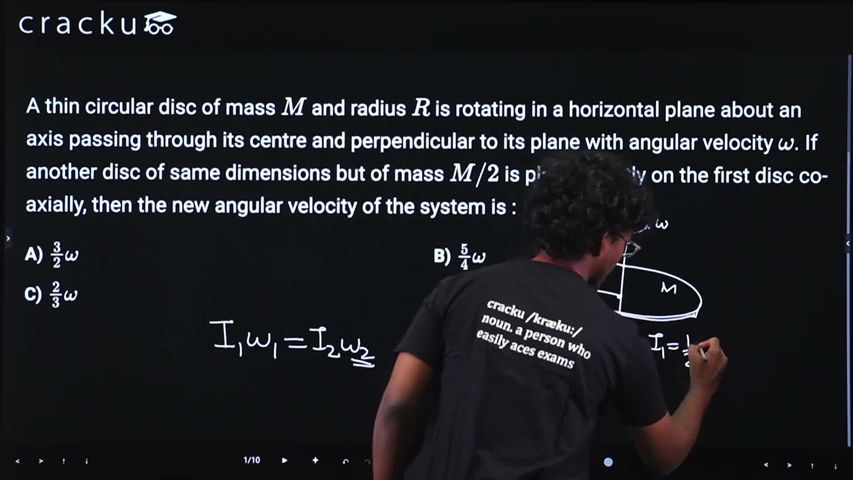
A thin circular disc of mass $$M$$ and radius $$R$$ is rotating in a horizontal plane about an axis passing through its centre and perpendicular to its plane with angular velocity $$\omega$$. If another disc of same dimensions but of mass $$M/2$$ is placed gently on the first disc co-axially, then the new angular velocity of the system is :
A disc of mass $$M$$ and radius $$R$$ rotates with angular velocity $$\omega$$. When another disc of mass $$M/2$$ and the same radius is placed gently on it coaxially, no external torque acts on the system and therefore angular momentum is conserved: $$L_{\text{before}} = L_{\text{after}}$$.
The moment of inertia of a disc about an axis through its centre perpendicular to its plane is given by $$I = \frac{1}{2}MR^2$$. Hence the initial moment of inertia is $$I_1 = \frac{1}{2}MR^2$$ while the moment of inertia of the second disc is $$I_2 = \frac{1}{2} \cdot \frac{M}{2} \cdot R^2 = \frac{MR^2}{4}$$. The combined moment of inertia therefore becomes $$I_1 + I_2 = \frac{MR^2}{2} + \frac{MR^2}{4} = \frac{3MR^2}{4}$$.
Since angular momentum is conserved, we have $$I_1 \omega = (I_1 + I_2)\omega'$$. Substituting the expressions for the moments of inertia gives $$\frac{MR^2}{2} \cdot \omega = \frac{3MR^2}{4} \cdot \omega'$$, which simplifies to $$\omega' = \frac{MR^2/2}{3MR^2/4} \cdot \omega = \frac{2}{3}\omega$$.
Therefore, the new angular velocity is $$\frac{2}{3}\omega$$.
Was this solution helpful?
Click on the Email ☝️ to Watch the Video Solution
Create a FREE account and get:
_1.webp)

Educational materials for JEE preparation

Ask our AI anything

AI can make mistakes. Please verify important information.
AI can make mistakes. Please verify important information.
