
Join Our JEE Preparation Group
Prep with like-minded aspirants; Get access to free daily tests and study material.
Sign in
Please select an account to continue using cracku.in
↓ →
Join Our JEE Preparation Group
Prep with like-minded aspirants; Get access to free daily tests and study material.
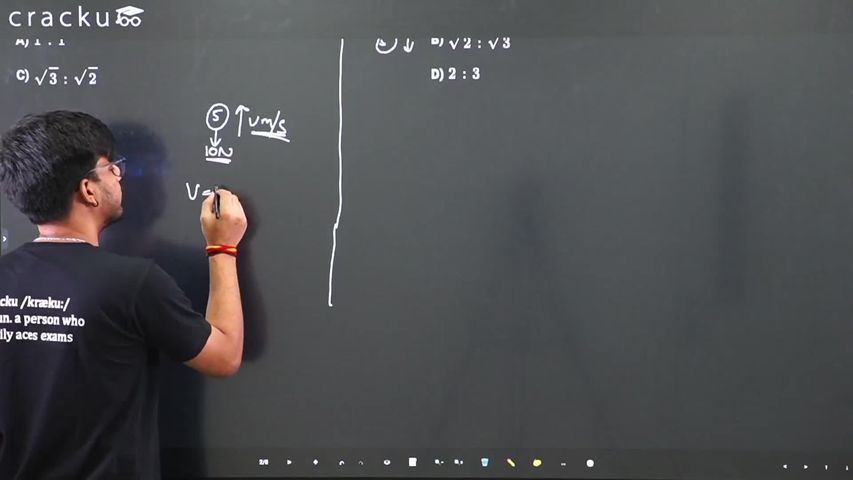
An object of mass $$5$$ kg is thrown vertically upwards from the ground. The air resistance produces a constant retarding force of $$10$$ N throughout the motion. The ratio of time of ascent to the time of descent will be equal to : [Use $$g = 10$$ m s$$^{-2}$$]
Given: mass $$m = 5$$ kg, air resistance force $$F = 10$$ N (constant, always opposing motion), $$g = 10$$ m/s$$^2$$.
Find the effective accelerations: During ascent (object moves upward):
Both gravity and air resistance act downward (opposing upward motion).
$$a_{\text{ascent}} = g + \frac{F}{m} = 10 + \frac{10}{5} = 10 + 2 = 12 \text{ m/s}^2 \text{ (retardation)}$$
During descent (object moves downward):
Gravity acts downward, air resistance acts upward (opposing downward motion).
$$a_{\text{descent}} = g - \frac{F}{m} = 10 - \frac{10}{5} = 10 - 2 = 8 \text{ m/s}^2 \text{ (acceleration)}$$
Find the time of ascent: Let the initial velocity be $$u$$. During ascent, the object decelerates from $$u$$ to $$0$$. Using $$v = u - a_{\text{ascent}} \cdot t_a$$:
$$0 = u - 12 \cdot t_a$$
$$t_a = \frac{u}{12}$$
Find the maximum height: Using $$v^2 = u^2 - 2a_{\text{ascent}} \cdot h$$:
$$0 = u^2 - 2(12)h$$
$$h = \frac{u^2}{24}$$
Find the time of descent: During descent, the object starts from rest at the top and falls through height $$h$$ with acceleration $$a_{\text{descent}} = 8$$ m/s$$^2$$. Using $$h = \frac{1}{2}a_{\text{descent}} \cdot t_d^2$$:
$$\frac{u^2}{24} = \frac{1}{2}(8) t_d^2 = 4t_d^2$$
$$t_d^2 = \frac{u^2}{96}$$
$$t_d = \frac{u}{\sqrt{96}} = \frac{u}{4\sqrt{6}}$$
Find the ratio: $$\frac{t_a}{t_d} = \frac{\frac{u}{12}}{\frac{u}{4\sqrt{6}}} = \frac{u}{12} \times \frac{4\sqrt{6}}{u} = \frac{4\sqrt{6}}{12} = \frac{\sqrt{6}}{3}$$
Simplify: $$\frac{\sqrt{6}}{3} = \frac{\sqrt{6}}{\sqrt{9}} = \sqrt{\frac{6}{9}} = \sqrt{\frac{2}{3}} = \frac{\sqrt{2}}{\sqrt{3}}$$
Therefore, the ratio of time of ascent to time of descent is $$\sqrt{2} : \sqrt{3}$$.
The correct answer is Option B.
Was this solution helpful?
Click on the Email ☝️ to Watch the Video Solution
Create a FREE account and get:
_1.webp)

Educational materials for JEE preparation

Ask our AI anything

AI can make mistakes. Please verify important information.
AI can make mistakes. Please verify important information.
