
Join Our JEE Preparation Group
Prep with like-minded aspirants; Get access to free daily tests and study material.
Sign in
Please select an account to continue using cracku.in
↓ →
Join Our JEE Preparation Group
Prep with like-minded aspirants; Get access to free daily tests and study material.
We need to identify which pair of physical quantities have the same dimensions.
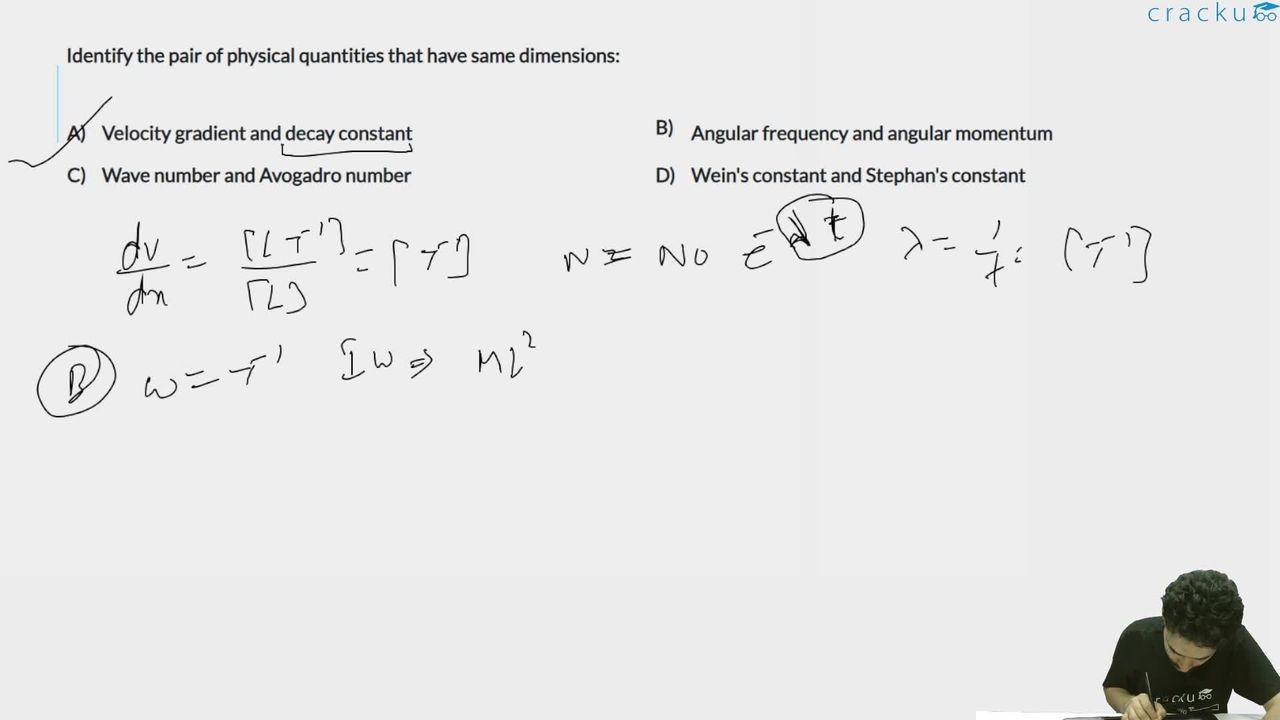
For option A, velocity gradient and decay constant are considered. Velocity gradient is defined as the rate of change of velocity with respect to distance: $$\text{Velocity gradient} = \frac{dv}{dx}$$ Its dimensions are: $$\frac{[LT^{-1}]}{[L]} = [T^{-1}]$$ Decay constant $$\lambda$$ appears in the radioactive decay law $$N = N_0 e^{-\lambda t}$$ and since $$\lambda t$$ must be dimensionless, $$[\lambda] = [T^{-1}]$$ Both have dimensions $$[T^{-1}]$$ and therefore match.
For option B, angular frequency $$\omega$$ has dimensions $$[T^{-1}]$$, while angular momentum $$L = I\omega$$ has dimensions $$[ML^2T^{-1}]$$. These are different.
For option C, wave number $$k = 1/\lambda$$ has dimensions $$[L^{-1}]$$, while Avogadro number $$N_A$$ has dimensions $$[\text{mol}^{-1}]$$. These are different.
For option D, Wien's displacement constant $$b$$ has dimensions $$[LK]$$ (from $$\lambda_{max} T = b$$), while Stefan's constant $$\sigma$$ has dimensions $$[MT^{-3}K^{-4}]$$ (from $$P = \sigma A T^4$$). These are different.
Therefore, the correct answer is Option A: Velocity gradient and decay constant both have dimensions $$[T^{-1}]$$.
Was this solution helpful?
Click on the Email ☝️ to Watch the Video Solution
Create a FREE account and get:
_1.webp)

Educational materials for JEE preparation

Ask our AI anything

AI can make mistakes. Please verify important information.
AI can make mistakes. Please verify important information.
