
Join Our JEE Preparation Group
Prep with like-minded aspirants; Get access to free daily tests and study material.
Sign in
Please select an account to continue using cracku.in
↓ →
Join Our JEE Preparation Group
Prep with like-minded aspirants; Get access to free daily tests and study material.
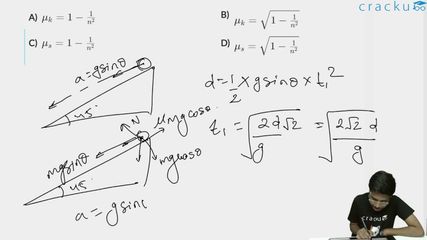
A smooth block is released at rest on a $$45^\circ$$ incline and then slides a distance $$d$$. The time taken to slide is $$n$$ times as much to slide on rough incline than on a smooth incline. The coefficient of friction is
A block of mass $$m$$ is allowed to slide a distance $$d$$ down an incline making an angle $$\theta = 45^{\circ}$$ with the horizontal.
Case 1: Smooth incline (no friction).
The only component of gravity along the plane is $$mg\sin\theta$$, so the acceleration is
$$a_1 = g\sin\theta = g\frac{1}{\sqrt{2}}$$ because $$\sin 45^{\circ} = \frac{1}{\sqrt{2}}$$.
Starting from rest, the time to cover distance $$d$$ is obtained from $$d = \tfrac12 a_1 t_1^{2}$$, giving
$$t_1 = \sqrt{\frac{2d}{a_1}}$$ $$= \sqrt{\frac{2d}{g/\sqrt{2}}}$$ $$= \sqrt{\frac{2\sqrt{2}d}{g}}$$.
Case 2: Rough incline (kinetic friction present).
Along the plane the net force is
$$mg\sin\theta - \mu_k mg\cos\theta,$$
so the acceleration is
$$a_2 = g\sin\theta - \mu_k g\cos\theta.$$
For $$\theta = 45^{\circ}$$ we have $$\sin\theta = \cos\theta = \tfrac1{\sqrt2}$$, hence
$$a_2 = g\frac{1}{\sqrt{2}}\bigl(1 - \mu_k\bigr)\;.$$
The time to slide the same distance $$d$$ now satisfies $$d = \tfrac12 a_2 t_2^{2}$$, so
$$t_2 = \sqrt{\frac{2d}{a_2}}$$ $$= \sqrt{\frac{2d}{g(1/\sqrt{2})(1-\mu_k)}}$$ $$= \sqrt{\frac{2\sqrt{2}d}{g}}\;\frac{1}{\sqrt{1-\mu_k}}.$$
Notice that $$\sqrt{\frac{2\sqrt{2}d}{g}}$$ is exactly $$t_1$$, hence
$$\frac{t_2}{t_1} = \frac{1}{\sqrt{1-\mu_k}}.$$
The problem states that the rough-incline time is $$n$$ times the smooth-incline time, i.e. $$t_2 = n\,t_1$$. Therefore
$$n = \frac{1}{\sqrt{1-\mu_k}}\; \Longrightarrow\; n^{2} = \frac{1}{1-\mu_k}\; \Longrightarrow\; 1-\mu_k = \frac{1}{n^{2}}.$$
Solving for $$\mu_k$$ gives
$$\mu_k = 1 - \frac{1}{n^{2}}.$$
Thus the coefficient of kinetic friction is $$\mu_k = 1 - \dfrac{1}{n^2}$$.
Option A which is: $$\mu_k = 1 - \frac{1}{n^2}$$
Was this solution helpful?
Click on the Email ☝️ to Watch the Video Solution
Create a FREE account and get:
_1.webp)

Educational materials for JEE preparation

Ask our AI anything

AI can make mistakes. Please verify important information.
AI can make mistakes. Please verify important information.
