
Join Our JEE Preparation Group
Prep with like-minded aspirants; Get access to free daily tests and study material.
Sign in
Please select an account to continue using cracku.in
↓ →
Join Our JEE Preparation Group
Prep with like-minded aspirants; Get access to free daily tests and study material.
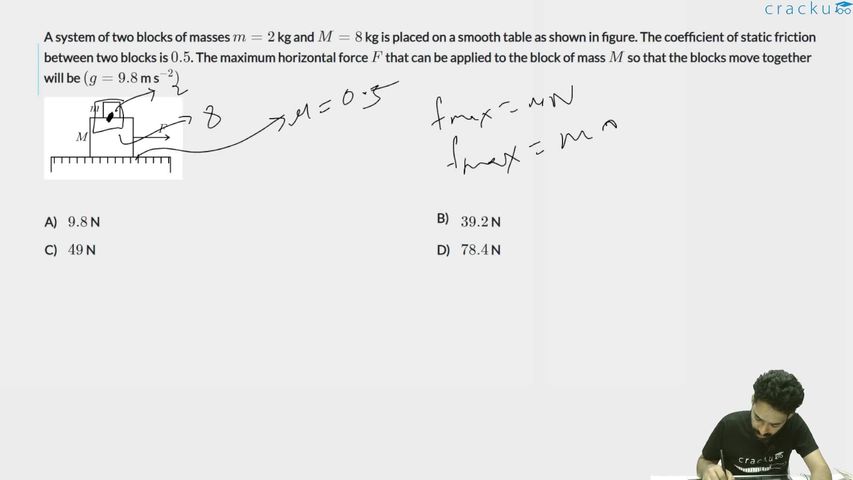
A system of two blocks of masses $$m = 2$$ kg and $$M = 8$$ kg is placed on a smooth table as shown in figure. The coefficient of static friction between two blocks is $$0.5$$. The maximum horizontal force $$F$$ that can be applied to the block of mass $$M$$ so that the blocks move together will be $$(g = 9.8$$ m s$$^{-2})$$
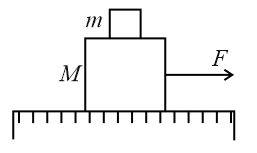
Given:$$m=2kg,\ M=8kg,\ μ=0.5,\ g=9.8m/s^2$$
Step 1: Maximum acceleration (no slipping)
Maximum acceleration comes from maximum static friction acting on the top block:
$$f_{\max}=\mu N=\mu mg\ $$
This friction is the only horizontal force accelerating the top block:
$$f_{\max}=ma_{\max}$$
$$μmg=ma_{\max}\ ⇒\ a_{\max}=μg=0.5\times9.8=4.9m/s^2$$
This ensures the top block does not slip over the bottom block.
Friction provides acceleration to top block:
$$a_{\max}=μg=0.5\times9.8=4.9m/s^2$$
Step 2: Treat system as one body
Total mass:
m+M=2+8=10 kg
Step 3: Maximum force
$$F_{\max}=(m+M)a_{\max}=10\times4.9=49N$$
Final Answer:
49 N
Was this solution helpful?
Click on the Email ☝️ to Watch the Video Solution
Create a FREE account and get:
_1.webp)

Educational materials for JEE preparation

Ask our AI anything

AI can make mistakes. Please verify important information.
AI can make mistakes. Please verify important information.
