
Join Our JEE Preparation Group
Prep with like-minded aspirants; Get access to free daily tests and study material.
Sign in
Please select an account to continue using cracku.in
↓ →
Join Our JEE Preparation Group
Prep with like-minded aspirants; Get access to free daily tests and study material.
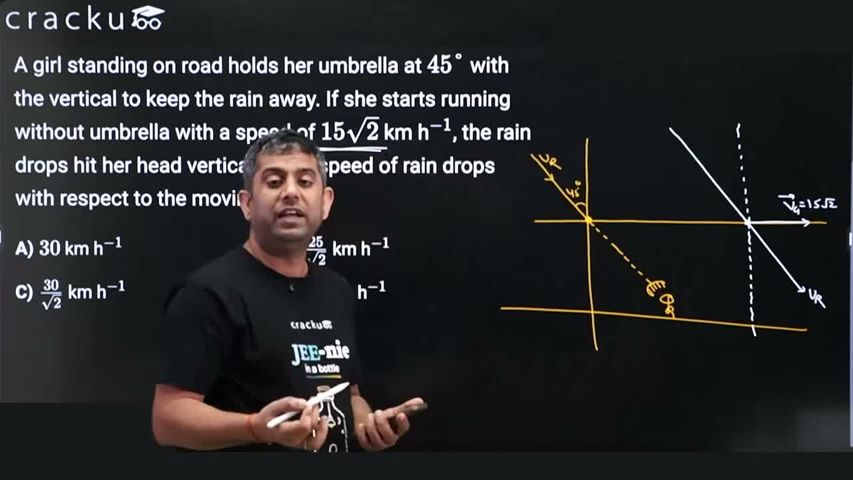
A girl standing on road holds her umbrella at $$45°$$ with the vertical to keep the rain away. If she starts running without umbrella with a speed of $$15\sqrt{2}$$ km h$$^{-1}$$, the rain drops hit her head vertically. The speed of rain drops with respect to the moving girl is
When the girl is standing still, she holds the umbrella at $$45°$$ with the vertical. This means the rain has equal horizontal and vertical velocity components.
Let the velocity of rain be $$\vec{v_r}$$ with horizontal component $$v_h$$ and vertical component $$v_v$$.
Since the umbrella is at $$45°$$ with vertical:
$$\tan 45° = \frac{v_h}{v_v} = 1$$
$$\therefore v_h = v_v$$
When the girl runs with speed $$15\sqrt{2}$$ km/h in the horizontal direction, the rain appears to fall vertically on her head. This means the horizontal component of rain velocity relative to the girl is zero.
$$v_h = 15\sqrt{2} \text{ km/h}$$
$$v_v = v_h = 15\sqrt{2} \text{ km/h}$$
The velocity of rain with respect to the moving girl has only a vertical component (since horizontal component cancels out):
$$v_{rain, girl} = v_v = 15\sqrt{2} \text{ km/h}$$
We can also write this as:
$$v_{rain, girl} = 15\sqrt{2} = \frac{30}{\sqrt{2}} \text{ km/h}$$
The correct answer is Option C.
Was this solution helpful?
Click on the Email ☝️ to Watch the Video Solution
Create a FREE account and get:
_1.webp)

Educational materials for JEE preparation

Ask our AI anything

AI can make mistakes. Please verify important information.
AI can make mistakes. Please verify important information.
