
Join Our JEE Preparation Group
Prep with like-minded aspirants; Get access to free daily tests and study material.
Sign in
Please select an account to continue using cracku.in
↓ →
Join Our JEE Preparation Group
Prep with like-minded aspirants; Get access to free daily tests and study material.
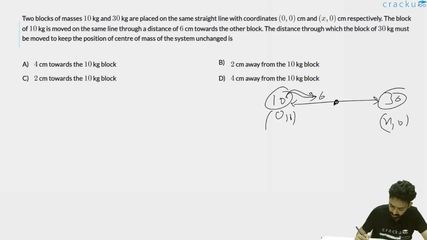
Two blocks of masses $$10$$ kg and $$30$$ kg are placed on the same straight line with coordinates $$(0, 0)$$ cm and $$(x, 0)$$ cm respectively. The block of $$10$$ kg is moved on the same line through a distance of $$6$$ cm towards the other block. The distance through which the block of $$30$$ kg must be moved to keep the position of centre of mass of the system unchanged is
For the centre of mass to remain unchanged, the total displacement weighted by mass must be zero.
Let the 10 kg block move a distance of 6 cm towards the 30 kg block (i.e., in the positive x-direction), and let the 30 kg block move a distance $$d$$ in some direction.
For the centre of mass position to remain unchanged:
$$m_1 \Delta x_1 + m_2 \Delta x_2 = 0$$
$$10 \times 6 + 30 \times \Delta x_2 = 0$$
$$60 + 30 \Delta x_2 = 0$$
$$\Delta x_2 = -2 \text{ cm}$$
The negative sign indicates that the 30 kg block must move in the opposite direction to the 10 kg block's movement. Since the 10 kg block moved towards the 30 kg block, the 30 kg block must move towards the 10 kg block.
Therefore, the 30 kg block must be moved 2 cm towards the 10 kg block.
The correct answer is Option C.
Was this solution helpful?
Click on the Email ☝️ to Watch the Video Solution
Create a FREE account and get:
_1.webp)

Educational materials for JEE preparation

Ask our AI anything

AI can make mistakes. Please verify important information.
AI can make mistakes. Please verify important information.
