91- 6303239042


 Group
Group


 Preferred Source

 Google Discover

Top 100 XAT 2026 VALR Questions PDF
Our Top 100 XAT 2026 VALR Questions PDF is an easy and helpful resource made to improve your reading, reasoning, and language skills for the XAT exam. The VALR section tests your comprehension, vocabulary, critical thinking, and ability to understand complex passages. This PDF covers all major VALR question types—Reading Comprehension, Critical Reasoning, Para Completion, Para Summary, Grammar, and Logical Reasoning sets—so you get complete and well-rounded practice.
Each question is created at the actual XAT difficulty level and comes with clear, step-by-step explanations. Whether you are building your basics or aiming for a 99+ percentile, these 100 selected questions will help you improve accuracy, understanding, and overall performance in the VALR section.
Why Practice with Our Top 100 VALR Questions for XAT 2026?
The VALR section of XAT checks your reading ability, interpretation skills, and logical reasoning. Practicing high-quality questions with proper explanations helps you:
-
Improve reading speed and comprehension
-
Understand different types of XAT RC passages
-
Learn the correct approach to Critical Reasoning questions
-
Strengthen grammar and verbal logic concepts
-
Handle tricky and lengthy questions more effectively
-
Build confidence to tackle higher-level VALR questions in the exam
With the XAT 2026 VALR Questions PDF, you can revise better, avoid common mistakes, and steadily improve your accuracy—helping you score well in one of the most important sections of the exam.
Question 1
Read the poem carefully, and answer the following question.
I smiled at you because I thought that you
Were someone else; you smiled back; and there
grew
Between two strangers in a library
Something that seems like love; but you loved
me
(If that’s the word) because you thought that I
Was other than I was. And by and by
We found we’d been mistaken all the while
From that first glance, that first mistaken smile
Which of the following CANNOT be inferred from the poem?
correct answer:- 4
Read the passage carefully and answer the THREE questions that follow.
Comprehension:
Stupidity is a very specific cognitive failing. Crudely put, it occurs when you don’t have the right conceptual tools for the job. The result is an inability to make sense of what is happening and a resulting tendency to force phenomena into crude, distorting pigeonholes.
This is easiest to introduce with a tragic case. British high command during the First World War frequently understood trench warfare using concepts and strategies from the cavalry battles of their youth. As one of Field Marshal Douglas Haig’s subordinates later remarked, they thought of the trenches as ‘mobile operations at the halt’: i.e., as fluid battle lines with the simple caveat that nothing in fact budged for years. Unsurprisingly, this did not serve them well in formulating a strategy: they were hampered, beyond the shortage of material resources, by a kind of ‘conceptual obsolescence’, a failure to update their cognitive tools to fit the task in hand. In at least some cases, intelligence actively abets stupidity by allowing pernicious rationalisation.
Stupidity will often arise in cases like this, when an outdated conceptual framework is forced into service, mangling the user’s grip on some new phenomenon. It is important to distinguish this from mere error. We make mistakes for all kinds of reasons. Stupidity is rather one specific and stubborn cause of error. Historically, philosophers have worried a great deal about the irrationality of not taking the available means to achieve goals: Tom wants to get fit, yet his running shoes are quietly gathering dust. The stock solution to Tom’s quandary is simple willpower. Stupidity is very different from this. It is rather a lack of the necessary means, a lack of the necessary intellectual equipment. Combatting it will typically require not brute willpower but the construction of a new way of seeing our self and our world. Such stupidity is perfectly compatible with intelligence: Haig was by any standard a smart man.
Question 2
Which of the following statements BEST summarizes the author's view on stupidity?
correct answer:- 3
Read the passage carefully and answer the THREE questions that follow.
Comprehension:
Stupidity is a very specific cognitive failing. Crudely put, it occurs when you don’t have the right conceptual tools for the job. The result is an inability to make sense of what is happening and a resulting tendency to force phenomena into crude, distorting pigeonholes.
This is easiest to introduce with a tragic case. British high command during the First World War frequently understood trench warfare using concepts and strategies from the cavalry battles of their youth. As one of Field Marshal Douglas Haig’s subordinates later remarked, they thought of the trenches as ‘mobile operations at the halt’: i.e., as fluid battle lines with the simple caveat that nothing in fact budged for years. Unsurprisingly, this did not serve them well in formulating a strategy: they were hampered, beyond the shortage of material resources, by a kind of ‘conceptual obsolescence’, a failure to update their cognitive tools to fit the task in hand. In at least some cases, intelligence actively abets stupidity by allowing pernicious rationalisation.
Stupidity will often arise in cases like this, when an outdated conceptual framework is forced into service, mangling the user’s grip on some new phenomenon. It is important to distinguish this from mere error. We make mistakes for all kinds of reasons. Stupidity is rather one specific and stubborn cause of error. Historically, philosophers have worried a great deal about the irrationality of not taking the available means to achieve goals: Tom wants to get fit, yet his running shoes are quietly gathering dust. The stock solution to Tom’s quandary is simple willpower. Stupidity is very different from this. It is rather a lack of the necessary means, a lack of the necessary intellectual equipment. Combatting it will typically require not brute willpower but the construction of a new way of seeing our self and our world. Such stupidity is perfectly compatible with intelligence: Haig was by any standard a smart man.
Question 3
Which of the following statements BEST explains why stupidity for a smart person is“perfectly compatible with intelligence”?
correct answer:- 3
Read the passage carefully and answer the THREE questions that follow.
Comprehension:
Stupidity is a very specific cognitive failing. Crudely put, it occurs when you don’t have the right conceptual tools for the job. The result is an inability to make sense of what is happening and a resulting tendency to force phenomena into crude, distorting pigeonholes.
This is easiest to introduce with a tragic case. British high command during the First World War frequently understood trench warfare using concepts and strategies from the cavalry battles of their youth. As one of Field Marshal Douglas Haig’s subordinates later remarked, they thought of the trenches as ‘mobile operations at the halt’: i.e., as fluid battle lines with the simple caveat that nothing in fact budged for years. Unsurprisingly, this did not serve them well in formulating a strategy: they were hampered, beyond the shortage of material resources, by a kind of ‘conceptual obsolescence’, a failure to update their cognitive tools to fit the task in hand. In at least some cases, intelligence actively abets stupidity by allowing pernicious rationalisation.
Stupidity will often arise in cases like this, when an outdated conceptual framework is forced into service, mangling the user’s grip on some new phenomenon. It is important to distinguish this from mere error. We make mistakes for all kinds of reasons. Stupidity is rather one specific and stubborn cause of error. Historically, philosophers have worried a great deal about the irrationality of not taking the available means to achieve goals: Tom wants to get fit, yet his running shoes are quietly gathering dust. The stock solution to Tom’s quandary is simple willpower. Stupidity is very different from this. It is rather a lack of the necessary means, a lack of the necessary intellectual equipment. Combatting it will typically require not brute willpower but the construction of a new way of seeing our self and our world. Such stupidity is perfectly compatible with intelligence: Haig was by any standard a smart man.
Question 4
Based on the passage, which of the following can BEST help a leader avoidstupidity?
correct answer:- 2
Read the passage carefully and answer the THREE questions that follow.
Comprehension:
What bullshit essentially misrepresents is neither the state of affairs to which it refers nor the beliefs of the speaker concerning that state of affairs. Those are what lies misrepresent, by virtue of being false. Since bullshit need not be false, it differs from lies in its misrepresentational intent. The bullshitter may not deceive us, or even intend to do so, either about the facts or about what he takes the facts to be. What he does necessarily attempt to deceive us about is his enterprise. His only indispensably distinctive characteristic is that in a certain way he misrepresents what he is up to. This is the crux of the distinction between him and the liar. Both he and the liar represent themselves falsely as endeavoring to communicate the truth. The success of each depends upon deceiving us about that. But the fact about himself that the liar hides is that he is attempting to lead us away from a correct apprehension of reality; we are not to know that he wants us to believe something he supposes to be false. The fact about himself that the bullshitter hides, on the other hand, is that the truth-values of his statements are of no central interest to him; what we are not to understand is that his intention is neither to report the truth nor to conceal it. This does not mean that his speech is anarchically impulsive, but that the motive guiding and controlling it is unconcerned with how the things about which he speaks truly are. It is impossible for someone to lie unless he thinks he knows the truth. Producing bullshit requires no such conviction. A person who lies is thereby responding to the truth, and he is to that extent respectful of it. When an honest man speaks, he says only what he believes to be true; and for the liar, it is correspondingly indispensable that he considers his statements to be false.
Question 5
Which of the following statements can be BEST inferred from the passage?
correct answer:- 2

Read the passage carefully and answer the THREE questions that follow.
Comprehension:
What bullshit essentially misrepresents is neither the state of affairs to which it refers nor the beliefs of the speaker concerning that state of affairs. Those are what lies misrepresent, by virtue of being false. Since bullshit need not be false, it differs from lies in its misrepresentational intent. The bullshitter may not deceive us, or even intend to do so, either about the facts or about what he takes the facts to be. What he does necessarily attempt to deceive us about is his enterprise. His only indispensably distinctive characteristic is that in a certain way he misrepresents what he is up to. This is the crux of the distinction between him and the liar. Both he and the liar represent themselves falsely as endeavoring to communicate the truth. The success of each depends upon deceiving us about that. But the fact about himself that the liar hides is that he is attempting to lead us away from a correct apprehension of reality; we are not to know that he wants us to believe something he supposes to be false. The fact about himself that the bullshitter hides, on the other hand, is that the truth-values of his statements are of no central interest to him; what we are not to understand is that his intention is neither to report the truth nor to conceal it. This does not mean that his speech is anarchically impulsive, but that the motive guiding and controlling it is unconcerned with how the things about which he speaks truly are. It is impossible for someone to lie unless he thinks he knows the truth. Producing bullshit requires no such conviction. A person who lies is thereby responding to the truth, and he is to that extent respectful of it. When an honest man speaks, he says only what he believes to be true; and for the liar, it is correspondingly indispensable that he considers his statements to be false.
Question 6
Why does the author say that the bullshitter’s intention “is neither to report the truth nor to conceal it?”
correct answer:- 4
Read the passage carefully and answer the THREE questions that follow.
Comprehension:
What bullshit essentially misrepresents is neither the state of affairs to which it refers nor the beliefs of the speaker concerning that state of affairs. Those are what lies misrepresent, by virtue of being false. Since bullshit need not be false, it differs from lies in its misrepresentational intent. The bullshitter may not deceive us, or even intend to do so, either about the facts or about what he takes the facts to be. What he does necessarily attempt to deceive us about is his enterprise. His only indispensably distinctive characteristic is that in a certain way he misrepresents what he is up to. This is the crux of the distinction between him and the liar. Both he and the liar represent themselves falsely as endeavoring to communicate the truth. The success of each depends upon deceiving us about that. But the fact about himself that the liar hides is that he is attempting to lead us away from a correct apprehension of reality; we are not to know that he wants us to believe something he supposes to be false. The fact about himself that the bullshitter hides, on the other hand, is that the truth-values of his statements are of no central interest to him; what we are not to understand is that his intention is neither to report the truth nor to conceal it. This does not mean that his speech is anarchically impulsive, but that the motive guiding and controlling it is unconcerned with how the things about which he speaks truly are. It is impossible for someone to lie unless he thinks he knows the truth. Producing bullshit requires no such conviction. A person who lies is thereby responding to the truth, and he is to that extent respectful of it. When an honest man speaks, he says only what he believes to be true; and for the liar, it is correspondingly indispensable that he considers his statements to be false.
Question 7
When will a liar BEST turn into a bullshitter?
correct answer:- 3
Read the passage carefully and answer the THREE questions that follow.
Comprehension:
What does a good life look like to you? For some, the phrase may conjure up images of a close-knit family, a steady job, and a Victorian house at the end of a street arched with oak trees. Others may focus on the goal of making a difference in the world, whether by working as a nurse or teacher, volunteering, or pouring their energy into environmental activism. According to Aristotlean theory, the first kind of life would be classified as “hedonic”—one based on pleasure, comfort, stability, and strong social relationships. The second is“eudaimonic,” primarily concerned with the sense of purpose and fulfilment one gets by contributing to the greater good. The ancient Greek philosopher outlined these ideas in his treatise Nicomachean Ethics, and the psychological sciences have pretty much stuck with them ever since when discussing the possibilities of what people might want out of their time on Earth. But a new paper, published in the American Psychological Association’s Psychological Review, suggests there’s another way to live a good life. It isn’t focused on happiness or purpose, but rather it’s a life that’s “psychologically rich.”
What is a psychologically rich life? According to authors Shige Oishi, a professor of psychology at the University of Virginia, and Erin Westgate, an assistant professor of psychology at the University of Florida, it’s one characterized by “interesting experiences in which novelty and/or complexity are accompanied by profound changes in perspective.” Studying abroad, for example, is one way that college students often introduce psychological richness into their lives. As they learn more about a new country’s customs and history, they’re often prompted to reconsider the social mores of their own cultures. Deciding to embark on a difficult new career path or immersing one’s self in avant-garde art(the paper gives a specific shout-out to James Joyce’s Ulysses) also could make a person feel as if their life is more psychologically rich.
Crucially, an experience doesn’t have to be fun in order to qualify as psychologically enriching. It might even be a hardship. Living through war or a natural disaster might make it hard to feel as though you’re living a particularly happy or purposeful life, but you can still come out of the experience with psychological richness. Or you might encounter less dramatic but nonetheless painful events: infertility, chronic illness, unemployment. Regardless of the specifics, you may experience suffering but still find value in how your experience shapes your understanding of yourself and the world around you.
Question 8
Which of the following statements BEST contrasts Hedonic from Eudaimonic?
correct answer:- 2
Read the passage carefully and answer the THREE questions that follow.
Comprehension:
What does a good life look like to you? For some, the phrase may conjure up images of a close-knit family, a steady job, and a Victorian house at the end of a street arched with oak trees. Others may focus on the goal of making a difference in the world, whether by working as a nurse or teacher, volunteering, or pouring their energy into environmental activism. According to Aristotlean theory, the first kind of life would be classified as “hedonic”—one based on pleasure, comfort, stability, and strong social relationships. The second is“eudaimonic,” primarily concerned with the sense of purpose and fulfilment one gets by contributing to the greater good. The ancient Greek philosopher outlined these ideas in his treatise Nicomachean Ethics, and the psychological sciences have pretty much stuck with them ever since when discussing the possibilities of what people might want out of their time on Earth. But a new paper, published in the American Psychological Association’s Psychological Review, suggests there’s another way to live a good life. It isn’t focused on happiness or purpose, but rather it’s a life that’s “psychologically rich.”
What is a psychologically rich life? According to authors Shige Oishi, a professor of psychology at the University of Virginia, and Erin Westgate, an assistant professor of psychology at the University of Florida, it’s one characterized by “interesting experiences in which novelty and/or complexity are accompanied by profound changes in perspective.” Studying abroad, for example, is one way that college students often introduce psychological richness into their lives. As they learn more about a new country’s customs and history, they’re often prompted to reconsider the social mores of their own cultures. Deciding to embark on a difficult new career path or immersing one’s self in avant-garde art(the paper gives a specific shout-out to James Joyce’s Ulysses) also could make a person feel as if their life is more psychologically rich.
Crucially, an experience doesn’t have to be fun in order to qualify as psychologically enriching. It might even be a hardship. Living through war or a natural disaster might make it hard to feel as though you’re living a particularly happy or purposeful life, but you can still come out of the experience with psychological richness. Or you might encounter less dramatic but nonetheless painful events: infertility, chronic illness, unemployment. Regardless of the specifics, you may experience suffering but still find value in how your experience shapes your understanding of yourself and the world around you.
Question 9
Which of the following statements BEST defines a “psychologically rich life”?
correct answer:- 5
Read the passage carefully and answer the THREE questions that follow.
Comprehension:
What does a good life look like to you? For some, the phrase may conjure up images of a close-knit family, a steady job, and a Victorian house at the end of a street arched with oak trees. Others may focus on the goal of making a difference in the world, whether by working as a nurse or teacher, volunteering, or pouring their energy into environmental activism. According to Aristotlean theory, the first kind of life would be classified as “hedonic”—one based on pleasure, comfort, stability, and strong social relationships. The second is“eudaimonic,” primarily concerned with the sense of purpose and fulfilment one gets by contributing to the greater good. The ancient Greek philosopher outlined these ideas in his treatise Nicomachean Ethics, and the psychological sciences have pretty much stuck with them ever since when discussing the possibilities of what people might want out of their time on Earth. But a new paper, published in the American Psychological Association’s Psychological Review, suggests there’s another way to live a good life. It isn’t focused on happiness or purpose, but rather it’s a life that’s “psychologically rich.”
What is a psychologically rich life? According to authors Shige Oishi, a professor of psychology at the University of Virginia, and Erin Westgate, an assistant professor of psychology at the University of Florida, it’s one characterized by “interesting experiences in which novelty and/or complexity are accompanied by profound changes in perspective.” Studying abroad, for example, is one way that college students often introduce psychological richness into their lives. As they learn more about a new country’s customs and history, they’re often prompted to reconsider the social mores of their own cultures. Deciding to embark on a difficult new career path or immersing one’s self in avant-garde art(the paper gives a specific shout-out to James Joyce’s Ulysses) also could make a person feel as if their life is more psychologically rich.
Crucially, an experience doesn’t have to be fun in order to qualify as psychologically enriching. It might even be a hardship. Living through war or a natural disaster might make it hard to feel as though you’re living a particularly happy or purposeful life, but you can still come out of the experience with psychological richness. Or you might encounter less dramatic but nonetheless painful events: infertility, chronic illness, unemployment. Regardless of the specifics, you may experience suffering but still find value in how your experience shapes your understanding of yourself and the world around you.
Question 10
Which of the following statements can be BEST concluded from the passage?
correct answer:- 3

Read the passage carefully and answer the THREE questions that follow.
Comprehension:
What Arendt does for us is to remind us that our “publicness” is as important to our flourishing as our sociability and our privacy. She draws a distinction between what it means to act “socially” and what is means to act “politically.” The social realm for Arendt is both the context where all our basic survival needs “are permitted to appear in public” and also the realm of “behaviour.” One of the things she fears about modern societies is that society - focused on how we behave and what we will permit for ourselves and others -becomes the realm of conformism. This is worrying not just because we don’t really get vibrant societies out of conformism and sameness, but also, Arendt says because there is a risk that we think this is all there is to our living together. We lose ourselves in the tasks of managing behaviour and forget that our true public task is to act, and to distinguish ourselves in doing so. The risk, says Arendt, is therefore that we confuse behaviour with action , that in modern liberal societies “behaviour replaces action as the foremost mode of human relationship.” This confusion can happen in any area of our modern lives and institutions, secular or faith-based. None is immune.
Arendt wants to drive home the point that the healthy public life requires that we do not just see ourselves as social actors but also as fully public persons, committed to judging and acting as members of a common world we want to inhabit and pass on. Arendt tells us that public action is action in which we stand out, are individuated, become in some way excellent in a manner that is of service to others and a greater good. This is the space where we take risks, subject our common life to scrutiny, seek justice (that sometimes requires us to transgress what seem like accepted laws) in order to be increasingly open to the claims and needs of other humans - ones who are not our household and our kin.
Question 11
According to the passage, who can be BEST categorised as a “public person”?
correct answer:- 2
Read the passage carefully and answer the THREE questions that follow.
Comprehension:
What Arendt does for us is to remind us that our “publicness” is as important to our flourishing as our sociability and our privacy. She draws a distinction between what it means to act “socially” and what is means to act “politically.” The social realm for Arendt is both the context where all our basic survival needs “are permitted to appear in public” and also the realm of “behaviour.” One of the things she fears about modern societies is that society - focused on how we behave and what we will permit for ourselves and others -becomes the realm of conformism. This is worrying not just because we don’t really get vibrant societies out of conformism and sameness, but also, Arendt says because there is a risk that we think this is all there is to our living together. We lose ourselves in the tasks of managing behaviour and forget that our true public task is to act, and to distinguish ourselves in doing so. The risk, says Arendt, is therefore that we confuse behaviour with action , that in modern liberal societies “behaviour replaces action as the foremost mode of human relationship.” This confusion can happen in any area of our modern lives and institutions, secular or faith-based. None is immune.
Arendt wants to drive home the point that the healthy public life requires that we do not just see ourselves as social actors but also as fully public persons, committed to judging and acting as members of a common world we want to inhabit and pass on. Arendt tells us that public action is action in which we stand out, are individuated, become in some way excellent in a manner that is of service to others and a greater good. This is the space where we take risks, subject our common life to scrutiny, seek justice (that sometimes requires us to transgress what seem like accepted laws) in order to be increasingly open to the claims and needs of other humans - ones who are not our household and our kin.
Question 12
Based on the passage, which of the following options BEST describes “public action”?
correct answer:- 2
Read the passage carefully and answer the THREE questions that follow.
Comprehension:
What Arendt does for us is to remind us that our “publicness” is as important to our flourishing as our sociability and our privacy. She draws a distinction between what it means to act “socially” and what is means to act “politically.” The social realm for Arendt is both the context where all our basic survival needs “are permitted to appear in public” and also the realm of “behaviour.” One of the things she fears about modern societies is that society - focused on how we behave and what we will permit for ourselves and others -becomes the realm of conformism. This is worrying not just because we don’t really get vibrant societies out of conformism and sameness, but also, Arendt says because there is a risk that we think this is all there is to our living together. We lose ourselves in the tasks of managing behaviour and forget that our true public task is to act, and to distinguish ourselves in doing so. The risk, says Arendt, is therefore that we confuse behaviour with action , that in modern liberal societies “behaviour replaces action as the foremost mode of human relationship.” This confusion can happen in any area of our modern lives and institutions, secular or faith-based. None is immune.
Arendt wants to drive home the point that the healthy public life requires that we do not just see ourselves as social actors but also as fully public persons, committed to judging and acting as members of a common world we want to inhabit and pass on. Arendt tells us that public action is action in which we stand out, are individuated, become in some way excellent in a manner that is of service to others and a greater good. This is the space where we take risks, subject our common life to scrutiny, seek justice (that sometimes requires us to transgress what seem like accepted laws) in order to be increasingly open to the claims and needs of other humans - ones who are not our household and our kin.
Question 13
Which of the following is the BEST reason for focusing on behaviour instead of acting in public?
correct answer:- 1
Read the poem carefully, and answer the TWO questions that follow.
Comprehension:
It hurts to walk on new legs:
The curse of consonants. The wobble of vowels.
And you for whom I gave up a kingdom
Can never love that thing I was.
When you look into my past
You see
Only weeds and scales.
Once I had a voice.
Now I have legs.
Sometimes I wonder
Was it a fair trade?
Question 14
Which of the following statements BEST reflects the theme of the poem?
correct answer:- 2
Read the poem carefully, and answer the TWO questions that follow.
Comprehension:
It hurts to walk on new legs:
The curse of consonants. The wobble of vowels.
And you for whom I gave up a kingdom
Can never love that thing I was.
When you look into my past
You see
Only weeds and scales.
Once I had a voice.
Now I have legs.
Sometimes I wonder
Was it a fair trade?
Question 15
What does the author BEST mean by “Once I had a voice. /Now I have legs?”
correct answer:- 1

Question 16
Read the following statements.
The leave policy is bound to be unpopular either with the management or among workers. If the leave policy is unpopular with the management, it should be modified.
We should adopt a new policy if it is unpopular with workers.
If the above statements are true, which one of the following MUST also be true?
correct answer:- 3
Question 17
Read the following passage and answer the question that follows.
More people signed up for Harvard’s online courses in a year, for example, than have attended the university in its 377 years of existence. In the same spirit, there are more unique visits each month to the WebMD network, a collection of health websites, than to all the doctors working in the United States. In the legal world, three times as many disagreements each year amongst eBay traders are resolved using ‘online dispute resolution’ than there are lawsuits filed in the entire US court system. On its sixth birthday, the Huffington Post had more unique monthly visitors than the website of the New York Times, which is almost 164 years of age. The British tax authorities use a fraud-detection system that holds more data than the British Library (which has copies of every book ever published in the UK). In 2014, the US tax authorities received electronic tax returns from almost 48 million people who had used online tax preparation software rather than a tax professional to help them. The architectural firm Gramazio & Kohler used a group of autonomous flying robots to assemble a structure out of 1500 bricks. The consulting firm Accenture has 750 hospital nurses on its staff, while Deloitte, founded as an audit practice 170 years ago, now has over 200,000 professionals and its own full-scale corporate university set in a 700,000-square-foot campus in Texas.
The author of the above paragraph is trying to conclude something by citing different pieces of evidence. What could the author be trying to prove?
correct answer:- 1
Question 18
Read the following paragraph and answer the question that follows.
The fundamental laws that govern the smallest constituents of matter and energy, when applied to the Universe over long enough cosmic timescales, can explain everything that will ever emerge. This means that the formation of literally everything in our Universe, from atomic nuclei to atoms to simple molecules to complex molecules to life to intelligence to consciousness and beyond, can all be understood as something that emerges directly from the fundamental laws underpinning reality, with no additional laws and forces.
Which of the following can be BEST inferred from the paragraph above?
correct answer:- 3
Read the following passage and answer the THREE questions that follow.
Interpretation in our own time, however, is even more complex. For the contemporary zeal for the project of interpretation is often prompted not by piety toward the troublesome text (which may conceal an aggression), but by an open aggressiveness, an overt contempt for appearances. The old style of interpretation was insistent, but respectful; it erected another meaning on top of the literal one. The modern style of interpretation excavates, and as it excavates, destroys; it digs “behind” the text, to find a sub-text which is the true one. The most celebrated and influential modern doctrines, those of Marx and Freud, actually amount to elaborate systems of hermeneutics, aggressive and impious theories of interpretation. All observable phenomena are bracketed, in Freud’s phrase, as manifest content. This manifest content must be probed and pushed aside to find the true meaning—the latent content beneath. For Marx, social events like revolutions and wars; for Freud, the events of individual lives (like neurotic symptoms and slips of the tongue) as well as texts (like a dream or a work of art)—all are treated as occasions for interpretation. According to Marx and Freud, these events only seem to be intelligible. Actually, they have no meaning without interpretation. To understand is to interpret. And to interpret is to restate the phenomenon, in effect to find an equivalent for it.
Thus, interpretation is not (as most people assume) an absolute value, a gesture of mind situated in some timeless realm of capabilities. Interpretation must itself be evaluated, within a historical view of human consciousness. In some cultural contexts, interpretation is a liberating act. It is a means of revising, of transvaluing, of escaping the dead past. In other cultural contexts, it is reactionary, impertinent, cowardly and stifling.
Question 19
What does the author mean by “Thus, interpretation is not…a gesture of
mind situated in some timeless realm of capabilities?”
correct answer:- 5
Read the following passage and answer the THREE questions that follow.
Interpretation in our own time, however, is even more complex. For the contemporary zeal for the project of interpretation is often prompted not by piety toward the troublesome text (which may conceal an aggression), but by an open aggressiveness, an overt contempt for appearances. The old style of interpretation was insistent, but respectful; it erected another meaning on top of the literal one. The modern style of interpretation excavates, and as it excavates, destroys; it digs “behind” the text, to find a sub-text which is the true one. The most celebrated and influential modern doctrines, those of Marx and Freud, actually amount to elaborate systems of hermeneutics, aggressive and impious theories of interpretation. All observable phenomena are bracketed, in Freud’s phrase, as manifest content. This manifest content must be probed and pushed aside to find the true meaning—the latent content beneath. For Marx, social events like revolutions and wars; for Freud, the events of individual lives (like neurotic symptoms and slips of the tongue) as well as texts (like a dream or a work of art)—all are treated as occasions for interpretation. According to Marx and Freud, these events only seem to be intelligible. Actually, they have no meaning without interpretation. To understand is to interpret. And to interpret is to restate the phenomenon, in effect to find an equivalent for it.
Thus, interpretation is not (as most people assume) an absolute value, a gesture of mind situated in some timeless realm of capabilities. Interpretation must itself be evaluated, within a historical view of human consciousness. In some cultural contexts, interpretation is a liberating act. It is a means of revising, of transvaluing, of escaping the dead past. In other cultural contexts, it is reactionary, impertinent, cowardly and stifling.
Question 20
According to the passage, which of the following is NOT an act of interpretation?
correct answer:- 3

Analyse the following passage and provide appropriate answers for the questions that follow:
The base of Objectivism according to Ayan Rand is explicit: “Existence exists - and the act of grasping that statement implies two corollary axioms: that something exists which one perceives and that one exists processing consciousness, consciousness being the faculty of perceiving that which exists.”
Existence and consciousness are facts implicit in every perception. They are the base of all knowledge (and the precondition of proof): knowledge presupposes something to know and someone to know it. They are absolutes which cannot be questioned or escaped: every human utterance, including the denial of these axioms, implies their use and acceptance. The third axiom at the base of knowledge - an axioms true, in Aristotle’s words, of “being qua
being” - is the Law of Identity. This law defines the essence of existence: to be is to be something, a thing is what it is; and leads to the fundamental principle of all action, the law of causality. The law of causality states that a thing’s actions are determined not by chance, but by its nature, i.e. by what it is. It is important to observe the interrelation of these three axioms. Existence is the first axiom. The universe exists independent of consciousness. Man is able to adapt his background to his own requirements, but “Nature, to be commanded, must be obeyed” (Francis Bacon). There is no mental process that can change the laws of nature or erase facts. The function of consciousness is not to create reality, but to apprehend it. “Existence is Identity, Consciousness is Identification.”
Question 21
Which of the following can be best captured as ‘Identity’ and ‘Identification,?
correct answer:- 2
Analyse the following passage and provide appropriate answers for the questions that follow:
The base of Objectivism according to Ayan Rand is explicit: “Existence exists - and the act of grasping that statement implies two corollary axioms: that something exists which one perceives and that one exists processing consciousness, consciousness being the faculty of perceiving that which exists.”
Existence and consciousness are facts implicit in every perception. They are the base of all knowledge (and the precondition of proof): knowledge presupposes something to know and someone to know it. They are absolutes which cannot be questioned or escaped: every human utterance, including the denial of these axioms, implies their use and acceptance. The third axiom at the base of knowledge - an axioms true, in Aristotle’s words, of “being qua
being” - is the Law of Identity. This law defines the essence of existence: to be is to be something, a thing is what it is; and leads to the fundamental principle of all action, the law of causality. The law of causality states that a thing’s actions are determined not by chance, but by its nature, i.e. by what it is. It is important to observe the interrelation of these three axioms. Existence is the first axiom. The universe exists independent of consciousness. Man is able to adapt his background to his own requirements, but “Nature, to be commanded, must be obeyed” (Francis Bacon). There is no mental process that can change the laws of nature or erase facts. The function of consciousness is not to create reality, but to apprehend it. “Existence is Identity, Consciousness is Identification.”
Question 22
The author would interpret Francis Bacon’s “Nature, to be commanded, must be obeyed” as:
correct answer:- 5
Analyse the following passage and provide appropriate answers for the questions that follow:
Each piece, or part, of the whole of nature is always merely an approximation to the complete truth, or the complete truth so far as we know it. In fact, everything we know is only some kind of approximation, because we know that we do not know all the laws as yet. Therefore, things must be learned only to be unlearned again or, more likely, to be corrected. The principal of science, the definition, almost, is the following: The test of all knowledge is experiment. Experiment is the sole judge of scientific “truth.” But what is the source of
knowledge? Where do the laws that are to be tested come from? Experiment, itself, helps to produce these laws, in the sense that it gives us hints. But also needed is imagination to create from these laws, in the sense that it gives us hints. But also needed is imagination to create from these hints the great generalizations - to guess at the wonderful, simple, but very strange patterns beneath them all, and then to experiment to check again whether we have made the right guess. This imagining process is so difficult that there is a division of labour in physics: there are theoretical physicists who imagine, deduce, and guess at new laws, but do not experiment; and then there are experimental physicists who experiment, imagine, deduce, and guess.
We said that the laws of nature are approximate: that we first find the “wrong” ones, and then we find the “right” ones. Now, how can an experiment be “wrong”? First, in a trivial way: the apparatus can be faulty and you did not notice. But these things are easily fixed and checked back and forth. So without snatching at such minor things, how can the results of an experiment be wrong? Only by being inaccurate. For example, the mass of an object never seems to change; a spinning top has the same weight as a still one. So a “law” was invented: mass is constant, independent of speed. That “law” is now found to be incorrect. Mass is found is to increase with velocity, but appreciable increase requires velocities near that of light. A true law is: if an object moves with a speed of less than one hundred miles a second the mass is constant to within one part in a million. In some such approximate form this is a correct law. So in practice one might think that the new law makes no significant difference. Well, yes and no. For ordinary speeds we can certainly forget it and use the simple constant mass law as a good approximation. But for high speeds we are wrong, and the higher the speed, the wrong we are. Finally, and most interesting, philosophically we are completely wrong with the approximate law. Our entire picture of the world has to be altered even though the mass changes only by a little bit. This is a very peculiar thing about the philosophy, or the ideas, behind the laws. Even a very small effect sometimes requires profound changes to our ideas.
Question 23
Which of the following options is DEFINITLY NOT an approximation to the complete truth?
correct answer:- 4
Analyse the following passage and provide appropriate answers for the questions that follow:
Each piece, or part, of the whole of nature is always merely an approximation to the complete truth, or the complete truth so far as we know it. In fact, everything we know is only some kind of approximation, because we know that we do not know all the laws as yet. Therefore, things must be learned only to be unlearned again or, more likely, to be corrected. The principal of science, the definition, almost, is the following: The test of all knowledge is experiment. Experiment is the sole judge of scientific “truth.” But what is the source of
knowledge? Where do the laws that are to be tested come from? Experiment, itself, helps to produce these laws, in the sense that it gives us hints. But also needed is imagination to create from these laws, in the sense that it gives us hints. But also needed is imagination to create from these hints the great generalizations - to guess at the wonderful, simple, but very strange patterns beneath them all, and then to experiment to check again whether we have made the right guess. This imagining process is so difficult that there is a division of labour in physics: there are theoretical physicists who imagine, deduce, and guess at new laws, but do not experiment; and then there are experimental physicists who experiment, imagine, deduce, and guess.
We said that the laws of nature are approximate: that we first find the “wrong” ones, and then we find the “right” ones. Now, how can an experiment be “wrong”? First, in a trivial way: the apparatus can be faulty and you did not notice. But these things are easily fixed and checked back and forth. So without snatching at such minor things, how can the results of an experiment be wrong? Only by being inaccurate. For example, the mass of an object never seems to change; a spinning top has the same weight as a still one. So a “law” was invented: mass is constant, independent of speed. That “law” is now found to be incorrect. Mass is found is to increase with velocity, but appreciable increase requires velocities near that of light. A true law is: if an object moves with a speed of less than one hundred miles a second the mass is constant to within one part in a million. In some such approximate form this is a correct law. So in practice one might think that the new law makes no significant difference. Well, yes and no. For ordinary speeds we can certainly forget it and use the simple constant mass law as a good approximation. But for high speeds we are wrong, and the higher the speed, the wrong we are. Finally, and most interesting, philosophically we are completely wrong with the approximate law. Our entire picture of the world has to be altered even though the mass changes only by a little bit. This is a very peculiar thing about the philosophy, or the ideas, behind the laws. Even a very small effect sometimes requires profound changes to our ideas.
Question 24
Consider the two statements from the passage:
Statement I: The mass of an object never seems to change.
Statement II: Mass is found to increase with velocity.
Which of the following options CANNOT be concluded from the above passage?
correct answer:- 5
Analyse the following passage and provide appropriate answers for the questions that follow:
Each piece, or part, of the whole of nature is always merely an approximation to the complete truth, or the complete truth so far as we know it. In fact, everything we know is only some kind of approximation, because we know that we do not know all the laws as yet. Therefore, things must be learned only to be unlearned again or, more likely, to be corrected. The principal of science, the definition, almost, is the following: The test of all knowledge is experiment. Experiment is the sole judge of scientific “truth.” But what is the source of
knowledge? Where do the laws that are to be tested come from? Experiment, itself, helps to produce these laws, in the sense that it gives us hints. But also needed is imagination to create from these laws, in the sense that it gives us hints. But also needed is imagination to create from these hints the great generalizations - to guess at the wonderful, simple, but very strange patterns beneath them all, and then to experiment to check again whether we have made the right guess. This imagining process is so difficult that there is a division of labour in physics: there are theoretical physicists who imagine, deduce, and guess at new laws, but do not experiment; and then there are experimental physicists who experiment, imagine, deduce, and guess.
We said that the laws of nature are approximate: that we first find the “wrong” ones, and then we find the “right” ones. Now, how can an experiment be “wrong”? First, in a trivial way: the apparatus can be faulty and you did not notice. But these things are easily fixed and checked back and forth. So without snatching at such minor things, how can the results of an experiment be wrong? Only by being inaccurate. For example, the mass of an object never seems to change; a spinning top has the same weight as a still one. So a “law” was invented: mass is constant, independent of speed. That “law” is now found to be incorrect. Mass is found is to increase with velocity, but appreciable increase requires velocities near that of light. A true law is: if an object moves with a speed of less than one hundred miles a second the mass is constant to within one part in a million. In some such approximate form this is a correct law. So in practice one might think that the new law makes no significant difference. Well, yes and no. For ordinary speeds we can certainly forget it and use the simple constant mass law as a good approximation. But for high speeds we are wrong, and the higher the speed, the wrong we are. Finally, and most interesting, philosophically we are completely wrong with the approximate law. Our entire picture of the world has to be altered even though the mass changes only by a little bit. This is a very peculiar thing about the philosophy, or the ideas, behind the laws. Even a very small effect sometimes requires profound changes to our ideas.
Question 25
‘Big Bang’ is a popular theory related to the origin of the universe. It states that the universe was the outcome of a big bang that released enormous energy.
Which of the following is the MOST PROBABLE inference about the big bang theory?
correct answer:- 2

Analyse the following passage and provide appropriate answers for questions that follow.
The understanding that the brain has areas of specialization has brought with it the tendency to teach in ways that reflect these specialized functions. For example, research concerning the specialized functions of the left and right hemispheres has led to left and right hemisphere teaching. Recent research suggests that such an approach neither reflects how the brain learns, nor how it functions once learning has occurred. To the contrary, in most ‘higher vertebrates’ brain systems interact together as a whole brain with the external world. Learning is about making connections within the brain and between the brain and outside world.
What does this mean? Until recently, the idea that the neural basis for learning resided in connections between neurons remained a speculation. Now, there is direct evidence that when learning occurs, neuro - chemical communication between neurons is facilitated, and less input is required to activate established connections over time. This evidence also indicates that learning creates connections between not only adjacent neurons but also between distant neurons, and that connections are made from simple circuits to complex ones and from complex circuits to simple ones
As connections are formed among adjacent neurons to form circuits, connections also begin to form with neurons in other regions of the brain that are associated with visual, tactile, and even olfactory information related to the sound of the word. Meaning is attributed to ‘sounds of words’ because of these connections. Some of the brain sites for these other neurons are far from the neural circuits that correspond to the component sounds of the words; they include sites in other areas of the left hemisphere and even sites in the right hemisphere. The whole complex of interconnected neurons that are activated by the word is called a neural network.
In early stages of learning, neural circuits are activated piecemeal, incompletely, and weakly. It is like getting a glimpse of a partially exposed and blurry picture. With more experience, practice, and exposure, the picture becomes clearer and more detailed. As the exposure is repeated, less input is needed to activate the entire network. With time, activation and recognition become relatively automatic, and the learner can direct her attention to other parts of the task. This also explains why learning takes time. Time is needed to establish new neural networks and connections between networks. This suggests that the neural mechanism for learning is essentially the same as the products of learning. Learning is a process that establishes new connections among networks. The newly acquired skills or knowledge are nothing but formation of neutral circuits and networks.
Question 26
It can be inferred that, for a nursery student, learning will ...
correct answer:- 1
Analyse the following passage and provide appropriate answers for questions that follow.
The understanding that the brain has areas of specialization has brought with it the tendency to teach in ways that reflect these specialized functions. For example, research concerning the specialized functions of the left and right hemispheres has led to left and right hemisphere teaching. Recent research suggests that such an approach neither reflects how the brain learns, nor how it functions once learning has occurred. To the contrary, in most ‘higher vertebrates’ brain systems interact together as a whole brain with the external world. Learning is about making connections within the brain and between the brain and outside world.
What does this mean? Until recently, the idea that the neural basis for learning resided in connections between neurons remained a speculation. Now, there is direct evidence that when learning occurs, neuro - chemical communication between neurons is facilitated, and less input is required to activate established connections over time. This evidence also indicates that learning creates connections between not only adjacent neurons but also between distant neurons, and that connections are made from simple circuits to complex ones and from complex circuits to simple ones
As connections are formed among adjacent neurons to form circuits, connections also begin to form with neurons in other regions of the brain that are associated with visual, tactile, and even olfactory information related to the sound of the word. Meaning is attributed to ‘sounds of words’ because of these connections. Some of the brain sites for these other neurons are far from the neural circuits that correspond to the component sounds of the words; they include sites in other areas of the left hemisphere and even sites in the right hemisphere. The whole complex of interconnected neurons that are activated by the word is called a neural network.
In early stages of learning, neural circuits are activated piecemeal, incompletely, and weakly. It is like getting a glimpse of a partially exposed and blurry picture. With more experience, practice, and exposure, the picture becomes clearer and more detailed. As the exposure is repeated, less input is needed to activate the entire network. With time, activation and recognition become relatively automatic, and the learner can direct her attention to other parts of the task. This also explains why learning takes time. Time is needed to establish new neural networks and connections between networks. This suggests that the neural mechanism for learning is essentially the same as the products of learning. Learning is a process that establishes new connections among networks. The newly acquired skills or knowledge are nothing but formation of neutral circuits and networks.
Question 27
Read the following statements and answer the question that follows.
I. The two hemispheres of the brain are responsible for learning autonomously.
II. Simultaneous activation of circuits can take place in different areas of the brain.
III. There are specific regions of the brain associated with sight, touch and smell.
IV. The brain receives inputs from multiple external sources.
V. Learning is not the result of connections between neurons.
Which of the above statements are consistent with ideas expressed in the passage?
correct answer:- 2
Analyse the following passage and provide appropriate answers for questions that follow.
The understanding that the brain has areas of specialization has brought with it the tendency to teach in ways that reflect these specialized functions. For example, research concerning the specialized functions of the left and right hemispheres has led to left and right hemisphere teaching. Recent research suggests that such an approach neither reflects how the brain learns, nor how it functions once learning has occurred. To the contrary, in most ‘higher vertebrates’ brain systems interact together as a whole brain with the external world. Learning is about making connections within the brain and between the brain and outside world.
What does this mean? Until recently, the idea that the neural basis for learning resided in connections between neurons remained a speculation. Now, there is direct evidence that when learning occurs, neuro - chemical communication between neurons is facilitated, and less input is required to activate established connections over time. This evidence also indicates that learning creates connections between not only adjacent neurons but also between distant neurons, and that connections are made from simple circuits to complex ones and from complex circuits to simple ones
As connections are formed among adjacent neurons to form circuits, connections also begin to form with neurons in other regions of the brain that are associated with visual, tactile, and even olfactory information related to the sound of the word. Meaning is attributed to ‘sounds of words’ because of these connections. Some of the brain sites for these other neurons are far from the neural circuits that correspond to the component sounds of the words; they include sites in other areas of the left hemisphere and even sites in the right hemisphere. The whole complex of interconnected neurons that are activated by the word is called a neural network.
In early stages of learning, neural circuits are activated piecemeal, incompletely, and weakly. It is like getting a glimpse of a partially exposed and blurry picture. With more experience, practice, and exposure, the picture becomes clearer and more detailed. As the exposure is repeated, less input is needed to activate the entire network. With time, activation and recognition become relatively automatic, and the learner can direct her attention to other parts of the task. This also explains why learning takes time. Time is needed to establish new neural networks and connections between networks. This suggests that the neural mechanism for learning is essentially the same as the products of learning. Learning is a process that establishes new connections among networks. The newly acquired skills or knowledge are nothing but formation of neutral circuits and networks.
Question 28
Which of the following proverbs best describes the passage?
correct answer:- 5
Analyse the following passage and provide appropriate answers for questions that follow.
The understanding that the brain has areas of specialization has brought with it the tendency to teach in ways that reflect these specialized functions. For example, research concerning the specialized functions of the left and right hemispheres has led to left and right hemisphere teaching. Recent research suggests that such an approach neither reflects how the brain learns, nor how it functions once learning has occurred. To the contrary, in most ‘higher vertebrates’ brain systems interact together as a whole brain with the external world. Learning is about making connections within the brain and between the brain and outside world.
What does this mean? Until recently, the idea that the neural basis for learning resided in connections between neurons remained a speculation. Now, there is direct evidence that when learning occurs, neuro - chemical communication between neurons is facilitated, and less input is required to activate established connections over time. This evidence also indicates that learning creates connections between not only adjacent neurons but also between distant neurons, and that connections are made from simple circuits to complex ones and from complex circuits to simple ones
As connections are formed among adjacent neurons to form circuits, connections also begin to form with neurons in other regions of the brain that are associated with visual, tactile, and even olfactory information related to the sound of the word. Meaning is attributed to ‘sounds of words’ because of these connections. Some of the brain sites for these other neurons are far from the neural circuits that correspond to the component sounds of the words; they include sites in other areas of the left hemisphere and even sites in the right hemisphere. The whole complex of interconnected neurons that are activated by the word is called a neural network.
In early stages of learning, neural circuits are activated piecemeal, incompletely, and weakly. It is like getting a glimpse of a partially exposed and blurry picture. With more experience, practice, and exposure, the picture becomes clearer and more detailed. As the exposure is repeated, less input is needed to activate the entire network. With time, activation and recognition become relatively automatic, and the learner can direct her attention to other parts of the task. This also explains why learning takes time. Time is needed to establish new neural networks and connections between networks. This suggests that the neural mechanism for learning is essentially the same as the products of learning. Learning is a process that establishes new connections among networks. The newly acquired skills or knowledge are nothing but formation of neutral circuits and networks.
Question 29
A father and son aged 60 and 25 respectively, have been learning paragliding for quite some time. Based on the passage above, which of the following would be true?
correct answer:- 2
Analyse the following passage and provide appropriate answers for questions that follow.
Certain variants of key behavioural genes, “risk allele” make people more vulnerable to certain mood, psychiatric, or personality disorders. An allele is any of the variants of a gene that takes more than one form. A risk allele, then, is simply a gene variant that increases your likelihood of developing a problem.
Researchers have identified a dozen - odd gene variants that can increase a person’s susceptibility to depression, anxiety and antisocial, sociopathic, or violent behaviours, and other problems - if, and only if, the person carrying the variant suffers a traumatic or stressful childhood or faces particularly trying experiences later in life. This hypothesis, often called the “stress diathesis” or “genetic vulnerability” model, has come to saturate psychiatry and behavioural science.
Recently, however, an alternate hypothesis has emerged from this one and is turning it inside out. This new model suggests that it’s a mistake to understand these “risk” genes only as liabilities. According to this new thinking, these “bad genes” can create dysfunctions in unfavourable contexts - but they can also enhance function in favourable contexts. The genetic sensitivities to negative experience that the vulnerability hypothesis has identified, it follows, are just the downside of a bigger phenomenon: a heightened genetic sensitivity to all experience.
This hypothesis has been anticipated by Swedish folk wisdom which has long spoken of “dandelion” children. These dandelion children - equivalent to our “normal” or “healthy” children, with “resilient” genes - do pretty well almost anywhere, whether raised in the equivalent of a sidewalk crack or well - tended garden. There are also “orchid” children, who will wilt if ignored or maltreated but bloom spectacularly with greenhouse care. According to this orchid hypothesis, risk becomes possibility; vulnerability becomes plasticity and responsiveness. Gene variants generally considered misfortunes can instead now be understood as highly leveraged evolutionary bets, with both high risks and high potential rewards.
In this view, having both dandelion and orchid kids greatly raises a family’s (and a species’) chance of succeeding, over time and in any given environment. The behavioural diversity provided by these two different types of temperament also supplies precisely what a smart, strong species needs if it is to spread across and dominate a changing world. The many dandelions in a population provide an underlying stability. The less - numerous orchids, meanwhile, may falter in some environments but can excel in those that suit them. And even when they lead troubled early lives, some of the resulting heightened responses to adversity that can be problematic in everyday life - increased novelty - seeking, restlessness of attention, elevated risk - taking, or aggression - can prove advantageous in certain challenging situations: wars, social strife of many kinds, and migrations to new environments. Together, the steady dandelions and the mercurial orchids offer an adaptive flexibility that neither can provide alone. Together, they open a path to otherwise unreachable individual and collective achievements.
Question 30
The passage suggests ‘orchids’:
correct answer:- 4

Analyse the following passage and provide appropriate answers for questions that follow.
Certain variants of key behavioural genes, “risk allele” make people more vulnerable to certain mood, psychiatric, or personality disorders. An allele is any of the variants of a gene that takes more than one form. A risk allele, then, is simply a gene variant that increases your likelihood of developing a problem.
Researchers have identified a dozen - odd gene variants that can increase a person’s susceptibility to depression, anxiety and antisocial, sociopathic, or violent behaviours, and other problems - if, and only if, the person carrying the variant suffers a traumatic or stressful childhood or faces particularly trying experiences later in life. This hypothesis, often called the “stress diathesis” or “genetic vulnerability” model, has come to saturate psychiatry and behavioural science.
Recently, however, an alternate hypothesis has emerged from this one and is turning it inside out. This new model suggests that it’s a mistake to understand these “risk” genes only as liabilities. According to this new thinking, these “bad genes” can create dysfunctions in unfavourable contexts - but they can also enhance function in favourable contexts. The genetic sensitivities to negative experience that the vulnerability hypothesis has identified, it follows, are just the downside of a bigger phenomenon: a heightened genetic sensitivity to all experience.
This hypothesis has been anticipated by Swedish folk wisdom which has long spoken of “dandelion” children. These dandelion children - equivalent to our “normal” or “healthy” children, with “resilient” genes - do pretty well almost anywhere, whether raised in the equivalent of a sidewalk crack or well - tended garden. There are also “orchid” children, who will wilt if ignored or maltreated but bloom spectacularly with greenhouse care. According to this orchid hypothesis, risk becomes possibility; vulnerability becomes plasticity and responsiveness. Gene variants generally considered misfortunes can instead now be understood as highly leveraged evolutionary bets, with both high risks and high potential rewards.
In this view, having both dandelion and orchid kids greatly raises a family’s (and a species’) chance of succeeding, over time and in any given environment. The behavioural diversity provided by these two different types of temperament also supplies precisely what a smart, strong species needs if it is to spread across and dominate a changing world. The many dandelions in a population provide an underlying stability. The less - numerous orchids, meanwhile, may falter in some environments but can excel in those that suit them. And even when they lead troubled early lives, some of the resulting heightened responses to adversity that can be problematic in everyday life - increased novelty - seeking, restlessness of attention, elevated risk - taking, or aggression - can prove advantageous in certain challenging situations: wars, social strife of many kinds, and migrations to new environments. Together, the steady dandelions and the mercurial orchids offer an adaptive flexibility that neither can provide alone. Together, they open a path to otherwise unreachable individual and collective achievements.
Question 31
Which of the following statements correctly echoes the author’s view?
correct answer:- 4
Analyse the following passage and provide appropriate answers for questions that follow.
Certain variants of key behavioural genes, “risk allele” make people more vulnerable to certain mood, psychiatric, or personality disorders. An allele is any of the variants of a gene that takes more than one form. A risk allele, then, is simply a gene variant that increases your likelihood of developing a problem.
Researchers have identified a dozen - odd gene variants that can increase a person’s susceptibility to depression, anxiety and antisocial, sociopathic, or violent behaviours, and other problems - if, and only if, the person carrying the variant suffers a traumatic or stressful childhood or faces particularly trying experiences later in life. This hypothesis, often called the “stress diathesis” or “genetic vulnerability” model, has come to saturate psychiatry and behavioural science.
Recently, however, an alternate hypothesis has emerged from this one and is turning it inside out. This new model suggests that it’s a mistake to understand these “risk” genes only as liabilities. According to this new thinking, these “bad genes” can create dysfunctions in unfavourable contexts - but they can also enhance function in favourable contexts. The genetic sensitivities to negative experience that the vulnerability hypothesis has identified, it follows, are just the downside of a bigger phenomenon: a heightened genetic sensitivity to all experience.
This hypothesis has been anticipated by Swedish folk wisdom which has long spoken of “dandelion” children. These dandelion children - equivalent to our “normal” or “healthy” children, with “resilient” genes - do pretty well almost anywhere, whether raised in the equivalent of a sidewalk crack or well - tended garden. There are also “orchid” children, who will wilt if ignored or maltreated but bloom spectacularly with greenhouse care. According to this orchid hypothesis, risk becomes possibility; vulnerability becomes plasticity and responsiveness. Gene variants generally considered misfortunes can instead now be understood as highly leveraged evolutionary bets, with both high risks and high potential rewards.
In this view, having both dandelion and orchid kids greatly raises a family’s (and a species’) chance of succeeding, over time and in any given environment. The behavioural diversity provided by these two different types of temperament also supplies precisely what a smart, strong species needs if it is to spread across and dominate a changing world. The many dandelions in a population provide an underlying stability. The less - numerous orchids, meanwhile, may falter in some environments but can excel in those that suit them. And even when they lead troubled early lives, some of the resulting heightened responses to adversity that can be problematic in everyday life - increased novelty - seeking, restlessness of attention, elevated risk - taking, or aggression - can prove advantageous in certain challenging situations: wars, social strife of many kinds, and migrations to new environments. Together, the steady dandelions and the mercurial orchids offer an adaptive flexibility that neither can provide alone. Together, they open a path to otherwise unreachable individual and collective achievements.
Question 32
The word ‘diathesis’ means:
correct answer:- 1
Analyse the following passage and provide appropriate answers for questions that follow.
Certain variants of key behavioural genes, “risk allele” make people more vulnerable to certain mood, psychiatric, or personality disorders. An allele is any of the variants of a gene that takes more than one form. A risk allele, then, is simply a gene variant that increases your likelihood of developing a problem.
Researchers have identified a dozen - odd gene variants that can increase a person’s susceptibility to depression, anxiety and antisocial, sociopathic, or violent behaviours, and other problems - if, and only if, the person carrying the variant suffers a traumatic or stressful childhood or faces particularly trying experiences later in life. This hypothesis, often called the “stress diathesis” or “genetic vulnerability” model, has come to saturate psychiatry and behavioural science.
Recently, however, an alternate hypothesis has emerged from this one and is turning it inside out. This new model suggests that it’s a mistake to understand these “risk” genes only as liabilities. According to this new thinking, these “bad genes” can create dysfunctions in unfavourable contexts - but they can also enhance function in favourable contexts. The genetic sensitivities to negative experience that the vulnerability hypothesis has identified, it follows, are just the downside of a bigger phenomenon: a heightened genetic sensitivity to all experience.
This hypothesis has been anticipated by Swedish folk wisdom which has long spoken of “dandelion” children. These dandelion children - equivalent to our “normal” or “healthy” children, with “resilient” genes - do pretty well almost anywhere, whether raised in the equivalent of a sidewalk crack or well - tended garden. There are also “orchid” children, who will wilt if ignored or maltreated but bloom spectacularly with greenhouse care. According to this orchid hypothesis, risk becomes possibility; vulnerability becomes plasticity and responsiveness. Gene variants generally considered misfortunes can instead now be understood as highly leveraged evolutionary bets, with both high risks and high potential rewards.
In this view, having both dandelion and orchid kids greatly raises a family’s (and a species’) chance of succeeding, over time and in any given environment. The behavioural diversity provided by these two different types of temperament also supplies precisely what a smart, strong species needs if it is to spread across and dominate a changing world. The many dandelions in a population provide an underlying stability. The less - numerous orchids, meanwhile, may falter in some environments but can excel in those that suit them. And even when they lead troubled early lives, some of the resulting heightened responses to adversity that can be problematic in everyday life - increased novelty - seeking, restlessness of attention, elevated risk - taking, or aggression - can prove advantageous in certain challenging situations: wars, social strife of many kinds, and migrations to new environments. Together, the steady dandelions and the mercurial orchids offer an adaptive flexibility that neither can provide alone. Together, they open a path to otherwise unreachable individual and collective achievements.
Question 33
Mr. Good and Mr. Evil were batch - mates during the college. Five years after graduating, Mr.Evil was put behind bars for financial fraud while Mr. Good was running a successful NGO, working for orphans. Mr. Good was raised in a protective environment while Mr. Evil was a self - made man. Based on the above information, which of the following statements is definitely correct ?
correct answer:- 5
Analyse the following passage and provide appropriate answers for questions that follow.
Alone – he was alone again – again condemned to silence – again face to face with nothingness! Alone! – never again to see the face, never again to hear the voice of the only human being who united him to earth! Was not Faria’s fate the better, after all – to solve the problem of life at its source, even at the risk of horrible suffering? The idea of suicide, which his friend had driven away and kept away by his cheerful presence, now hovered like a phantom over the abbe’s dead body.
“If I could die,” he said, “I should go where he goes, and should assuredly find him again. But how to die? It is very easy,” he went on with a smile; “I will remain here, rush on the first person that opens the door, strangle him, and then they will guillotine me.” But excessive grief is like a storm at sea, where the frail bark is tossed from the depths to the top of the wave. Dantes recoiled from the idea of so infamous a death, and passed suddenly from despair to an ardent desire for life and liberty.
“Die? Oh, no,” he exclaimed – “not die now, after having lived and suffered so long and so much! Die? yes, had I died years ago; but now to die would be, indeed, to give way to the sarcasm of destiny. No, I want to live; I shall struggle to the very last; I will yet win back the happiness of which I have been deprived. Before I die I must not forget that I have my executioners to punish, and perhaps, too, who knows, some friends to reward. Yet they will forget me here, and I shall die in my dungeon like Faria, ” As he said this, he became silent and gazed straight before him like one overwhelmed with a strange and amazing thought. Suddenly he arose, lifted his hand to his brow as if his brain were giddy, paced twice or thrice round the dungeon, and then paused abruptly by the bed.
“Just God!” he muttered, “whence comes this thought? Is it from thee? Since none but the dead pass freely from this dungeon, let me take the place of the dead!” Without giving himself time to reconsider his decision, and , indeed, that he might not allow his thoughts to be distracted from his desperate resolution, he bent over the appalling shroud, opened it with the knife which Faria had made, drew the corpse from the sack, and bore it along the tunnel to his own chamber, laid it on his couch, tied around its head the rag he wore at night around his own, covered it with his counterpane, once again kissed the ice - cold brow, and tried vainly to close the resisting eyes, which glared horribly, turned the head towards the wall, so that the jailer might, when he brought the evening meal, believe that he was asleep, as was his frequent custom; entered the tunnel again, drew the bed against the wall, returned to the other cell,
took from the hiding – place the needle and thread, flung off his rags, that they might feel only naked flesh beneath the coarse canvas, and getting inside the sack, placed himself in the posture in which the dead body had been laid, and sewed up the mouth of the sack from the inside.
Question 34
How was the protagonist planning to resolve his problem?
correct answer:- 5
Analyse the following passage and provide appropriate answers for questions that follow.
Alone – he was alone again – again condemned to silence – again face to face with nothingness! Alone! – never again to see the face, never again to hear the voice of the only human being who united him to earth! Was not Faria’s fate the better, after all – to solve the problem of life at its source, even at the risk of horrible suffering? The idea of suicide, which his friend had driven away and kept away by his cheerful presence, now hovered like a phantom over the abbe’s dead body.
“If I could die,” he said, “I should go where he goes, and should assuredly find him again. But how to die? It is very easy,” he went on with a smile; “I will remain here, rush on the first person that opens the door, strangle him, and then they will guillotine me.” But excessive grief is like a storm at sea, where the frail bark is tossed from the depths to the top of the wave. Dantes recoiled from the idea of so infamous a death, and passed suddenly from despair to an ardent desire for life and liberty.
“Die? Oh, no,” he exclaimed – “not die now, after having lived and suffered so long and so much! Die? yes, had I died years ago; but now to die would be, indeed, to give way to the sarcasm of destiny. No, I want to live; I shall struggle to the very last; I will yet win back the happiness of which I have been deprived. Before I die I must not forget that I have my executioners to punish, and perhaps, too, who knows, some friends to reward. Yet they will forget me here, and I shall die in my dungeon like Faria, ” As he said this, he became silent and gazed straight before him like one overwhelmed with a strange and amazing thought. Suddenly he arose, lifted his hand to his brow as if his brain were giddy, paced twice or thrice round the dungeon, and then paused abruptly by the bed.
“Just God!” he muttered, “whence comes this thought? Is it from thee? Since none but the dead pass freely from this dungeon, let me take the place of the dead!” Without giving himself time to reconsider his decision, and , indeed, that he might not allow his thoughts to be distracted from his desperate resolution, he bent over the appalling shroud, opened it with the knife which Faria had made, drew the corpse from the sack, and bore it along the tunnel to his own chamber, laid it on his couch, tied around its head the rag he wore at night around his own, covered it with his counterpane, once again kissed the ice - cold brow, and tried vainly to close the resisting eyes, which glared horribly, turned the head towards the wall, so that the jailer might, when he brought the evening meal, believe that he was asleep, as was his frequent custom; entered the tunnel again, drew the bed against the wall, returned to the other cell,
took from the hiding – place the needle and thread, flung off his rags, that they might feel only naked flesh beneath the coarse canvas, and getting inside the sack, placed himself in the posture in which the dead body had been laid, and sewed up the mouth of the sack from the inside.
Question 35
Which one of the following options is nearest in meaning to that implied by the phrase ‘sarcasm of destiny’ in this passage?
correct answer:- 2

Analyse the following passage and provide appropriate answers for questions that follow.
Alone – he was alone again – again condemned to silence – again face to face with nothingness! Alone! – never again to see the face, never again to hear the voice of the only human being who united him to earth! Was not Faria’s fate the better, after all – to solve the problem of life at its source, even at the risk of horrible suffering? The idea of suicide, which his friend had driven away and kept away by his cheerful presence, now hovered like a phantom over the abbe’s dead body.
“If I could die,” he said, “I should go where he goes, and should assuredly find him again. But how to die? It is very easy,” he went on with a smile; “I will remain here, rush on the first person that opens the door, strangle him, and then they will guillotine me.” But excessive grief is like a storm at sea, where the frail bark is tossed from the depths to the top of the wave. Dantes recoiled from the idea of so infamous a death, and passed suddenly from despair to an ardent desire for life and liberty.
“Die? Oh, no,” he exclaimed – “not die now, after having lived and suffered so long and so much! Die? yes, had I died years ago; but now to die would be, indeed, to give way to the sarcasm of destiny. No, I want to live; I shall struggle to the very last; I will yet win back the happiness of which I have been deprived. Before I die I must not forget that I have my executioners to punish, and perhaps, too, who knows, some friends to reward. Yet they will forget me here, and I shall die in my dungeon like Faria, ” As he said this, he became silent and gazed straight before him like one overwhelmed with a strange and amazing thought. Suddenly he arose, lifted his hand to his brow as if his brain were giddy, paced twice or thrice round the dungeon, and then paused abruptly by the bed.
“Just God!” he muttered, “whence comes this thought? Is it from thee? Since none but the dead pass freely from this dungeon, let me take the place of the dead!” Without giving himself time to reconsider his decision, and , indeed, that he might not allow his thoughts to be distracted from his desperate resolution, he bent over the appalling shroud, opened it with the knife which Faria had made, drew the corpse from the sack, and bore it along the tunnel to his own chamber, laid it on his couch, tied around its head the rag he wore at night around his own, covered it with his counterpane, once again kissed the ice - cold brow, and tried vainly to close the resisting eyes, which glared horribly, turned the head towards the wall, so that the jailer might, when he brought the evening meal, believe that he was asleep, as was his frequent custom; entered the tunnel again, drew the bed against the wall, returned to the other cell,
took from the hiding – place the needle and thread, flung off his rags, that they might feel only naked flesh beneath the coarse canvas, and getting inside the sack, placed himself in the posture in which the dead body had been laid, and sewed up the mouth of the sack from the inside.
Question 36
Among the options given below, which phrase specifically captures the change of mood of the protagonist?
correct answer:- 3
Analyse the following passage and provide appropriate answers for questions that follow.
Alone – he was alone again – again condemned to silence – again face to face with nothingness! Alone! – never again to see the face, never again to hear the voice of the only human being who united him to earth! Was not Faria’s fate the better, after all – to solve the problem of life at its source, even at the risk of horrible suffering? The idea of suicide, which his friend had driven away and kept away by his cheerful presence, now hovered like a phantom over the abbe’s dead body.
“If I could die,” he said, “I should go where he goes, and should assuredly find him again. But how to die? It is very easy,” he went on with a smile; “I will remain here, rush on the first person that opens the door, strangle him, and then they will guillotine me.” But excessive grief is like a storm at sea, where the frail bark is tossed from the depths to the top of the wave. Dantes recoiled from the idea of so infamous a death, and passed suddenly from despair to an ardent desire for life and liberty.
“Die? Oh, no,” he exclaimed – “not die now, after having lived and suffered so long and so much! Die? yes, had I died years ago; but now to die would be, indeed, to give way to the sarcasm of destiny. No, I want to live; I shall struggle to the very last; I will yet win back the happiness of which I have been deprived. Before I die I must not forget that I have my executioners to punish, and perhaps, too, who knows, some friends to reward. Yet they will forget me here, and I shall die in my dungeon like Faria, ” As he said this, he became silent and gazed straight before him like one overwhelmed with a strange and amazing thought. Suddenly he arose, lifted his hand to his brow as if his brain were giddy, paced twice or thrice round the dungeon, and then paused abruptly by the bed.
“Just God!” he muttered, “whence comes this thought? Is it from thee? Since none but the dead pass freely from this dungeon, let me take the place of the dead!” Without giving himself time to reconsider his decision, and , indeed, that he might not allow his thoughts to be distracted from his desperate resolution, he bent over the appalling shroud, opened it with the knife which Faria had made, drew the corpse from the sack, and bore it along the tunnel to his own chamber, laid it on his couch, tied around its head the rag he wore at night around his own, covered it with his counterpane, once again kissed the ice - cold brow, and tried vainly to close the resisting eyes, which glared horribly, turned the head towards the wall, so that the jailer might, when he brought the evening meal, believe that he was asleep, as was his frequent custom; entered the tunnel again, drew the bed against the wall, returned to the other cell,
took from the hiding – place the needle and thread, flung off his rags, that they might feel only naked flesh beneath the coarse canvas, and getting inside the sack, placed himself in the posture in which the dead body had been laid, and sewed up the mouth of the sack from the inside.
Question 37
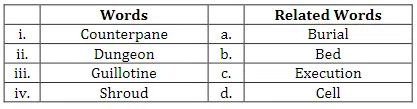
Which of the above ‘related words’ on the right - hand side are correctly matched with ‘words’ on the left - hand side?
correct answer:- 1
Analyse the following passage and provide appropriate answers for questions that follow.
Creative thinking can be used by management teams to produce actions that will potentially increase innovation and identify opportunities. Brainstorming is one technique that can enhance creativity. Brainstorming is usually regarded as a method to be used with groups of people. Although, it can be employed with individuals, the benefit of involving a group is that one person’s idea can help to stimulate even more ideas by other group members.
Underlying brainstorm is the idea that people’s creativity is restricted because they tend to reject ideas at too early a stage. This can be because they may be imposing imaginary constraints on a problem or making false assumptions. Alternatively, they may be unable to see a problem from multiple perspectives or they may be stereotyping problems and possible solutions and hence failing to see their wider potential. Involvement of people with different perspectives enriches the idea generation.
Question 38
Pick the option that best captures the relationship between the two paragraphs above.
correct answer:- 5
Analyse the following passage and provide appropriate answers for questions that follow.
Creative thinking can be used by management teams to produce actions that will potentially increase innovation and identify opportunities. Brainstorming is one technique that can enhance creativity. Brainstorming is usually regarded as a method to be used with groups of people. Although, it can be employed with individuals, the benefit of involving a group is that one person’s idea can help to stimulate even more ideas by other group members.
Underlying brainstorm is the idea that people’s creativity is restricted because they tend to reject ideas at too early a stage. This can be because they may be imposing imaginary constraints on a problem or making false assumptions. Alternatively, they may be unable to see a problem from multiple perspectives or they may be stereotyping problems and possible solutions and hence failing to see their wider potential. Involvement of people with different perspectives enriches the idea generation.
Question 39
Which of the following options would be closest to the main argument in the second paragraph above?
correct answer:- 4
Analyse the following passage and provide appropriate answers for questions that follow.
For private goods, competitive markets ensure efficiency despite the decentralized nature of the information about individual’s tastes and firm technologies. Implicitly, market competition solved adverse selection problems and the fixed - price contracts associated with exogenous prices solve moral hazard problems. However, markets fail for pure public goods and public intervention is thus needed. In this case, the mechanisms used for those collective decisions must solve the incentive problem of acquiring the private information that agents have about their references for public goods. Voting mechanisms are particular incentive mechanisms without any monetary transfers for which the same question of strategic voting, i.e., not voting according to the true preferences, can be raised. For private goods, increasing returns to scale create a situation of natural monopoly far away from the world of competitive markets. When the monopoly has private information about its cost or demand, its regulation by a regulatory commission becomes a principal - agent problem.
(Note: Public goods are those in which individuals cannot be excluded from use and where use by one individual does not reduce availability to others, while an individual can be excluded in case of private goods.)
Question 40
For which of the following goods, can markets not be efficient?
correct answer:- 3
.webp)
Analyse the following passage and provide appropriate answers for questions that follow.
For private goods, competitive markets ensure efficiency despite the decentralized nature of the information about individual’s tastes and firm technologies. Implicitly, market competition solved adverse selection problems and the fixed - price contracts associated with exogenous prices solve moral hazard problems. However, markets fail for pure public goods and public intervention is thus needed. In this case, the mechanisms used for those collective decisions must solve the incentive problem of acquiring the private information that agents have about their references for public goods. Voting mechanisms are particular incentive mechanisms without any monetary transfers for which the same question of strategic voting, i.e., not voting according to the true preferences, can be raised. For private goods, increasing returns to scale create a situation of natural monopoly far away from the world of competitive markets. When the monopoly has private information about its cost or demand, its regulation by a regulatory commission becomes a principal - agent problem.
(Note: Public goods are those in which individuals cannot be excluded from use and where use by one individual does not reduce availability to others, while an individual can be excluded in case of private goods.)
Question 41
Which of the following cannot be concluded from the above paragraph?
correct answer:- 1
Analyse the following passage and provide appropriate answers for questions that follow.
For private goods, competitive markets ensure efficiency despite the decentralized nature of the information about individual’s tastes and firm technologies. Implicitly, market competition solved adverse selection problems and the fixed - price contracts associated with exogenous prices solve moral hazard problems. However, markets fail for pure public goods and public intervention is thus needed. In this case, the mechanisms used for those collective decisions must solve the incentive problem of acquiring the private information that agents have about their references for public goods. Voting mechanisms are particular incentive mechanisms without any monetary transfers for which the same question of strategic voting, i.e., not voting according to the true preferences, can be raised. For private goods, increasing returns to scale create a situation of natural monopoly far away from the world of competitive markets. When the monopoly has private information about its cost or demand, its regulation by a regulatory commission becomes a principal - agent problem.
(Note: Public goods are those in which individuals cannot be excluded from use and where use by one individual does not reduce availability to others, while an individual can be excluded in case of private goods.)
Question 42
Read the following statement carefully:
Statement 1:
In India factories dump their waste in the nearby water bodies.
Statement 2:
Government is thinking of granting tax benefits to factories which adopt eco - friendly practices.
Which of the following options best captures the relationships between Statement 1 and Statement 2?
correct answer:- 3
Analyze the following passage and provide appropriate answers for the questions that follow.
The assumption of rationality puts an economist in a position to “explain” some features of market behavior, such as the dispersion of prices of psychophysically identical goods such as beer according to the amount spent on advertising them (no doubt, the fact that most beer is bought by individuals rather than as raw material by firms, which could be expected to be more rational than individuals, is part of the explanation.) Clearly something is wrong somewhere with the usual model of a competitive market with perfect information, for the virtually content less advertising cannot be considered as increasing the utility of beer in an obvious way. But if one can keep the assumption of rational actors, one need not get into the intellectual swamp of sentiment nor of preferences that depend on price. If one agrees, for example, that consumers use advertising as an index of the effort a producer will put into protecting its reputation and so as a predictor of quality control efforts, one can combine it with the standard mechanism and derive testable consequences from it.
But why, logically speaking, does it not matter that any of us, with a few years’ training, could disprove the assumptions? It is for the same reason that the statistical mechanics of gases is not undermined when Rutherford teaches a lot of only moderately bright physicists to use X-ray diffraction to disprove the assumption that molecules are little hard elastic balls. The point is, departures that Rutherford teaches us to find from the mechanism built into statistical mechanics are small and hardly ever systematic at level of gases. Ignorance and error about the quality of beer is also, unlikely to be systematic at the level of the consumers’ beer market, though it would become systematic if buyers imposed quality control procedures on sellers in contracts of sale (as corporations very often do in their contracts with suppliers). So when we find beers that advertising can make the ignorance and error systematic at the level of markets, just as lasers with wavelengths resonant with the internal structures and sizes of molecules can make molecular motions in gases systematic. The interesting one is that virtually content-less advertising is nevertheless information to a rational actor.
Question 43
Which of the following statements would be the closest to the arguments in the passage?
correct answer:- 4
Analyze the following passage and provide appropriate answers for the questions that follow.
The assumption of rationality puts an economist in a position to “explain” some features of market behavior, such as the dispersion of prices of psychophysically identical goods such as beer according to the amount spent on advertising them (no doubt, the fact that most beer is bought by individuals rather than as raw material by firms, which could be expected to be more rational than individuals, is part of the explanation.) Clearly something is wrong somewhere with the usual model of a competitive market with perfect information, for the virtually content less advertising cannot be considered as increasing the utility of beer in an obvious way. But if one can keep the assumption of rational actors, one need not get into the intellectual swamp of sentiment nor of preferences that depend on price. If one agrees, for example, that consumers use advertising as an index of the effort a producer will put into protecting its reputation and so as a predictor of quality control efforts, one can combine it with the standard mechanism and derive testable consequences from it.
But why, logically speaking, does it not matter that any of us, with a few years’ training, could disprove the assumptions? It is for the same reason that the statistical mechanics of gases is not undermined when Rutherford teaches a lot of only moderately bright physicists to use X-ray diffraction to disprove the assumption that molecules are little hard elastic balls. The point is, departures that Rutherford teaches us to find from the mechanism built into statistical mechanics are small and hardly ever systematic at level of gases. Ignorance and error about the quality of beer is also, unlikely to be systematic at the level of the consumers’ beer market, though it would become systematic if buyers imposed quality control procedures on sellers in contracts of sale (as corporations very often do in their contracts with suppliers). So when we find beers that advertising can make the ignorance and error systematic at the level of markets, just as lasers with wavelengths resonant with the internal structures and sizes of molecules can make molecular motions in gases systematic. The interesting one is that virtually content-less advertising is nevertheless information to a rational actor.
Question 44
Why has the author referred to Rutherford in the passage?
correct answer:- 2
Analyze the following passage and provide appropriate answers for the questions that follow.
The assumption of rationality puts an economist in a position to “explain” some features of market behavior, such as the dispersion of prices of psychophysically identical goods such as beer according to the amount spent on advertising them (no doubt, the fact that most beer is bought by individuals rather than as raw material by firms, which could be expected to be more rational than individuals, is part of the explanation.) Clearly something is wrong somewhere with the usual model of a competitive market with perfect information, for the virtually content less advertising cannot be considered as increasing the utility of beer in an obvious way. But if one can keep the assumption of rational actors, one need not get into the intellectual swamp of sentiment nor of preferences that depend on price. If one agrees, for example, that consumers use advertising as an index of the effort a producer will put into protecting its reputation and so as a predictor of quality control efforts, one can combine it with the standard mechanism and derive testable consequences from it.
But why, logically speaking, does it not matter that any of us, with a few years’ training, could disprove the assumptions? It is for the same reason that the statistical mechanics of gases is not undermined when Rutherford teaches a lot of only moderately bright physicists to use X-ray diffraction to disprove the assumption that molecules are little hard elastic balls. The point is, departures that Rutherford teaches us to find from the mechanism built into statistical mechanics are small and hardly ever systematic at level of gases. Ignorance and error about the quality of beer is also, unlikely to be systematic at the level of the consumers’ beer market, though it would become systematic if buyers imposed quality control procedures on sellers in contracts of sale (as corporations very often do in their contracts with suppliers). So when we find beers that advertising can make the ignorance and error systematic at the level of markets, just as lasers with wavelengths resonant with the internal structures and sizes of molecules can make molecular motions in gases systematic. The interesting one is that virtually content-less advertising is nevertheless information to a rational actor.
Question 45
Which of the following, as per author, are psychophysical goods?
1.Concrete
2.Car
3.Mobile Phone
correct answer:- 5

Analyze the following passage and provide appreciate answers for the questions that follow.
Ideas involving the theory probability play a decisive part in modern physics. Yet we will still lack a satisfactory, consistence definition of probability; or, what amounts to much the same, we still lack a satisfactory axiomatic system for the calculus of probability. The relations between probability and experience are also still in need of clarification. In investigating this problem we shall discover what will at first seem an almost insuperable objection to my methodological views. For although probability statements play such a vitally important role in empirical science, they turn out to be in principle impervious to strict falsification. Yet this very stumbling block will become a touchstone upon which to test my theory, in order to find out what it is worth. Thus, we are confronted with two tasks. The first is to provide new foundations for the calculus of probability. This I shall try to do by developing the theory of probability as a frequency theory, along the lines followed by Richard von Mises, But without the use of what he calls the ‘axiom of convergence’ (or ‘limit axiom’) and with a somewhat weakened ‘axiom of randomness’ The second task is to elucidate the relations between probability and experience. This means solving what I call the problem of decidability statements. My hope is that the investigations will help to relieve the present unsatisfactory situation in which physicists make much use of probabilities without being able to say, consistently, what they mean by ‘probability’.
Question 46
The statement, “The relations between probability and experience are still in need of clarification” implies that:
correct answer:- 3
Analyze the following passage and provide appreciate answers for the questions that follow.
Ideas involving the theory probability play a decisive part in modern physics. Yet we will still lack a satisfactory, consistence definition of probability; or, what amounts to much the same, we still lack a satisfactory axiomatic system for the calculus of probability. The relations between probability and experience are also still in need of clarification. In investigating this problem we shall discover what will at first seem an almost insuperable objection to my methodological views. For although probability statements play such a vitally important role in empirical science, they turn out to be in principle impervious to strict falsification. Yet this very stumbling block will become a touchstone upon which to test my theory, in order to find out what it is worth. Thus, we are confronted with two tasks. The first is to provide new foundations for the calculus of probability. This I shall try to do by developing the theory of probability as a frequency theory, along the lines followed by Richard von Mises, But without the use of what he calls the ‘axiom of convergence’ (or ‘limit axiom’) and with a somewhat weakened ‘axiom of randomness’ The second task is to elucidate the relations between probability and experience. This means solving what I call the problem of decidability statements. My hope is that the investigations will help to relieve the present unsatisfactory situation in which physicists make much use of probabilities without being able to say, consistently, what they mean by ‘probability’.
Question 47
Author has talked about the two tasks in the above passage. Choose the best option from the following statements relevant to the tasks.
correct answer:- 5
Analyze the following passage and provide appreciate answers for the questions that follow.
Ideas involving the theory probability play a decisive part in modern physics. Yet we will still lack a satisfactory, consistence definition of probability; or, what amounts to much the same, we still lack a satisfactory axiomatic system for the calculus of probability. The relations between probability and experience are also still in need of clarification. In investigating this problem we shall discover what will at first seem an almost insuperable objection to my methodological views. For although probability statements play such a vitally important role in empirical science, they turn out to be in principle impervious to strict falsification. Yet this very stumbling block will become a touchstone upon which to test my theory, in order to find out what it is worth. Thus, we are confronted with two tasks. The first is to provide new foundations for the calculus of probability. This I shall try to do by developing the theory of probability as a frequency theory, along the lines followed by Richard von Mises, But without the use of what he calls the ‘axiom of convergence’ (or ‘limit axiom’) and with a somewhat weakened ‘axiom of randomness’ The second task is to elucidate the relations between probability and experience. This means solving what I call the problem of decidability statements. My hope is that the investigations will help to relieve the present unsatisfactory situation in which physicists make much use of probabilities without being able to say, consistently, what they mean by ‘probability’.
Question 48
Which one of the following statements can be inferred from the passage?
correct answer:- 4
Analyze the following passage and provide appropriate answers for the questions that follow.
The ways by which you may get money almost exception lead downwards. To have done anything by which you earned money merely is to have been truly idle or worse. If the laborer gets no more than the wages which his employer pays him, he is cheated, he cheats himself. If you would get money as a writer or lecturer, you must be popular, which is to go down perpendicularly. Those services which the community will most readily pay for, it is most disagreeable to render. You are paid for being something less than a man. The State does not commonly reward a genius any more wisely. Even the poet laureate would rather not have to celebrate the accidents of royalty. He must be bribed with a pipe of wine; and perhaps another poet is called away from his muse to gauge that very pipe. The aim of the laborer should be, not to get his living, to get “a good job” but to perform well a certain work; and even in a pecuniary sense, it would be economy for a town to pay its laborers so well that they would not feel that they were working for low ends, for a livelihood merely, but for scientific, or even moral ends. Do not hire a man who does your work for money, but him who does it for love of it.
The community has no bribe that will tempt a wise man. You may raise money enough to tunnel a mountain, but you cannot raise money enough to hire a man who is minding his own business. An efficient and valuable man does what he can, whether the community pays him for it or not. The inefficient offer their inefficiency to the highest bidder, and are forever expecting to be put into office. One would suppose that they were rarely disappointed. God gave the righteous man a certificate entitling him to food and raiment, but the unrighteous man found a facsimile of the same in God’s coffers, and appropriated it, and obtained food and raiment like the former. It is one of the most extensive systems of counterfeiting that the world has seen. I did not know that mankind was suffering for want of gold. I have seen a little of it. I know that it is very malleable, but not so malleable as wit. A grain of gold will gild a great surface, but not so much as a grain of wisdom.
Question 49
Which of the following would the author disagree most with?
correct answer:- 4
Analyze the following passage and provide appropriate answers for the questions that follow.
The ways by which you may get money almost exception lead downwards. To have done anything by which you earned money merely is to have been truly idle or worse. If the laborer gets no more than the wages which his employer pays him, he is cheated, he cheats himself. If you would get money as a writer or lecturer, you must be popular, which is to go down perpendicularly. Those services which the community will most readily pay for, it is most disagreeable to render. You are paid for being something less than a man. The State does not commonly reward a genius any more wisely. Even the poet laureate would rather not have to celebrate the accidents of royalty. He must be bribed with a pipe of wine; and perhaps another poet is called away from his muse to gauge that very pipe. The aim of the laborer should be, not to get his living, to get “a good job” but to perform well a certain work; and even in a pecuniary sense, it would be economy for a town to pay its laborers so well that they would not feel that they were working for low ends, for a livelihood merely, but for scientific, or even moral ends. Do not hire a man who does your work for money, but him who does it for love of it.
The community has no bribe that will tempt a wise man. You may raise money enough to tunnel a mountain, but you cannot raise money enough to hire a man who is minding his own business. An efficient and valuable man does what he can, whether the community pays him for it or not. The inefficient offer their inefficiency to the highest bidder, and are forever expecting to be put into office. One would suppose that they were rarely disappointed. God gave the righteous man a certificate entitling him to food and raiment, but the unrighteous man found a facsimile of the same in God’s coffers, and appropriated it, and obtained food and raiment like the former. It is one of the most extensive systems of counterfeiting that the world has seen. I did not know that mankind was suffering for want of gold. I have seen a little of it. I know that it is very malleable, but not so malleable as wit. A grain of gold will gild a great surface, but not so much as a grain of wisdom.
Question 50
Which of the following could be a good title for the above passage?
correct answer:- 1
Analyze the following passage and provide appropriate answers for the questions that follow.
The ways by which you may get money almost exception lead downwards. To have done anything by which you earned money merely is to have been truly idle or worse. If the laborer gets no more than the wages which his employer pays him, he is cheated, he cheats himself. If you would get money as a writer or lecturer, you must be popular, which is to go down perpendicularly. Those services which the community will most readily pay for, it is most disagreeable to render. You are paid for being something less than a man. The State does not commonly reward a genius any more wisely. Even the poet laureate would rather not have to celebrate the accidents of royalty. He must be bribed with a pipe of wine; and perhaps another poet is called away from his muse to gauge that very pipe. The aim of the laborer should be, not to get his living, to get “a good job” but to perform well a certain work; and even in a pecuniary sense, it would be economy for a town to pay its laborers so well that they would not feel that they were working for low ends, for a livelihood merely, but for scientific, or even moral ends. Do not hire a man who does your work for money, but him who does it for love of it.
The community has no bribe that will tempt a wise man. You may raise money enough to tunnel a mountain, but you cannot raise money enough to hire a man who is minding his own business. An efficient and valuable man does what he can, whether the community pays him for it or not. The inefficient offer their inefficiency to the highest bidder, and are forever expecting to be put into office. One would suppose that they were rarely disappointed. God gave the righteous man a certificate entitling him to food and raiment, but the unrighteous man found a facsimile of the same in God’s coffers, and appropriated it, and obtained food and raiment like the former. It is one of the most extensive systems of counterfeiting that the world has seen. I did not know that mankind was suffering for want of gold. I have seen a little of it. I know that it is very malleable, but not so malleable as wit. A grain of gold will gild a great surface, but not so much as a grain of wisdom.
Question 51
The author of the passage went on to say: “We are provincial, because we do not find at home our standards; because we do not worship truth, but the reflection of truth; because we are warped and narrowed by an exclusive devotion to trade and commerce and manufactures and agriculture and the like, which are but means, and not the end.”
Which of the following, as per author, could have been the end (last words in the lines above)?
correct answer:- 2
I heartily accept the motto, “That government is best which governs least”; and I should like to see it acted up to more rapidly and systematically. Carried out, it finally amounts to this, which also I believe--“That government is best which governs not at all”; and when men are prepared for it, that will be the kind of governments which they will have. Government is at best but an expedient; but most government are usually, and all governments are sometimes, inexpedient. The objection which have been brought against a standing army, and they are many and weighty, and deserve to prevail, may also at last be brought against a standing government. The standing army is only an arm of the standing government. The government itself, which is only the mode which the people have chosen to execute their will, is equally liable to be abused and perverted before the people can act through it.
After all, the practical reason why, when the power is once in the hands of the people, a majority are permitted, and for a long period continue, to rule is not because they are most likely to be in the right, nor because this seems fairest to the minority, but because they are physically the strongest. But a government in which the majority rules in all cases cannot be based on justice, even as far as men understand it. Can there not be a government in which the majorities do not virtually decide right and wrong, but conscience? -- in which majorities decide only those questions to which the rule of expediency is applicable? Must the citizen ever for a moment or in the least degree, resign his conscience to legislator? Why has every man a conscience then? I think that we should be men first, and subjects afterward. It is not desirable to cultivate a respect for the law, so much as for the right The only obligation which I have a right to assume is to do at any time what I think right. It is truly enough said that a corporation has no conscience; but a corporation of conscientious men is a corporation with a conscience. Law never made men a whit more just; and, by means of their respect for it, even the well-disposed are daily made the agents on injustice.
Question 52
According to the author of the paragraph, army is _____________ ?
correct answer:- 5
I heartily accept the motto, “That government is best which governs least”; and I should like to see it acted up to more rapidly and systematically. Carried out, it finally amounts to this, which also I believe--“That government is best which governs not at all”; and when men are prepared for it, that will be the kind of governments which they will have. Government is at best but an expedient; but most government are usually, and all governments are sometimes, inexpedient. The objection which have been brought against a standing army, and they are many and weighty, and deserve to prevail, may also at last be brought against a standing government. The standing army is only an arm of the standing government. The government itself, which is only the mode which the people have chosen to execute their will, is equally liable to be abused and perverted before the people can act through it.
After all, the practical reason why, when the power is once in the hands of the people, a majority are permitted, and for a long period continue, to rule is not because they are most likely to be in the right, nor because this seems fairest to the minority, but because they are physically the strongest. But a government in which the majority rules in all cases cannot be based on justice, even as far as men understand it. Can there not be a government in which the majorities do not virtually decide right and wrong, but conscience? -- in which majorities decide only those questions to which the rule of expediency is applicable? Must the citizen ever for a moment or in the least degree, resign his conscience to legislator? Why has every man a conscience then? I think that we should be men first, and subjects afterward. It is not desirable to cultivate a respect for the law, so much as for the right The only obligation which I have a right to assume is to do at any time what I think right. It is truly enough said that a corporation has no conscience; but a corporation of conscientious men is a corporation with a conscience. Law never made men a whit more just; and, by means of their respect for it, even the well-disposed are daily made the agents on injustice.
Question 53
In general, when would government of majority be good for minorities?
correct answer:- 4
I heartily accept the motto, “That government is best which governs least”; and I should like to see it acted up to more rapidly and systematically. Carried out, it finally amounts to this, which also I believe--“That government is best which governs not at all”; and when men are prepared for it, that will be the kind of governments which they will have. Government is at best but an expedient; but most government are usually, and all governments are sometimes, inexpedient. The objection which have been brought against a standing army, and they are many and weighty, and deserve to prevail, may also at last be brought against a standing government. The standing army is only an arm of the standing government. The government itself, which is only the mode which the people have chosen to execute their will, is equally liable to be abused and perverted before the people can act through it.
After all, the practical reason why, when the power is once in the hands of the people, a majority are permitted, and for a long period continue, to rule is not because they are most likely to be in the right, nor because this seems fairest to the minority, but because they are physically the strongest. But a government in which the majority rules in all cases cannot be based on justice, even as far as men understand it. Can there not be a government in which the majorities do not virtually decide right and wrong, but conscience? -- in which majorities decide only those questions to which the rule of expediency is applicable? Must the citizen ever for a moment or in the least degree, resign his conscience to legislator? Why has every man a conscience then? I think that we should be men first, and subjects afterward. It is not desirable to cultivate a respect for the law, so much as for the right The only obligation which I have a right to assume is to do at any time what I think right. It is truly enough said that a corporation has no conscience; but a corporation of conscientious men is a corporation with a conscience. Law never made men a whit more just; and, by means of their respect for it, even the well-disposed are daily made the agents on injustice.
Question 54
Which of the following statements would the author agree the most with?
correct answer:- 1
Analyze the following passage and provide appropriate answers for the questions that follow.
Either explicitly or implicitly, our informants suggest that the objects that transfix them are hoped to be conduits to, rather than surrogates for, love, respect, recognition, status, security, escape, or attractiveness. These are the social relations we desire, consciously or subconsciously, beneath the objects that we find so compelling. The value of the objects that we focus our longing upon inheres less in the object or in a Lacanian search for childhood love than in the culture. The hope for the hope that an altered state of being may result keeps the cycle of desire moving. Desires are nurtured by self-embellished fantasies of a wholly different self, and they may be stimulated by external sources, including advertising, retail displays, films, television programs, stories told by other people, and the consumption behavior of real or imaginary others. But we find that the person who feels strong desire has almost always actively stimulated this desire by attending, seeking out, entertaining, and embellishing such images. The desires that occupy us are vivid and riveting fantasies that we participate in nurturing, growing, and pursuing, through self-seduction.
The social nature of desire implies that preferences of consumers are far from being independent. Yet, choice models assume that preferences of consumers act as individuals. The mimetic aspect of desire creates difficulties for using individual attitude or intention measures to predict adoption of new products whose use will be visible. The notion of desire we have derived suggests that the appeal of the desired object is not inherent in the object itself. Models that begin with preferences for product attributes or benefits are therefore problematic. The consumer, individually and jointly, has a role in constructing the object of desire, within a social context. What makes consumer desire attach to a particular object is not so much the object’s particular characteristics as the consumer’s own hopes for an altered state of being,involving an altered set of social relationships.
Question 55
Consider the statement given below as true:
“The failure of men to transition from being shoppers and consumers to producers and creators has implications about their manliness.”
Which of the following statements would concur with the above idea and the theme of the main paragraph?
correct answer:- 5
Analyze the following passage and provide appropriate answers for the questions that follow.
Either explicitly or implicitly, our informants suggest that the objects that transfix them are hoped to be conduits to, rather than surrogates for, love, respect, recognition, status, security, escape, or attractiveness. These are the social relations we desire, consciously or subconsciously, beneath the objects that we find so compelling. The value of the objects that we focus our longing upon inheres less in the object or in a Lacanian search for childhood love than in the culture. The hope for the hope that an altered state of being may result keeps the cycle of desire moving. Desires are nurtured by self-embellished fantasies of a wholly different self, and they may be stimulated by external sources, including advertising, retail displays, films, television programs, stories told by other people, and the consumption behavior of real or imaginary others. But we find that the person who feels strong desire has almost always actively stimulated this desire by attending, seeking out, entertaining, and embellishing such images. The desires that occupy us are vivid and riveting fantasies that we participate in nurturing, growing, and pursuing, through self-seduction.
The social nature of desire implies that preferences of consumers are far from being independent. Yet, choice models assume that preferences of consumers act as individuals. The mimetic aspect of desire creates difficulties for using individual attitude or intention measures to predict adoption of new products whose use will be visible. The notion of desire we have derived suggests that the appeal of the desired object is not inherent in the object itself. Models that begin with preferences for product attributes or benefits are therefore problematic. The consumer, individually and jointly, has a role in constructing the object of desire, within a social context. What makes consumer desire attach to a particular object is not so much the object’s particular characteristics as the consumer’s own hopes for an altered state of being,involving an altered set of social relationships.
Question 56
Consider the statement given below as true:
“Men use the plasticity of consumer identity construction to forge atavistic masculine identities based upon an imagined life of self-reliant, pre-modern men who lived outside the confines of cities, families, and work bureaucracies.” Which of the following statements would concur with the above idea and the theme of the main paragraph?
correct answer:- 4
Analyze the following passage and provide appropriate answers for the questions that follow.
Either explicitly or implicitly, our informants suggest that the objects that transfix them are hoped to be conduits to, rather than surrogates for, love, respect, recognition, status, security, escape, or attractiveness. These are the social relations we desire, consciously or subconsciously, beneath the objects that we find so compelling. The value of the objects that we focus our longing upon inheres less in the object or in a Lacanian search for childhood love than in the culture. The hope for the hope that an altered state of being may result keeps the cycle of desire moving. Desires are nurtured by self-embellished fantasies of a wholly different self, and they may be stimulated by external sources, including advertising, retail displays, films, television programs, stories told by other people, and the consumption behavior of real or imaginary others. But we find that the person who feels strong desire has almost always actively stimulated this desire by attending, seeking out, entertaining, and embellishing such images. The desires that occupy us are vivid and riveting fantasies that we participate in nurturing, growing, and pursuing, through self-seduction.
The social nature of desire implies that preferences of consumers are far from being independent. Yet, choice models assume that preferences of consumers act as individuals. The mimetic aspect of desire creates difficulties for using individual attitude or intention measures to predict adoption of new products whose use will be visible. The notion of desire we have derived suggests that the appeal of the desired object is not inherent in the object itself. Models that begin with preferences for product attributes or benefits are therefore problematic. The consumer, individually and jointly, has a role in constructing the object of desire, within a social context. What makes consumer desire attach to a particular object is not so much the object’s particular characteristics as the consumer’s own hopes for an altered state of being,involving an altered set of social relationships.
Question 57
Consider the statement given below as true:
“By appropriating fashion discourse, consumers generate personalized fashion narratives and metaphoric and metonymic references that negotiate key existential tensions and that often express resistance to dominant fashion norms in their social milieu or consumer culture at large.”
Which of the following statements would concur with the above idea and the theme of the main paragraph?
correct answer:- 4
Read the following passage and provide appropriate answers for the questions
There is an essential and irreducible ‘duality’ in the normative conceptualization of an individual person. We can see the person in terms of his or her ‘agency’, recognizing and respecting his or her ability to form goals, commitments, values, etc., and we can also see the person in terms of his or her ‘well-being’. This dichotomy is lost in a model of exclusively self- interested motivation, in which a person’s agency must be entirely geared to his or her own well-being. But once that straitjacket of self-interested motivation is removed, it becomes possible to recognize the indisputable fact that the person’s agency can well be geared to considerations not covered - or at least not fully covered - by his or her own well-being. Agency may be seen as important (not just instrumentally for the pursuit of well-being, but also intrinsically), but that still leaves open the question as to how that agency is to be evaluated and appraised. Even though the use of one’s agency is a matter for oneself to judge, the need for careful assessment of aims, objective, allegiances, etc., and the conception of the good, may be important and exacting. To recognize the distinction between the ‘agency aspect’ and the ‘well-being aspect’ of a person does not require us to take the view that the person’s success as an agent must be independent, or completely separable from, his or her success in terms of well-being. A person may well feel happier and better off as a result of achieving what he or she wanted to achieve - perhaps for his or her family, or community, or class, or party, or some other cause. Also it is quite possible that a person’s well-being will go down as a result of frustration if there is some failure to achieve what he or she wanted to achieve as an agent, even though those achievements are not directly concerned with his or her well-being. There is really no sound basis for demanding that the agency aspect and the well-being aspect of a person should be independent of each other, and it is, I suppose, even possible that every change in one will affect the other as well. However, the point at issue is not the plausibility of their independence, but the sustainability and relevance of the distinction. The fact that two variables may be so related that one cannot change without the other, does not imply that they are the same variable, or that they will have the same values, or that the value of one can be obtained from the other on basis of some simple transformation. The importance of an agency achievement does not rest entirely on the enhancement of well-being that it may indirectly cause. The agency achievement and well-being achievement, both of which have some distinct importance, may be casually linked with each other, but this fact does not compromise the specific importance of either. In so far as utility - based welfare calculations concentrate only on the well- being of the person, ignoring the agency aspect, or actually fails to distinguish between the agency aspect and well-being aspect altogether, something of real importance is lost.
Question 58
According to the ideas in the passage, the following are not true expect:
correct answer:- 1
Read the following passage and provide appropriate answers for the questions
There is an essential and irreducible ‘duality’ in the normative conceptualization of an individual person. We can see the person in terms of his or her ‘agency’, recognizing and respecting his or her ability to form goals, commitments, values, etc., and we can also see the person in terms of his or her ‘well-being’. This dichotomy is lost in a model of exclusively self- interested motivation, in which a person’s agency must be entirely geared to his or her own well-being. But once that straitjacket of self-interested motivation is removed, it becomes possible to recognize the indisputable fact that the person’s agency can well be geared to considerations not covered - or at least not fully covered - by his or her own well-being. Agency may be seen as important (not just instrumentally for the pursuit of well-being, but also intrinsically), but that still leaves open the question as to how that agency is to be evaluated and appraised. Even though the use of one’s agency is a matter for oneself to judge, the need for careful assessment of aims, objective, allegiances, etc., and the conception of the good, may be important and exacting. To recognize the distinction between the ‘agency aspect’ and the ‘well-being aspect’ of a person does not require us to take the view that the person’s success as an agent must be independent, or completely separable from, his or her success in terms of well-being. A person may well feel happier and better off as a result of achieving what he or she wanted to achieve - perhaps for his or her family, or community, or class, or party, or some other cause. Also it is quite possible that a person’s well-being will go down as a result of frustration if there is some failure to achieve what he or she wanted to achieve as an agent, even though those achievements are not directly concerned with his or her well-being. There is really no sound basis for demanding that the agency aspect and the well-being aspect of a person should be independent of each other, and it is, I suppose, even possible that every change in one will affect the other as well. However, the point at issue is not the plausibility of their independence, but the sustainability and relevance of the distinction. The fact that two variables may be so related that one cannot change without the other, does not imply that they are the same variable, or that they will have the same values, or that the value of one can be obtained from the other on basis of some simple transformation. The importance of an agency achievement does not rest entirely on the enhancement of well-being that it may indirectly cause. The agency achievement and well-being achievement, both of which have some distinct importance, may be casually linked with each other, but this fact does not compromise the specific importance of either. In so far as utility - based welfare calculations concentrate only on the well- being of the person, ignoring the agency aspect, or actually fails to distinguish between the agency aspect and well-being aspect altogether, something of real importance is lost.
Question 59
In the case of Japan, there is a strong empirical evidence to suggest that systematic departure
from self-interested behavior, in the direction of duty, loyalty and goodwill have played a substantial part in industrial success.Which of the following in closest to the ideas presented in the passage?
correct answer:- 4
Read the following passage and provide appropriate answers for the questions
There is an essential and irreducible ‘duality’ in the normative conceptualization of an individual person. We can see the person in terms of his or her ‘agency’, recognizing and respecting his or her ability to form goals, commitments, values, etc., and we can also see the person in terms of his or her ‘well-being’. This dichotomy is lost in a model of exclusively self- interested motivation, in which a person’s agency must be entirely geared to his or her own well-being. But once that straitjacket of self-interested motivation is removed, it becomes possible to recognize the indisputable fact that the person’s agency can well be geared to considerations not covered - or at least not fully covered - by his or her own well-being. Agency may be seen as important (not just instrumentally for the pursuit of well-being, but also intrinsically), but that still leaves open the question as to how that agency is to be evaluated and appraised. Even though the use of one’s agency is a matter for oneself to judge, the need for careful assessment of aims, objective, allegiances, etc., and the conception of the good, may be important and exacting. To recognize the distinction between the ‘agency aspect’ and the ‘well-being aspect’ of a person does not require us to take the view that the person’s success as an agent must be independent, or completely separable from, his or her success in terms of well-being. A person may well feel happier and better off as a result of achieving what he or she wanted to achieve - perhaps for his or her family, or community, or class, or party, or some other cause. Also it is quite possible that a person’s well-being will go down as a result of frustration if there is some failure to achieve what he or she wanted to achieve as an agent, even though those achievements are not directly concerned with his or her well-being. There is really no sound basis for demanding that the agency aspect and the well-being aspect of a person should be independent of each other, and it is, I suppose, even possible that every change in one will affect the other as well. However, the point at issue is not the plausibility of their independence, but the sustainability and relevance of the distinction. The fact that two variables may be so related that one cannot change without the other, does not imply that they are the same variable, or that they will have the same values, or that the value of one can be obtained from the other on basis of some simple transformation. The importance of an agency achievement does not rest entirely on the enhancement of well-being that it may indirectly cause. The agency achievement and well-being achievement, both of which have some distinct importance, may be casually linked with each other, but this fact does not compromise the specific importance of either. In so far as utility - based welfare calculations concentrate only on the well- being of the person, ignoring the agency aspect, or actually fails to distinguish between the agency aspect and well-being aspect altogether, something of real importance is lost.
Question 60
Of the options presented below, which one is the best example for the ideas propounded in the passage?
correct answer:- 5
Read the following passage and provide appropriate answers for the questions
There is an essential and irreducible ‘duality’ in the normative conceptualization of an individual person. We can see the person in terms of his or her ‘agency’, recognizing and respecting his or her ability to form goals, commitments, values, etc., and we can also see the person in terms of his or her ‘well-being’. This dichotomy is lost in a model of exclusively self- interested motivation, in which a person’s agency must be entirely geared to his or her own well-being. But once that straitjacket of self-interested motivation is removed, it becomes possible to recognize the indisputable fact that the person’s agency can well be geared to considerations not covered - or at least not fully covered - by his or her own well-being. Agency may be seen as important (not just instrumentally for the pursuit of well-being, but also intrinsically), but that still leaves open the question as to how that agency is to be evaluated and appraised. Even though the use of one’s agency is a matter for oneself to judge, the need for careful assessment of aims, objective, allegiances, etc., and the conception of the good, may be important and exacting. To recognize the distinction between the ‘agency aspect’ and the ‘well-being aspect’ of a person does not require us to take the view that the person’s success as an agent must be independent, or completely separable from, his or her success in terms of well-being. A person may well feel happier and better off as a result of achieving what he or she wanted to achieve - perhaps for his or her family, or community, or class, or party, or some other cause. Also it is quite possible that a person’s well-being will go down as a result of frustration if there is some failure to achieve what he or she wanted to achieve as an agent, even though those achievements are not directly concerned with his or her well-being. There is really no sound basis for demanding that the agency aspect and the well-being aspect of a person should be independent of each other, and it is, I suppose, even possible that every change in one will affect the other as well. However, the point at issue is not the plausibility of their independence, but the sustainability and relevance of the distinction. The fact that two variables may be so related that one cannot change without the other, does not imply that they are the same variable, or that they will have the same values, or that the value of one can be obtained from the other on basis of some simple transformation. The importance of an agency achievement does not rest entirely on the enhancement of well-being that it may indirectly cause. The agency achievement and well-being achievement, both of which have some distinct importance, may be casually linked with each other, but this fact does not compromise the specific importance of either. In so far as utility - based welfare calculations concentrate only on the well- being of the person, ignoring the agency aspect, or actually fails to distinguish between the agency aspect and well-being aspect altogether, something of real importance is lost.
Question 61
Read the sentences given below and choose the option that is best in accordance with the ideas in the passage.
I.There is a need to distinguish between the agency aspect and the well-being aspect of a person.
II.A person can be conceptualized in terms of either agency or well-being.
III.A person is important, not just instrumentally, for the pursuit of well-being
correct answer:- 4
Question 62
Observe the cartoon below carefully and answer the question that follows.
(Cartoon by Tom Toro, originally published in The New Yorker on November 18, 2024. Used for educational purposes)
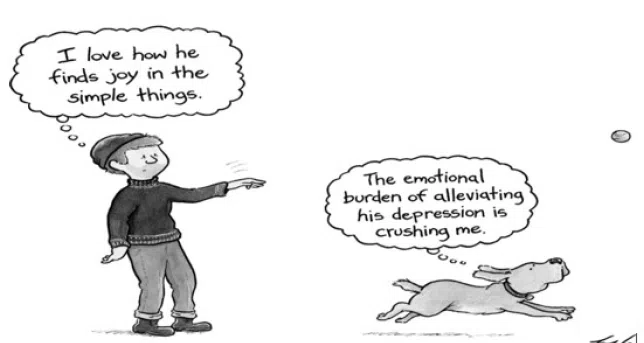
Which of the following options BEST explains the underlying message depicted in the cartoon?
correct answer:- 1
Question 63
Read the following passage and answer the question that follows.
We can think of the history of life on earth as a vast, long-term experiment in pure competition. Every living organism is competing with all other living organisms for resources (nutrients, sunlight, water, territory, etc.). Nature, or the natural world, is a laboratory of unfettered competition. It’s a dog-eat-dog, no-holds-barred, day-in and day-out struggle.
There are no governmental regulators to protect the weak or favor the strong. All organisms are given a chance, but not necessarily an equal chance. As the climate and the environment change (and change they do), some organisms are favored over others at times, but these advantages are fleeting. What nature gives, nature can take away.
Which of the following can be BEST concluded from the passage?
correct answer:- 5
Question 64
Read the following passage and answer the question that follows.
The painting, which is in poor condition, suggests that a highly advanced artistic culture existed some 44,000 years ago, punctuated by folklore, religious myths and spiritual belief. The scene may be regarded not only as the earliest dated figurative art in the world but also as the oldest evidence for the communication of a narrative in Palaeolithic art.
"This is noteworthy, given that the ability to invent fictional stories may have been the last and most crucial stage in the evolutionary history of human language and the development of modern-like patterns of cognition” researchers said.
Which of the following can be BEST concluded from the passage?
correct answer:- 1
Question 65
Read the following paragraph and answer the question that follows:
When asked what the politician will do for the nation’s economy, he attacked the opponent by saying, “Look at that face! Would anyone vote for that? I mean, she’s a woman, and I’m not supposed to say bad things, but really, folks, come on. Are we serious? Nevertheless, we’re going to defeat ISIS. ISIS happened a number of years ago in a vacuum that was left because of bad judgment. And I will tell you, I will take care of ISIS.”
Which of the following statements BEST describes the politician’s intent?
correct answer:- 1
Question 66
Read the following paragraph and answer the question that follows:
If we can send a human to the Moon, why can’t we build sustainable cities? Defeat cancer? Tackle climate change? So, go the rallying cries inspired by one of humanity’s greatest achievements, the US effort that put Neil Armstrong and Buzz Aldrin on the Moon on 20 July 1969.
Which of the following statements, if true, BEST communicates the intent of the paragraph?
correct answer:- 5
Question 67
Read the following paragraph and answer the question that follows:
Global surface temperatures in 2019 are on track to be either the second or third warmest since records began in the mid-1800s, behind only 2016 and possibly 2017. On top of the long-term warming trend, temperatures in 2019 have been buoyed by a moderate El Niño event that is likely to persist through the rest of the year.
Which of the following statements can be BEST inferred based on the above paragraph?
correct answer:- 4
Question 68
Read the following paragraph and answer the question that follows:
In Australia, jellyfish are most common between November and May. In Hawaii, jellyfish often show up on south-facing beaches eight days after a full moon. In the Mediterranean, blooms usually appear in the summer. Unfortunately for travellers, there is no worldwide database for recent jellyfish sightings, and tourism officials are sometimes reluctant to publicize jellyfish swarms out of fear that such news will scare off visitors.
Which of the following can be BEST concluded from the above paragraph?
correct answer:- 1
Question 69
Read the following paragraph and answer the question that follows:
In a 2017 survey of 3,915 American workers, my colleagues and I found that workers report experiencing a sizable “voice gap” at work — that is, a gap between how much say or influence they feel they ought to have and how much they actually have — on topics such as wages, working conditions, fair treatment, and input into how they do their work.
And now a second study, I have just completed with a new team, finds that today’s workers want forms of voice and representation that go well beyond traditional unions.
Based on the above paragraph, which of the following options would you agree with the MOST?
correct answer:- 5
Question 70
Read the following paragraph and answer the question that follows:
“People who work in law, hotel and food services, and technology were found the most likely to skip breakfast daily, according to a recent study. As for people who do eat breakfast and prefer a savoury type (like an egg), the study found they tend to make more money, be night owls and prefer cats over dogs. If you prefer a sweet breakfast like a donut you tend to be a morning person, like romcoms and are a dog person”.
Which of the following can be BEST inferred based on the above paragraph?
correct answer:- 1
Question 71
Study the text given below and answer the question that follows it:
Dense, dirty air laced with grease best describes the atmosphere of most Lagos streets. Drive from one corner of this great west African city to another and in no time you will find surfaces lightly dusted, like a soft sprinkling of icing on cakes. Under the half-moons of fingernails, thick grime settles. It’s a scene taken as typically African: polluted, bedraggled, unhealthy. This has only ever been made possible by the exploitation of Africa’s people. This week five west African countries, Nigeria included, announced plans to end the practice of European oil companies and traders exporting “African quality” diesel. “Dirty fuel” has earned the name because it is imported diesel with sulphur levels as high as 3,000 parts per million when the European maximum is 10ppm. To be clear, “African quality” fuel, is fuel not fit for European humans.
Which of the options is not necessarily the underlying assumption of the author in the paragraph above?
correct answer:- 3
Question 72
Read the following paragraph and answer the question that follows:
Alligators are freshwater reptiles. However, people have come face to face with them in mud in a salt marsh in Georgia. Finding alligators in the salt marsh is not a mystery or a miracle. At least 23 species of predator have been spotted living in surprising habitats. Predators such as alligators, otters, mountain lions, wolves and raptors are thriving in places they shouldn't, revealing some serious misunderstandings about their behaviour and how to protect them. Scientific literature divulges that these creatures are actually returning to places they once occupied. It gives us astonishing insights into the lives of animals and helps conservationists improve the old stomping grounds of these creatures.
Which of the following statements provides the most plausible explanation of the predators' behaviour?
correct answer:- 4
Question 73
Read the following paragraph and answer the question that follows:
An accurate measure of drug efficacy would require comparing the response of patients taking it with that of patients taking placebos; the drug effect could then be calculated by subtracting the placebo response from the overall response, much as a deli-counter worker subtracts the weight of the container to determine how much lobster salad you’re getting. In the last half of the 1950s, this calculus gave rise to a new way to evaluate drugs: the double-blind, placebo-controlled clinical trial, in which neither patient nor clinician knew who was getting the active drug and who the placebo.
Which of the options is a wrong answer to this Question How does a double-blind ensure a better trial of a new drug?
correct answer:- 1
Question 74
Read the following paragraph and answer the question that follows:
Empirical observation told us years ago that goats were slowly becoming the new dog, and according to a new study, they are truly qualified to be man’s best friend. The Royal Society released heart-warming research showing that just like humans, goats have no desire to interact with people who come off as angry or upset, and that they’re much more attracted to those with big smiles plastered across their faces. When 12 males and 8 females were released into a pen decorated with images of happy and angry humans, the scientists learned that goats can “distinguish between happy and angry images of the same person,” and in general, they prefer their humans to be happy.
Which of the following statements is definitely true according to the passage?
correct answer:- 1
Question 75
Read the following paragraph:
"Music probably does something interesting," explains neuropsychologist Catherine Loveday of the University of Westminster. "It stimulates the brain in a very powerful way, because of our emotional connection with it." Unlike brain-games, playing an instrument is a rich and complex experience. This is because it's integrating information from senses like vision, hearing, and touch, along with fine movements. This can result in long-lasting changes in the brain. This can also be applicable in the business world.
Go through the following statements:
1. Playing a musical instrument is a unique experience involving vision, hearing and touch.
2. Instrumental musicians are far more creative than vocalists.
3. Playing brain games does not integrate various senses and movements as much as playing a musical instrument.
4. Integrating the five senses is critical in the business world.
Which of the above statements can definitely be interpreted based on the passage above?
correct answer:- 3
Question 76
Read the following statement:
A manager seeks approval for conducting a training programme on 'openness'. He puts forward the following arguments in favour of the program to his CEO.
Which of the following arguments is the least likely to have a logical fallacy?
correct answer:- 3
Question 77
Read the following sentences and choose the option that best arranges them in a logical order.
1. As chroniclers of an incremental process, they discover that additional research makes it harder, not easier, to answer questions like: When was oxygen discovered? Who first conceived of energy conservation?
2. Simultaneously, these same historians confront growing difficulties in distinguishing the "scientific" component of past observation and belief from what their predecessors had readily labeled "error" and "superstition."
3. Increasingly, a few of them suspect that these are simply the wrong sorts of questions to ask. Perhaps science does not develop by the accumulation of individual discoveries and inventions.
4. In recent years, however, a few historians of science have been finding it more and more difficult to fulfill the functions that the concept of development-by-accumulation assigns to them.
correct answer:- 5
Question 78
Read the following sentences and choose the option that best arranges them in a logical order.
1. Finally he took a wrong turn and ran a few, steps past me, towards the hamlet, crying, "Johnny, Black Dog, Dirk," and other names, "you won't leave old Pew, mates—not old Pew!"
2. This quarrel was the saving of us, for while it was still raging, another sound came from the top of the hill on the side of the hamlet—the tramp of horses galloping.
3. And that was plainly the last signal of danger, for the buccaneers turned at once and ran, separating in every direction, one seaward along the cove, one slant across the hill, and so on, so that in half a minute not a sign of them remained but Pew.
4. Him they had deserted, whether in sheer panic or out of revenge for his ill words and blows I know not; but there he remained behind, tapping up and down the road in a frenzy, and groping and calling for his comrades.
5. Almost at the same time a pistol-shot, flash and report, came from the hedge side.
correct answer:- 3
Question 79
Read the following sentences and choose the option that best arranges them in a logical order.
1. I was scarcely in position ere my enemies began to arrive, seven or eight of them, running hard, their feet beating out of time along the road and the man with the lantern some paces in front.
2. My curiosity, in a sense, was stronger than my fear, for I could not remain where I was, but crept back to the bank again, whence, sheltering my head behind a bush of broom, I might command the road before our door.
3. Three men ran together, hand in hand; and I made out, even through the mist, that the middle man of this trio was the blind beggar.
4. The next moment his voice showed me that I was right.
correct answer:- 2
Question 80
Read the following statements and answer the question that follows:
1.The periodic table orders the elements in a way that helps to understand why atoms behave as they do.
2.The properties of the elements are due to electronic configuration, and their recurring pattern gives rise to periodicity.
3.In other words, what gives the elements their properties and what order lies below the surface of their seemingly random nature?
4.What makes Fluorine react violently with Caesium while its nearest neighbour neon is reluctant to react with anything?
Which of the following options is the best logical order of the above statements?
correct answer:- 2
Question 81
Read the following statements and answer the question that follows:
1.This is Russia’s Wild West, though the mountains lie to the south of Moscow and St. Petersburg.
2.The Caucasus range has throughout history held Russians, especially fierce nationalists like Solzhenitsyn, in fear and awe.
3.Here, between the Black and Caspian seas, is a land bridge where Europe gradually vanishes amid a six-hundred-mile chain of mountains as high as eighteen thousand feet - mesmerizing in their spangled beauty, especially after the yawning and flat mileage of the steppe lands to the north.
4.Here, since the seventeenth century, Russian colonizers have tried to subdue congeries of proud peoples: Chechens, Ingush, Ossetes, Daghestanis, Abkhaz, Kartvelians, Kakhetians, Armenians, Azeris, and others.
5.Here, the Russians encountered Islam in both its moderation and implacability.
Which of the following options is the best logical order of the above statements?
correct answer:- 2
Question 82
Read the sentences and choose the option that best arranges them in a logical order.
a. Generally, it is unusual for a new problem in international relations to be considered without at the same time some international organization being developed to deal with it.
b. International society has, in spite of the diversity of culture and political systems, been progressively drawn closer together and become more unified.
c. Despite the fears and concerns of some governments that international organizations are increasing too fast and that they are a burden on their exchequers, they are still proliferating at a considerable rate.
d. People and their governments now look far beyond national frontiers and feel a common responsibility for the major problems of the world and for lesser problems that may subsist within smaller groups of states.
e. More recently in the 1990s the problems of international trade, which was growing increasingly complex, led to the development of the WTO.
f. For instance, concern with the instability of commodities markets led to the establishment in the 1980s of the Common Fund for Commodities and the competition for the newly discovered wealth of the international seabed area resulted in the creation of the ISA under the Law of the Sea Convention of 1982, based on the concept of the ‘the common heritage of mankind’.
correct answer:- 4
Question 83
Which of the following sentences have the CORRECT usage of punctuation?
correct answer:- 5
Question 84
Read the following sentences carefully.
1. The exam will begin from 2:00 p.m. on January 8th.
2. While entering into the college building, he saw the statue of Mahatma Gandhi.
3. The government has entered into a discussion with the local bodies for keeping
the streets clean.
4. I will start my world tour from Sri Lanka.
5. Amitabh Bacchan is married with Jaya Bacchan
6. I have been working on this project for three weeks.
From the following, choose the option having all the CORRECT sentences.
correct answer:- 2
Question 85
Read the following sentences carefully.
1. The boss accused her employee for stealing information.
2. The boss had better discuss the issue with the employee concerned.
3. The India of 2022 is very different from the India of 1947.
4. The government is committed to providing people with food.
5. He is good in playing the piano.
From the following, identify the option with INCORRECT sentences.
correct answer:- 3
Question 86
Read the passage carefully and answer the following question.
Labouring is simply what we do to survive. We labour to eat. To keep our bodieshealthy. To keep roof over our heads, and to keep life reproducing. All animalslabour, with or without coaxing…. There’s nothing special about labour, save for thefact that without it we would die.
Work, on the other hand, gives collective meaning to what we do. When we work toproduce something we both put something into and leave something lasting in theworld: a table, a house, a book, a car, a rug, a high precision piece of engineeringwith which we can order the days into time, or keep a body breathing.
Which of the following statements can be BEST concluded from the passage?
correct answer:- 1
Question 87
Which of the following conditional sentences are grammatically INCORRECT?
1. If Sandhya had started from the hotel on time, she would have not missed the flight.
2. The students wouldn’t have completed their assignment even if the professor would have been there.
3. I had travelled across Europe if I weren’t afraid of airplane crashes.
4. Saurav won’t join music classes unless his father will ask him.
5. Should you wish to join the party, you must let me know by this evening.
6. We would be stupid if we shared our strategy with her.
correct answer:- 3
Question 88
Which of the following sentences have INCORRECT usage of preposition?
1. The manager was sitting at the desk.
2. My work is superior to yours.
3. I prefer coffee than tea.
4. She was accused for stealing gold.
5. This is an exception to the rule.
6. They are leaving to England soon.
correct answer:- 3
Question 89
Carefully read the following statement:
When I ask people to name three recently implemented technologies that most impact our world today, they usually propose the computers, the Internet and the laser. All three were unplanned, ___________, and_____________ upon their discovery and remained __________ well after their initial use.
Which of the following options will BEST fill up the above blanks meaningfully?
correct answer:- 1
Question 90
Carefully read the following statement:
The moment we no longer have a free press, anything can happen. What makes it_____ for a totalitarian or any other dictatorship to rule is that _____ are not informed; how can you have an opinion if you are not informed? If everybody always lies to you, the ________ is not that you believe the lies, but rather that nobody believes anything any longer. This is because lies, by their very nature, have to be changed, and a lying government has ________ to rewrite its own history.
Which of the following options will BEST fill up the above blanks meaningfully?
correct answer:- 1
Question 91
Which of the following sentences are grammatically CORRECT ?
1. Have you any clothes to dispose of?
2. I saw a pleasant dream last night.
3. I have done it many a times safely.
4. Students struggle to cope up with academic pressure.
5. You need not give negative feedback to your employees.
6. My friend is good at playing football.
correct answer:- 2
Question 92
Read the following sentences and answer the question that follows.
1. In my opinion, Tom Jones is a picaresque novel.
2. According to me, Tom Jones is a bildungsroman.
3. The books were distributed between Jessica, Neha and Swati.
4. The books were distributed among Jessica and Neha.
5. Life teaches us important lessons.
6. The life moves forward, teaches backward.
Which of the above sentences are grammatically CORRECT?
correct answer:- 5
Question 93
Read the following sentences and answer the question that follows.
1. We are going to a restaurant but we haven’t decided which one.
2. We went to the toilet behind the tree.
3. It was the November after we went to Indonesia.
4. My friend is travelling to UK.
5. She drinks medicine by a litre.
6. Would you rather go out or watch a TV.
Which of the above sentences have INCORRECT usages of articles?
correct answer:- 3
Question 94
Which of the following sentences uses a WRONG tag-question?
correct answer:- 4
Question 95
Which of the following is a grammatically CORRECT sentence?
correct answer:- 3
Question 96
Read the following sentences and answer the question that follows:
1. I have good knowledge of German.
2. Except for Rajiv, everybody was there.
3. Whole Delhi was celebrating Independence Day.
4. Neither the dog, nor is the cat responsible for this mess.
5. He knows to swim.
6. I look forward to seeing you.
Which of the above are grammatically INCORRECT?
correct answer:- 3
Question 97
Carefully read the paragraph below:
A map is a useful metaphor for our brain when talking about _______ because at its most basic level our brain __________to be our atlas of sorts, a system of routes _______to navigate us toward just one destination: staying alive!
From the options below, choose the set that MOST appropriately fills up the blanks.
correct answer:- 1
Question 98
Choose the option that would fill in the blanks meaningfully in the sentence(s) below:
______ the importance of ‘horizontal stratification’ ______ higher education is widely acknowledged, ______ attention has been applied to horizontal stratification ______ compulsory schooling.
correct answer:- 2
Question 99
Which of the following sentences contains correct and meaningful usage of the underlined words?
correct answer:- 3
Question 100
Read the following sentence and choose the best alternative which should replace the italicized part of the sentence.
Economic theory fails to explain the extent
to which savings from personal income has Shifted
to short-term bonds, money-market funds, and other near-term investments by the instability in the futures market.
correct answer:- 5
Question 101
Read the following sentence and choose the best alternative which should replace the italicized part of the sentence.
The tremendous insight of Einstein was that the passage of time does not appear to be the same while standing still as it does to a person traveling at a speed which is a significant fraction of the speed of light.
correct answer:- 2
Question 102
Read the following sentence and choose the best alternative which should replace the italicized part of the sentence.
To be a great manager
requires, strong inter-personal skills, the ability to think fast, and
demands a can-do attitude.
correct answer:- 2
Question 103
Choose the option with all the correct words and their correct accent (underlined syllable) that fits the blanks.
The suspension of the captain may _________ the number of spectators, who turn up for this match.
Transportation costs will directly __________ the cost of retail goods.
Grandmother’s advancing age could _________ her ability to take care of the house.
She ______ a Texan accent throughout the interview.
correct answer:- 3