NTA JEE Mains 24th Jan 2026 Shift 2
For the following questions answer them individually
NTA JEE Mains 24th Jan 2026 Shift 2 - Question 41
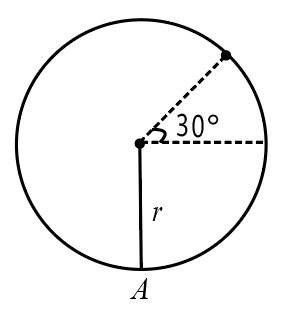
In case of vertical circular motion of a particle by a thread of length r if the tension in the thread is zero at an angle $$30^{\circ}$$ shown in figure, the velocity at the bottom point (A) of the circular path is
(g = gravitational acceleration)
NTA JEE Mains 24th Jan 2026 Shift 2 - Question 42
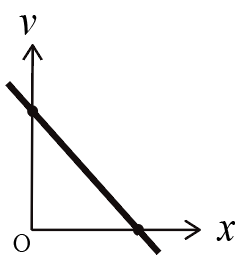
The velocity (v) - Distance (x) graph is shown in figure. Which graph represents accderation(a) versus distance (x) variation of this system?
NTA JEE Mains 24th Jan 2026 Shift 2 - Question 43
Distance between an object and three times magnified real image is 40 cm. The focal length of the minor used is ___ cm.

NTA JEE Mains 24th Jan 2026 Shift 2 - Question 44
A moving coil galvanometer of resistance $$100\Omega$$ shows a full scale deflection for a current of 1 mA. The value of resistance required to convert this galvanometer into an ammeter, showing full scale deflection for a current of 5 mA, is ____ $$\Omega$$
NTA JEE Mains 24th Jan 2026 Shift 2 - Question 45
Five persons $$P_{1},P_{2},P_{3},P{4}, \text{and} P_{5}$$ recorded object distance (u) and image distance (v) using same convex lens having powei· +5D as (25,96), (30,62), (35,37), (45,35)
and (50,32) respectively. Identify correct statement
NTA JEE Mains 24th Jan 2026 Shift 2 - Question 46
When 300 J of heat given to an ideal gas with $$C_{p}= \frac{7}{2}R$$ its temperature raises from $$20^{\circ}C$$ to $$50^{\circ}C$$ keeping its volume constant. The mass of the gas is (approximately) __ g. (R = 8.314 J/mol.K)
789
456
123
0.-
Clear All
NTA JEE Mains 24th Jan 2026 Shift 2 - Question 47
A uniform solid cylinder of length L and radius R has moment of inertia about its axis equal to $$I_{1}$$. A small co-centric cylinder of length L/2 and radius R/3 carved from this cylinder has moment of inertia about its axis equals to $$I_{2}$$. The ratio $$I_{1}/I_{2}$$ is __________.
789
456
123
0.-
Clear All
NTA JEE Mains 24th Jan 2026 Shift 2 - Question 48
A soap bubble of surface tension 0.04 N/m is blown to a diameter of 7 cm. If (15000 - x) $$\mu J$$ of work is done in blowing it further to make its diameterl4 cm, then the value of x is_____.
$$\left(\pi=22/7\right)$$
789
456
123
0.-
Clear All
NTA JEE Mains 24th Jan 2026 Shift 2 - Question 49
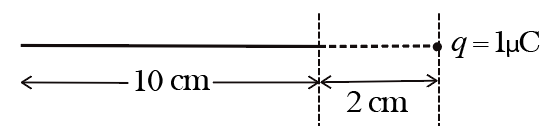
A point charge q = l $$\mu C$$ is located at a distance 2 cm from one end of a thin insulating wire of length 10 cm having a charge Q = 24 $$\mu C$$, distributed uniformly along its length, as shown in figure. Force between q and wire is __ N.
(Use: $$\frac{1}{4\pi\epsilon_{0}}=9 \times10^{9} N.m^{2}/C^{2}$$)
789
456
123
0.-
Clear All
NTA JEE Mains 24th Jan 2026 Shift 2 - Question 50
In a meter bridge experiment to determine the value of unknown resistance, first the resistances $$2\Omega$$ and $$3\Omega$$ are connected in the left and right gaps of the bridge and the null point is obtained at a distance l cm from the left. Now when an unknown resistance $$x\Omega$$ is connected in parallel to $$3\Omega$$ resistance, the null point is shifted by 10 cm to the right of wire. The value of unknown resistance x is __________ $$\Omega$$ .
789
456
123
0.-
Clear All