
Join Our JEE Preparation Group
Prep with like-minded aspirants; Get access to free daily tests and study material.
Sign in
Please select an account to continue using cracku.in
↓ →
Join Our JEE Preparation Group
Prep with like-minded aspirants; Get access to free daily tests and study material.
Let $$\overrightarrow{a}= 2\widehat{i}-\widehat{j}-\widehat{k}, \overrightarrow{b}=\widehat{i}+ 3\widehat{j}-\widehat{k}$$ and $$\overrightarrow{c} = 2\widehat{i}+\widehat{j}+3\widehat{k}.$$ Let $$\overrightarrow{\nu}$$ be the vector in the plane of the vectors $$\overrightarrow{a}$$ and $$\overrightarrow{b}$$, such that the length of its projection on the vector $$\overrightarrow{C}$$ is $$\frac{1}{\sqrt{14}}$$. Then $$\mid \overrightarrow{\nu} \mid$$ is euqal to
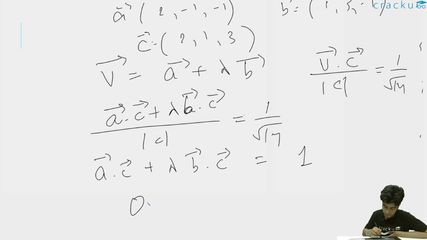
A vector lying in the plane of $$\overrightarrow{a}$$ and $$\overrightarrow{b}$$ can be written as a linear combination of the two,
$$\overrightarrow{\nu}= \overrightarrow{a}+ \lambda\,\overrightarrow{b} \qquad (\lambda \in \mathbb{R}).$$
The projection of $$\overrightarrow{\nu}$$ on $$\overrightarrow{c}$$ has length
$$\text{proj}_{\overrightarrow{c}}(\overrightarrow{\nu})=\frac{\left|\overrightarrow{\nu}\cdot\overrightarrow{c}\right|}{\left|\overrightarrow{c}\right|}.$$
First compute $$\left|\overrightarrow{c}\right|$$:
$$\overrightarrow{c}=2\widehat{i}+\widehat{j}+3\widehat{k}\;\;\Longrightarrow\;\;
\left|\overrightarrow{c}\right|=\sqrt{2^{2}+1^{2}+3^{2}}=\sqrt{14}.$$
Next evaluate the dot-products that will appear:
$$\overrightarrow{a}\cdot\overrightarrow{c}
=(2)(2)+(-1)(1)+(-1)(3)=4-1-3=0,$$
$$\overrightarrow{b}\cdot\overrightarrow{c}
=(1)(2)+(3)(1)+(-1)(3)=2+3-3=2.$$
Therefore
$$\overrightarrow{\nu}\cdot\overrightarrow{c} =(\overrightarrow{a}+\lambda\overrightarrow{b})\cdot\overrightarrow{c} =\overrightarrow{a}\cdot\overrightarrow{c} +\lambda\,\overrightarrow{b}\cdot\overrightarrow{c} =0+\lambda(2)=2\lambda.$$
The given condition on the projection is
$$\frac{\left|2\lambda\right|}{\sqrt{14}} =\frac{1}{\sqrt{14}} \;\;\Longrightarrow\;\; \left|2\lambda\right|=1 \;\;\Longrightarrow\;\; \lambda=\pm\frac12.$$
Choosing either sign (the magnitude will be the same), take
$$\overrightarrow{\nu}= \overrightarrow{a}+ \frac12\,\overrightarrow{b}.$$
Compute its magnitude:
$$\overrightarrow{\nu} =\left(2,-1,-1\right)+\frac12\left(1,3,-1\right) =\left(\frac52,\frac12,-\frac32\right).$$
Hence
$$\left|\overrightarrow{\nu}\right|^2
=\left(\frac52\right)^2+\left(\frac12\right)^2+\left(-\frac32\right)^2
=\frac{25}{4}+\frac{1}{4}+\frac{9}{4}
=\frac{35}{4},$$
$$\left|\overrightarrow{\nu}\right|
=\frac{\sqrt{35}}{2}.$$
Thus $$\mid\overrightarrow{\nu}\mid = \dfrac{\sqrt{35}}{2}.$$
Option D is correct.
Was this solution helpful?
Click on the Email ☝️ to Watch the Video Solution
Create a FREE account and get:
_1.webp)

Educational materials for JEE preparation

Ask our AI anything

AI can make mistakes. Please verify important information.
AI can make mistakes. Please verify important information.
