
Join Our JEE Preparation Group
Prep with like-minded aspirants; Get access to free daily tests and study material.
Sign in
Please select an account to continue using cracku.in
↓ →
Join Our JEE Preparation Group
Prep with like-minded aspirants; Get access to free daily tests and study material.
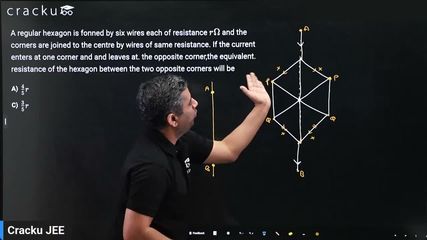
A regular hexagon is fonned by six wires each of resistance $$r \Omega$$ and the corners are joined to the centre by wires of same resistance. If the current enters at one corner and and leaves at. the opposite corner,the equivalent. resistance of the hexagon between the two opposite corners will be
Label the six vertices of the regular hexagon in order as $$A,\,B,\,C,\,D,\,E,\,F$$ and let the centre be $$O$$. Each side and each spoke (vertex-centre wire) has resistance $$r$$.
The current enters at vertex $$A$$ and leaves at the opposite vertex $$D$$.
Because the geometrical arrangement is symmetric about the line $$AD$$, the following potentials will be equal:
• $$V_B = V_F = x$$ (call this common potential $$x$$)
• $$V_C = V_E = y$$ (call this $$y$$)
• $$V_O = z$$ (centre potential)
Let the potential at $$A$$ be $$V_A = V$$ (unknown for now) and at $$D$$ be $$V_D = 0$$. We shall write Kirchhoff’s Current Law (KCL) at the three distinct internal potentials $$x,\,y,\,z$$. (All currents are taken as leaving the node, and each resistance is $$r$$.)
Case 1: Node $$B$$ (or $$F$$) at potential $$x$$
Connections: to $$A$$, $$C$$, $$O$$.
$$\frac{x - V}{r} + \frac{x - y}{r} + \frac{x - z}{r} = 0$$
Multiplying by $$r$$ gives:
$$3x - V - y - z = 0 \quad -(1)$$
Case 2: Node $$C$$ (or $$E$$) at potential $$y$$
Connections: to $$B$$, $$D$$, $$O$$.
$$\frac{y - x}{r} + \frac{y - 0}{r} + \frac{y - z}{r} = 0$$
Multiplying by $$r$$ gives:
$$3y - x - z = 0 \quad -(2)$$
Case 3: Centre $$O$$ at potential $$z$$
Connections: to all six vertices.
$$\frac{z - V}{r} + \frac{z - x}{r} + \frac{z - y}{r} + \frac{z - 0}{r} + \frac{z - y}{r} + \frac{z - x}{r} = 0$$
Grouping like terms and multiplying by $$r$$:
$$6z - V - 2x - 2y = 0 \quad -(3)$$
Solving the simultaneous equations
From $$-(1)$$: $$x = \frac{V + y + z}{3} \quad -(1a)$$
From $$-(2)$$: $$y = \frac{x + z}{3} \quad -(2a)$$
Substitute $$x$$ from $$(1a)$$ into $$(2a)$$:
$$y = \frac{\dfrac{V + y + z}{3} + z}{3} = \frac{V + y + 4z}{9}$$
$$\Rightarrow 9y = V + y + 4z \Longrightarrow 8y = V + 4z$$
$$\therefore \; y = \frac{V + 4z}{8} \quad -(4)$$
Put $$y$$ from $$(4)$$ into $$(1a)$$:
$$x = \frac{V + \dfrac{V + 4z}{8} + z}{3}
= \frac{9V + 12z}{24}
= \frac{3V + 4z}{8} \quad -(5)$$
Now use equation $$-(3)$$:
$$6z - V - 2x - 2y = 0$$
Insert $$x$$ and $$y$$ from $$-(5)$$ and $$-(4)$$:
$$6z - V - 2\!\left(\frac{3V + 4z}{8}\right) - 2\!\left(\frac{V + 4z}{8}\right)=0$$
$$\Longrightarrow 6z - V - \frac{3V + 4z}{4} - \frac{V + 4z}{4}=0$$
$$\Longrightarrow 6z - V - (V + 2z)=0$$
$$\Longrightarrow 4z - 2V=0 \;\; \Rightarrow\;\; z = \frac{V}{2}$$
Back-substitute $$z$$:
$$y = \frac{V + 4\!\left(\dfrac{V}{2}\right)}{8} = \frac{3V}{8}, \qquad x = \frac{3V + 4\!\left(\dfrac{V}{2}\right)}{8} = \frac{5V}{8}$$
Total current entering at $$A$$
Three resistors leave $$A$$: to $$B$$, $$O$$, $$F$$.
Hence
$$I = \frac{V - x}{r} + \frac{V - z}{r} + \frac{V - x}{r}
= \frac{2(V - x) + (V - z)}{r}$$
Substitute $$x = \dfrac{5V}{8}, \; z = \dfrac{V}{2}$$:
$$I = \frac{2\!\left(V - \dfrac{5V}{8}\right) + \left(V - \dfrac{V}{2}\right)}{r}
= \frac{2\!\left(\dfrac{3V}{8}\right) + \dfrac{V}{2}}{r}
= \frac{\dfrac{6V}{8} + \dfrac{4V}{8}}{r}
= \frac{\dfrac{10V}{8}}{r}
= \frac{5V}{4r}$$
Equivalent resistance
$$R_{\text{eq}} = \frac{V}{I} = \frac{V}{\dfrac{5V}{4r}} = \frac{4r}{5}$$
Therefore the equivalent resistance between the two opposite corners is $$\dfrac{4}{5}\,r$$.
Option A is correct.
Was this solution helpful?
Click on the Email ☝️ to Watch the Video Solution
Create a FREE account and get:
_1.webp)

Educational materials for JEE preparation

Ask our AI anything

AI can make mistakes. Please verify important information.
AI can make mistakes. Please verify important information.
