
Join Our JEE Preparation Group
Prep with like-minded aspirants; Get access to free daily tests and study material.
Sign in
Please select an account to continue using cracku.in
↓ →
Join Our JEE Preparation Group
Prep with like-minded aspirants; Get access to free daily tests and study material.
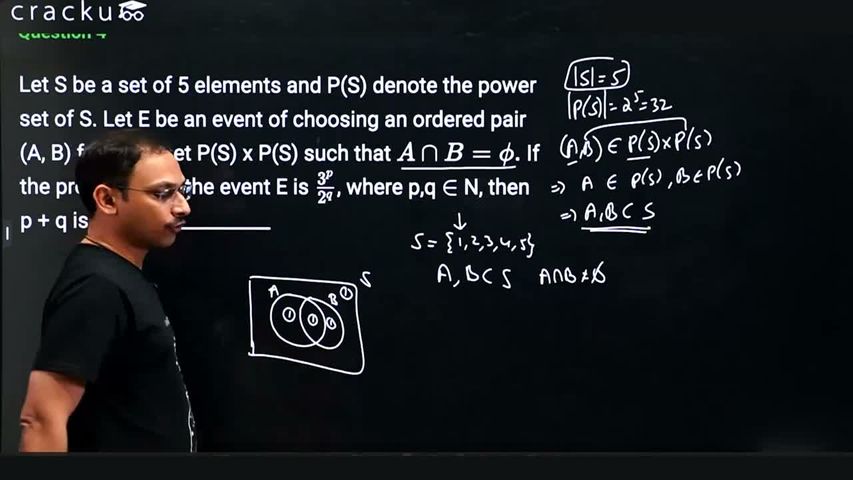
Let S be a set of 5 elements and P(S) denote the power set of S. Let E be an event of choosing an ordered pair (A, B) from the set P(S) x P(S) such that $$A\cap B=\phi.$$ If
the probability of the event E is $$\frac{3^{p}}{2^{q}}$$, where p,q $$\in$$ N, then p + q is equal to __________
Correct Answer: 15
$$S$$ has 5 elements. We choose an ordered pair $$(A, B)$$ from $$P(S) \times P(S)$$. We need the probability that $$A \cap B = \phi$$.
• Total Number of Pairs: Each set $$A$$ and $$B$$ is a subset of $$S$$. Since $$S$$ has 5 elements, $$P(S)$$ has $$2^5$$ elements. The total number of ordered pairs $$(A, B)$$ is $$2^5 \times 2^5 = 2^{10}$$.
• Favorable Outcomes: For each element $$x \in S$$, there are 4 possibilities for its "membership" in the pair $$(A, B)$$:
1. $$x \in A$$ and $$x \in B$$
2. $$x \in A$$ and $$x \notin B$$
3. $$x \notin A$$ and $$x \in B$$
4. $$x \notin A$$ and $$x \notin B$$
• For $$A \cap B = \phi$$, the first case ($$x$$ in both) is impossible. This leaves 3 choices for each of the 5 elements.
• Total favorable pairs $$= 3^5$$.
• Probability: $$P(E) = \frac{3^5}{2^{10}}$$.
• Comparing this to $$\frac{3^p}{2^q}$$, we get $$p = 5$$ and $$q = 10$$.
• Final Answer: $$p + q = 5 + 10 = \mathbf{15}$$.
Was this solution helpful?
Click on the Email ☝️ to Watch the Video Solution
Create a FREE account and get:
_1.webp)

Educational materials for JEE preparation

Ask our AI anything

AI can make mistakes. Please verify important information.
AI can make mistakes. Please verify important information.
