
Join Our JEE Preparation Group
Prep with like-minded aspirants; Get access to free daily tests and study material.
Sign in
Please select an account to continue using cracku.in
↓ →
Join Our JEE Preparation Group
Prep with like-minded aspirants; Get access to free daily tests and study material.
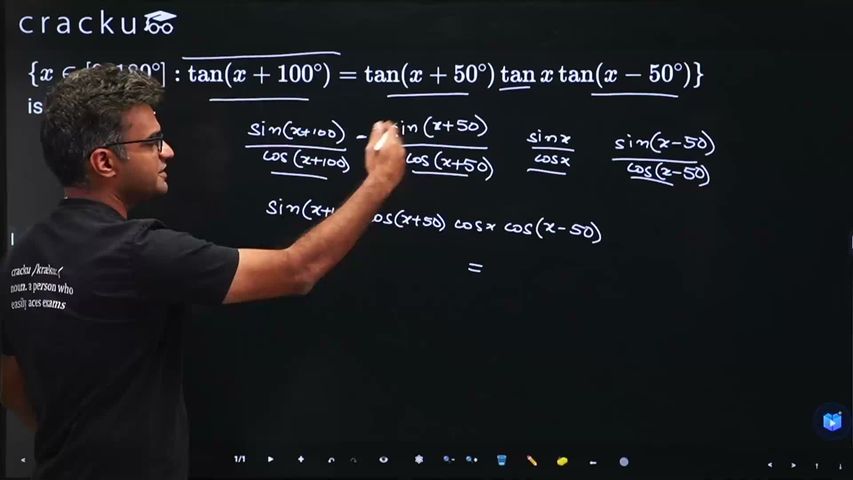
The number of elements in the set $$\left\{x \in [0,180^{\circ}]:\tan (x+100^{\circ}) = \tan (x+50^{\circ}) \tan x \tan(x-50^{\circ})\right\}$$ is ___________.
Correct Answer: 4
Step 1: Grouping and Converting to Sine and Cosine
We start by bringing the single tangent term to the denominator on the Left Hand Side to group our variables logically.
$$\frac{\tan(x + 100^\circ)}{\tan x} = \tan(x + 50^\circ) \tan(x - 50^\circ)$$
Next, we break everything down into sines and cosines using the fundamental identity $$\tan \theta = \frac{\sin \theta}{\cos \theta}$$.
For the Left Hand Side, we have a fraction divided by a fraction. When dividing by a fraction, we multiply by its reciprocal.
$$\text{Left Side} = \frac{\frac{\sin(x+100^\circ)}{\cos(x+100^\circ)}}{\frac{\sin x}{\cos x}}$$
$$\text{Left Side} = \frac{\sin(x+100^\circ)}{\cos(x+100^\circ)} \times \frac{\cos x}{\sin x} = \frac{\sin(x+100^\circ) \cos x}{\cos(x+100^\circ) \sin x}$$
For the Right Hand Side, we simply multiply two tangent fractions straight across the numerators and denominators.
$$\text{Right Side} = \left( \frac{\sin(x+50^\circ)}{\cos(x+50^\circ)} \right) \left( \frac{\sin(x-50^\circ)}{\cos(x-50^\circ)} \right) = \frac{\sin(x+50^\circ) \sin(x-50^\circ)}{\cos(x+50^\circ) \cos(x-50^\circ)}$$
Equating our newly expanded sides gives us our working foundation:
$$\frac{\sin(x+100^\circ) \cos x}{\cos(x+100^\circ) \sin x} = \frac{\sin(x+50^\circ) \sin(x-50^\circ)}{\cos(x+50^\circ) \cos(x-50^\circ)}$$
Step 2: Applying Componendo and Dividendo
If $$\frac{a}{b} = \frac{c}{d}$$, we can instantly rewrite it as $$\frac{a+b}{a-b} = \frac{c+d}{c-d}$$. This allows us to rapidly build standard trigonometric identities.
Processing the Left Hand Side:
The new numerator becomes $$a+b$$:
$$\sin(x+100^\circ) \cos x + \cos(x+100^\circ) \sin x = \sin(x+100^\circ + x) = \sin(2x + 100^\circ)$$
The new denominator becomes $$a-b$$:
$$\sin(x+100^\circ) \cos x - \cos(x+100^\circ) \sin x = \sin(x+100^\circ - x) = \sin 100^\circ$$
Processing the Right Hand Side:
The new numerator becomes $$c+d$$:
$$\sin(x+50^\circ) \sin(x-50^\circ) + \cos(x+50^\circ) \cos(x-50^\circ) = \cos((x+50^\circ) - (x-50^\circ)) = \cos 100^\circ$$
The new denominator becomes $$c-d$$:
$$\sin(x+50^\circ) \sin(x-50^\circ) - \cos(x+50^\circ) \cos(x-50^\circ)$$
$$= -[ \cos(x+50^\circ) \cos(x-50^\circ) - \sin(x+50^\circ) \sin(x-50^\circ) ] = -\cos(x+50^\circ + x-50^\circ) = -\cos 2x$$
Putting the new simplified fractions together, our massive equation shrinks down to:
$$\frac{\sin(2x + 100^\circ)}{\sin 100^\circ} = \frac{\cos 100^\circ}{-\cos 2x}$$
Step 3: Cross Multiplication and Double Angle Identities
Cross multiply to remove the fractions completely:
$$-\sin(2x + 100^\circ) \cos 2x = \sin 100^\circ \cos 100^\circ$$
Multiply both sides of the equation by 2. This perfectly sets up the product to sum formula $$2\sin A \cos B = \sin(A+B) + \sin(A-B)$$ on the left, and the double angle formula $$2\sin \theta \cos \theta = \sin 2\theta$$ on the right.
$$-2\sin(2x + 100^\circ) \cos 2x = 2\sin 100^\circ \cos 100^\circ$$
$$-[ \sin(2x + 100^\circ + 2x) + \sin(2x + 100^\circ - 2x) ] = \sin 200^\circ$$
$$-[ \sin(4x + 100^\circ) + \sin 100^\circ ] = \sin 200^\circ$$
Move $$\sin 100^\circ$$ to the other side to isolate our $$x$$ variable:
$$-\sin(4x + 100^\circ) = \sin 200^\circ + \sin 100^\circ$$
Step 4: Sum to Product Conversion
We simplify the right side using the formula $$\sin C + \sin D = 2\sin\left(\frac{C+D}{2}\right)\cos\left(\frac{C-D}{2}\right)$$:
$$\sin 200^\circ + \sin 100^\circ = 2\sin\left(\frac{300^\circ}{2}\right)\cos\left(\frac{100^\circ}{2}\right) = 2\sin 150^\circ \cos 50^\circ$$
Because $$\sin 150^\circ = \frac{1}{2}$$, this entire term collapses cleanly into just $$\cos 50^\circ$$.
$$-\sin(4x + 100^\circ) = \cos 50^\circ$$
$$\sin(4x + 100^\circ) = -\cos 50^\circ$$
Step 5: Solving for the Final Angles
To solve the equation, we need matching trigonometric functions. We must convert the negative cosine into a sine function.
$$-\cos 50^\circ = -\sin 40^\circ = \sin(-40^\circ)$$
This gives us our final trigonometric equation to solve:
$$\sin(4x + 100^\circ) = \sin(-40^\circ)$$
We plug this into the standard general solution formula $$\theta = n(180^\circ) + (-1)^n \alpha$$:
$$4x + 100^\circ = n(180^\circ) + (-1)^n (-40^\circ)$$
Now we test consecutive integer values for $$n$$ to discover the specific solutions that fit into the given interval between $$0^\circ$$ and $$180^\circ$$.
$$4x + 100^\circ = 180^\circ - (-40^\circ) = 220^\circ$$
$$4x = 120^\circ \implies x = 30^\circ$$
$$4x + 100^\circ = 360^\circ + (-40^\circ) = 320^\circ$$
$$4x = 220^\circ \implies x = 55^\circ$$
$$4x + 100^\circ = 540^\circ - (-40^\circ) = 580^\circ$$
$$4x = 480^\circ \implies x = 120^\circ$$
$$4x + 100^\circ = 720^\circ + (-40^\circ) = 680^\circ$$
$$4x = 580^\circ \implies x = 145^\circ$$
If we try $$n = 0$$, we get $$x = -35^\circ$$, and if we try $$n = 5$$, we get $$x = 210^\circ$$. Both of these fall strictly outside the required domain boundaries.
The valid angles are exactly $$30^\circ$$, $$55^\circ$$, $$120^\circ$$, and $$145^\circ$$.
The final number of elements in the set is 4.
Was this solution helpful?
Click on the Email ☝️ to Watch the Video Solution
Create a FREE account and get:
_1.webp)

Educational materials for JEE preparation

Ask our AI anything

AI can make mistakes. Please verify important information.
AI can make mistakes. Please verify important information.
