
Join Our JEE Preparation Group
Prep with like-minded aspirants; Get access to free daily tests and study material.
Sign in
Please select an account to continue using cracku.in
↓ →
Join Our JEE Preparation Group
Prep with like-minded aspirants; Get access to free daily tests and study material.
Consider the following gaseous equilibrimn in a closed container of volume 'V' at T(K).
$$P_{2}(g)+Q_{2}(g)\rightleftharpoons 2PQ(g)$$
2 moles each of $$P_{2}(g)$$, $$Q_{2}(g)$$ and PQ(g) are present at equilibrium. Now one mole each of'$$P_{2}$$' and '$$Q_{2}$$' are added to the equilibrium keeping the temperature at T(K). The number of moles of $$P_{2}$$, $$Q_{2}$$ and PQ at the new equilibrium, respectively, are
We need to find the new equilibrium moles after adding 1 mole each of P₂ and Q₂.
We first find the equilibrium constant for the reaction
$$P_2(g) + Q_2(g) \rightleftharpoons 2PQ(g)$$
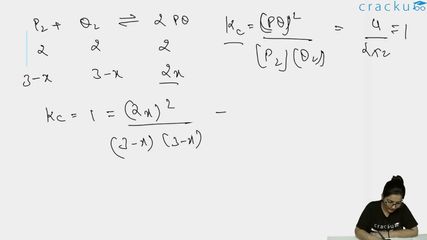
At equilibrium: [P₂] = 2/V, [Q₂] = 2/V, [PQ] = 2/V
$$K_c = \frac{[PQ]^2}{[P_2][Q_2]} = \frac{(2/V)^2}{(2/V)(2/V)} = 1$$
After adding 1 mol each of P₂ and Q₂, the initial moles are P₂ = 3, Q₂ = 3, PQ = 2.
Let x mol of P₂ react. Then at the new equilibrium, P₂ = 3-x, Q₂ = 3-x, PQ = 2+2x.
Using the equilibrium constant we have
$$K_c = \frac{(2+2x)^2/V^2}{((3-x)/V)((3-x)/V)} = \frac{(2+2x)^2}{(3-x)^2} = 1$$
This leads to
$$ (2+2x)^2 = (3-x)^2 $$
and hence
$$ 2+2x = \pm(3-x) $$
For the positive sign,
$$2+2x = 3-x \implies 3x = 1 \implies x = 1/3$$
The negative case gives $$2+2x = -(3-x) \implies 2+2x = -3+x \implies x = -5$$ which is rejected as unphysical.
Therefore, x = 1/3.
This means the new equilibrium amounts are
P₂ = 3 - 1/3 = 8/3 ≈ 2.67
Q₂ = 3 - 1/3 = 8/3 ≈ 2.67
PQ = 2 + 2/3 = 8/3 ≈ 2.67
Hence, the answer is Option 1: 2.67, 2.67, 2.67.
Was this solution helpful?
Click on the Email ☝️ to Watch the Video Solution
Create a FREE account and get:
_1.webp)

Educational materials for JEE preparation

Ask our AI anything

AI can make mistakes. Please verify important information.
AI can make mistakes. Please verify important information.
