
Join Our JEE Preparation Group
Prep with like-minded aspirants; Get access to free daily tests and study material.
Sign in
Please select an account to continue using cracku.in
↓ →
Join Our JEE Preparation Group
Prep with like-minded aspirants; Get access to free daily tests and study material.
If the domain of the function f(x) = $$\sin^{-1}\frac{1}{x^{2}-2x-2}$$, is $$\left[-\infty, \alpha\right] \cup \left[\beta,\gamma\right]\cup \left[\delta,\infty\right],$$ then $$\alpha+\beta+\gamma+\delta$$ is equal to
For the inverse-sine function to exist, its argument must lie in the closed interval $$[-1,\,1]$$.
Given $$f(x)=\sin^{-1}\!\left(\dfrac1{x^{2}-2x-2}\right)$$ we therefore require
$$-1 \;\le\; \dfrac1{x^{2}-2x-2}\;\le\; 1$$
and, of course, the denominator must not be zero:
$$x^{2}-2x-2\;\neq\;0.$$
Simplify the double inequality. Taking absolute values is the quickest route.
$$-1\;\le\;\dfrac1{x^{2}-2x-2}\;\le\;1 \;\Longleftrightarrow\; \left|\dfrac1{x^{2}-2x-2}\right|\;\le\;1 \;\Longleftrightarrow\; \dfrac1{|\,x^{2}-2x-2\,|}\;\le\;1$$
Since the reciprocal function is positive, we can invert both sides:
$$|\,x^{2}-2x-2\,|\;\ge\;1.$$
Let $$g(x)=x^{2}-2x-2=(x-1)^{2}-3.$$
The required condition becomes
$$|g(x)|\;\ge\;1.$$
This splits into two cases.
Case 1:
$$g(x)\;\ge\;1 \;\Longrightarrow\; x^{2}-2x-2\;\ge\;1 \;\Longrightarrow\; x^{2}-2x-3\;\ge\;0 \;\Longrightarrow\; (x+1)(x-3)\;\ge\;0.$$
The solution of $$(x+1)(x-3)\ge0$$ is
$$x\;\le\;-1\quad\text{or}\quad x\;\ge\;3.$$
Case 2:
$$g(x)\;\le\;-1 \;\Longrightarrow\; x^{2}-2x-2\;\le\;-1 \;\Longrightarrow\; x^{2}-2x-1\;\le\;0.$$
Solve $$x^{2}-2x-1=0$$:
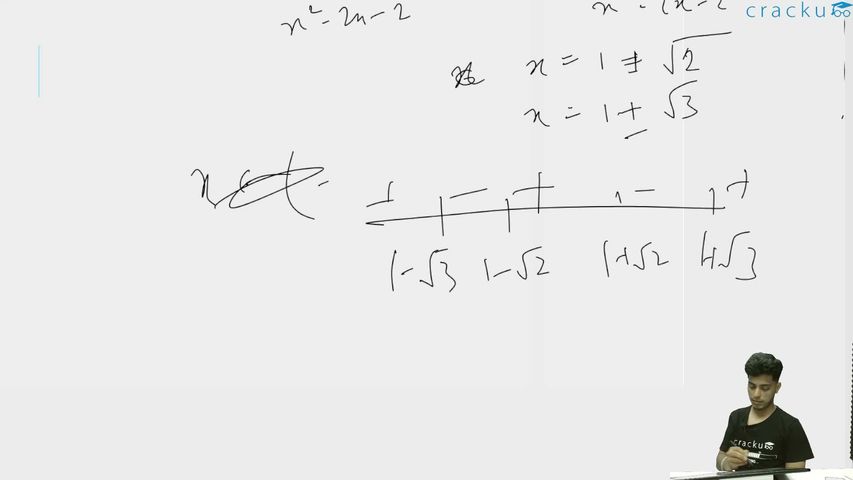
$$x=\dfrac{2\pm\sqrt{4+4}}{2}=1\pm\sqrt2.$$
A quadratic that opens upward is non-positive between its roots, so
$$1-\sqrt2\;\le\;x\;\le\;1+\sqrt2.$$
Combining both cases, and omitting the points where $$g(x)=0$$ (that is, $$x=1\pm\sqrt3$$), we get the complete domain:
$$(-\infty,\,-1] \;\cup\; [\,1-\sqrt2,\,1+\sqrt2\,] \;\cup\; [\,3,\,\infty).$$
Writing it in the prescribed form $$[-\infty,\,\alpha] \;\cup\; [\beta,\,\gamma] \;\cup\; [\delta,\,\infty),$$ we identify
$$\alpha=-1,\qquad \beta=1-\sqrt2,\qquad \gamma=1+\sqrt2,\qquad \delta=3.$$
The required sum is therefore
$$\alpha+\beta+\gamma+\delta =\;(-1)\;+\;(1-\sqrt2)\;+\;(1+\sqrt2)\;+\;3 =\;4.$$
Hence $$\alpha+\beta+\gamma+\delta=4,$$ which corresponds to Option B.
Was this solution helpful?
Click on the Email ☝️ to Watch the Video Solution
Create a FREE account and get:
_1.webp)

Educational materials for JEE preparation

Ask our AI anything

AI can make mistakes. Please verify important information.
AI can make mistakes. Please verify important information.
