
Join Our JEE Preparation Group
Prep with like-minded aspirants; Get access to free daily tests and study material.
Sign in
Please select an account to continue using cracku.in
↓ →
Join Our JEE Preparation Group
Prep with like-minded aspirants; Get access to free daily tests and study material.
Let f(a) denote the area of the region in the first quadrant bounded by x = 0, x = 1, $$y^{2}=x$$ and y = |ax - 5| - |1 - ax| + $$ax^{2}$$. Then (f(0) + f(1)) is equal
We need to find f(0) + f(1), where f(a) is the area in the first quadrant bounded by x = 0, x = 1, $$y^2 = x$$, and $$y = |ax - 5| - |1 - ax| + ax^2$$.
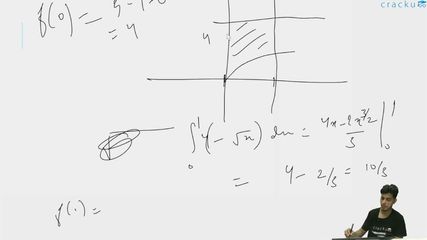
When a = 0, the expression for y becomes $$y = |0 - 5| - |1 - 0| + 0 = 5 - 1 = 4$$, so the boundary is the horizontal line y = 4. In the first quadrant the curve $$y^2 = x$$ corresponds to $$y = \sqrt{x}$$, which for x in [0,1] takes values from 0 to 1 and thus lies below y = 4. The area f(0) is therefore given by
$$f(0) = \int_0^1 (4 - \sqrt{x})\,dx = \left[4x - \frac{2x^{3/2}}{3}\right]_0^1 = 4 - \frac{2}{3} = \frac{10}{3}$$
When a = 1, the expression for y becomes $$y = |x - 5| - |1 - x| + x^2$$. For x in [0,1], we have x - 5 < 0 so |x-5| = 5-x, and 1 - x ≥ 0 so |1-x| = 1-x. Hence
$$y = (5-x) - (1-x) + x^2 = 4 + x^2$$, which on [0,1] ranges from 4 to 5, again lying above $$\sqrt{x}$$. The area f(1) is then
$$f(1) = \int_0^1 (4 + x^2 - \sqrt{x})\,dx = \left[4x + \frac{x^3}{3} - \frac{2x^{3/2}}{3}\right]_0^1 = 4 + \frac{1}{3} - \frac{2}{3} = 4 - \frac{1}{3} = \frac{11}{3}$$
Adding these results gives
$$f(0) + f(1) = \frac{10}{3} + \frac{11}{3} = \frac{21}{3} = 7$$
The answer is Option 3: 7.
Was this solution helpful?
Click on the Email ☝️ to Watch the Video Solution
Create a FREE account and get:
_1.webp)

Educational materials for JEE preparation

Ask our AI anything

AI can make mistakes. Please verify important information.
AI can make mistakes. Please verify important information.
