
Join Our JEE Preparation Group
Prep with like-minded aspirants; Get access to free daily tests and study material.
Sign in
Please select an account to continue using cracku.in
↓ →
Join Our JEE Preparation Group
Prep with like-minded aspirants; Get access to free daily tests and study material.
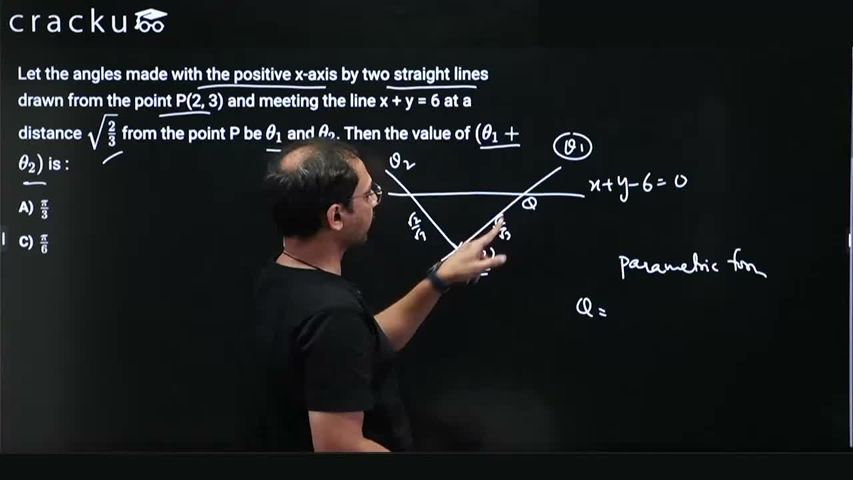
Let the angles made with the positive x-axis by two straight lines drawn from the point P(2, 3) and meeting the line x + y = 6 at a distance $$\sqrt{\frac{2}{3}}$$ from the point P be $$\theta_{1}$$ and $$\theta_{2}$$. Then the value of $$(\theta_{1}+\theta_{2})$$ is :
We wish to determine the sum $$\theta_1 + \theta_2$$ of the two angles formed by lines drawn from the point $$P(2,3)$$ to the line $$x + y = 6$$ such that the distance from $$P$$ to each intersection is $$\sqrt{2/3}$$.
A line through $$P(2,3)$$ making an angle $$\theta$$ with the x-axis contains points at a distance $$r$$ from $$P$$ of the form $$(2 + r\cos\theta,\; 3 + r\sin\theta).$$ Imposing the condition that these points lie on $$x + y = 6$$ gives $$2 + r\cos\theta + 3 + r\sin\theta = 6,$$ so $$r(\cos\theta + \sin\theta) = 1.$$
Substituting $$r = \sqrt{2/3}$$ yields $$\sqrt{2/3}(\cos\theta + \sin\theta) = 1,$$ from which $$\cos\theta + \sin\theta = \sqrt{3/2}.$$
Using the identity $$\cos\theta + \sin\theta = \sqrt{2}\,\sin\!\Bigl(\theta + \tfrac{\pi}{4}\Bigr)$$ we obtain $$\sqrt{2}\,\sin\!\Bigl(\theta + \tfrac{\pi}{4}\Bigr) = \sqrt{3/2},$$ so $$\sin\!\Bigl(\theta + \tfrac{\pi}{4}\Bigr) = \tfrac{\sqrt{3}}{2}.$$ This leads to $$\theta + \tfrac{\pi}{4} = \tfrac{\pi}{3}\quad\text{or}\quad \theta + \tfrac{\pi}{4} = \tfrac{2\pi}{3},$$ and hence $$\theta_1 = \tfrac{\pi}{3} - \tfrac{\pi}{4} = \tfrac{\pi}{12}\quad\text{and}\quad\theta_2 = \tfrac{2\pi}{3} - \tfrac{\pi}{4} = \tfrac{5\pi}{12}.$$
It follows that $$\theta_1 + \theta_2 = \tfrac{\pi}{12} + \tfrac{5\pi}{12} = \tfrac{6\pi}{12} = \tfrac{\pi}{2}.$$ Therefore, $$\theta_1 + \theta_2 = \text{Option 4: }\tfrac{\pi}{2}.$$
Was this solution helpful?
Click on the Email ☝️ to Watch the Video Solution
Create a FREE account and get:
_1.webp)

Educational materials for JEE preparation

Ask our AI anything

AI can make mistakes. Please verify important information.
AI can make mistakes. Please verify important information.
