
Join Our JEE Preparation Group
Prep with like-minded aspirants; Get access to free daily tests and study material.
Sign in
Please select an account to continue using cracku.in
↓ →
Join Our JEE Preparation Group
Prep with like-minded aspirants; Get access to free daily tests and study material.
The letters of the word "UDAYPUR" are written in all possible ways with or without meaning and these words are arranged as in a dictionary. The rank of the word "UDAYPUR" is
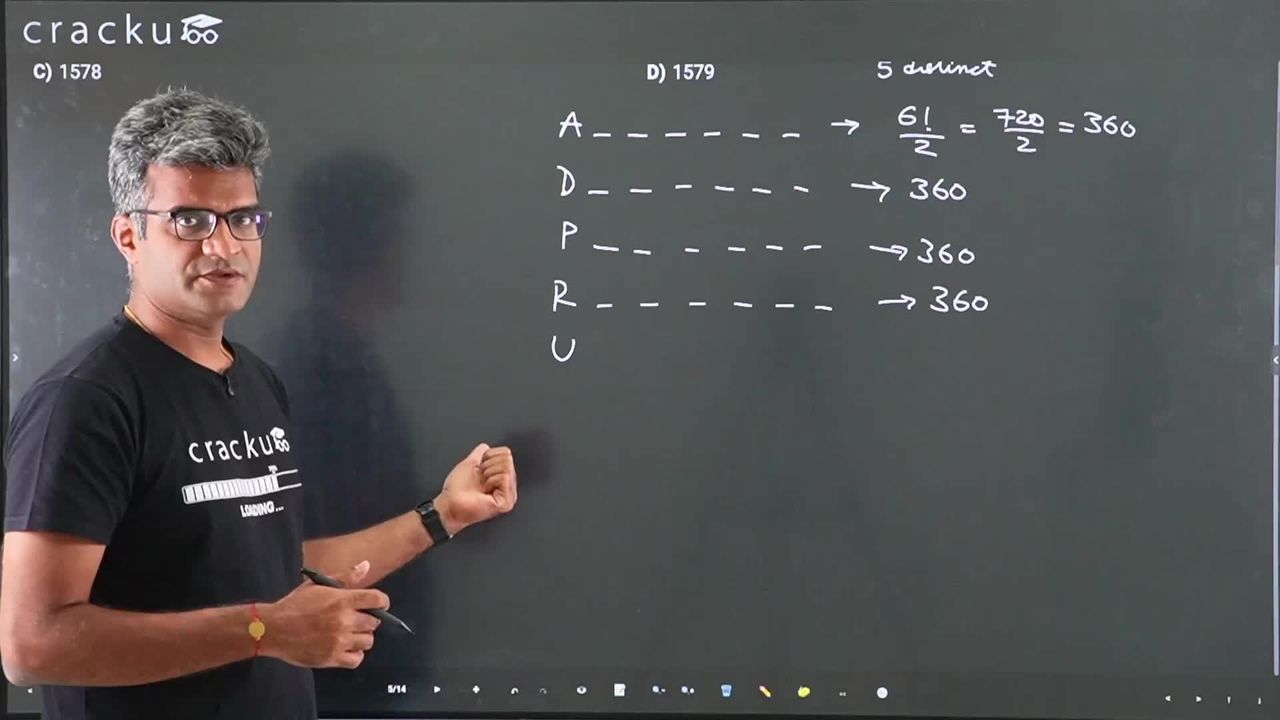
When the letters of the word "UDAYPUR" are arranged in alphabetical order, we get A, D, P, R, U, U, Y.
We need to find the rank of the word "UDAYPUR" out of all the words formed by arranging the above letters.
Number of words formed with first letter as A$$=\dfrac{6!}{2!}$$ (because all the 6 letters can be arranged in 6! ways and there are 2 U's, so dividing by 2!)
Number of words formed with first letter as D$$=\dfrac{6!}{2!}$$ (because all the 6 letters can be arranged in 6! ways and there are 2 U's, so dividing by 2!)
Number of words formed with first letter as P$$=\dfrac{6!}{2!}$$ (because all the 6 letters can be arranged in 6! ways and there are 2 U's, so dividing by 2!)
Number of words formed with first letter as P$$=\dfrac{6!}{2!}$$ (because all the 6 letters can be arranged in 6! ways and there are 2 U's, so dividing by 2!)
Number of words formed with first two letters as UA $$=5!$$ (because all the 5 letters left can be arranged in 5! ways)
Number of words formed with first four letters as UDAP $$=3!$$ (because all the 3 letters left can be arranged in 3! ways)
Number of words formed with first four letters as UDAR $$=3!$$ (because all the 3 letters left can be arranged in 3! ways)
Number of words formed with first four letters as UDAU $$=3!$$ (because all the 3 letters left can be arranged in 3! ways)
Number of words formed with the first six letters as UDAYPR $$=1$$ (which is UDAYPRU)
All the above words precede the word "UDAYPUR" when arranged in a dictionary, and to get the rank, we need to add all the above values and 1 to it, since it is the next word.
The next word formed is "UDAYPUR", and the rank of it can be calculated as,
Rank $$=\dfrac{6!}{2!}+\dfrac{6!}{2!}+\dfrac{6!}{2!}+\dfrac{6!}{2!}+5!+3!+3!+3!+1+1=360\times\ 4+120+6\times\ 3+2=1580$$
So, the rank of the word is 1580.
Hence, the correct answer is option A.
Was this solution helpful?
Click on the Email ☝️ to Watch the Video Solution
Create a FREE account and get:
_1.webp)

Educational materials for JEE preparation

Ask our AI anything

AI can make mistakes. Please verify important information.
AI can make mistakes. Please verify important information.
