
Join Our JEE Preparation Group
Prep with like-minded aspirants; Get access to free daily tests and study material.
Sign in
Please select an account to continue using cracku.in
↓ →
Join Our JEE Preparation Group
Prep with like-minded aspirants; Get access to free daily tests and study material.
A thin uniform rod X of mass M and length L is pivoted at a height $$(\frac{L}{3})$$ as shown in the figure. The rod is allowed to fall from a vertical position and lie horizontally on the table. The angular velocity of this rod when it hits the table top, is __________.
(g is the acceleration due to gravity)
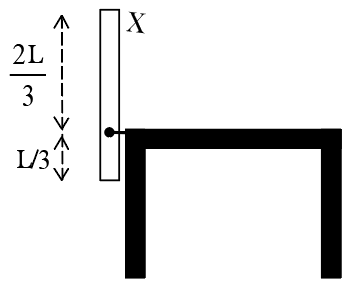
Moment of Inertia about the Pivot ($$I_P$$):
The rod is pivoted at a distance of $$L/3$$ from the bottom. The center of mass (CM) of the rod is at its midpoint, $$L/2$$ from the bottom.
The distance ($$d$$) between the pivot and the center of mass is:
$$d = \frac{L}{2} - \frac{L}{3} = \frac{L}{6}$$
Using the Parallel Axis Theorem:
$$I_P = I_{cm} + Md^2$$
$$I_P = \frac{1}{12}ML^2 + M\left(\frac{L}{6}\right)^2$$
$$I_P = \frac{1}{12}ML^2 + \frac{1}{36}ML^2 = \frac{1}{9}ML^2$$
Change in Potential Energy ($$\Delta PE$$):
When the rod falls from the vertical position to the horizontal position, the center of mass descends by a vertical height equal to its initial distance from the pivot.
$$\Delta h = d = \frac{L}{6}$$
$$\Delta PE = Mg\Delta h = Mg\left(\frac{L}{6}\right)$$
Conservation of Energy:
$$\Delta PE = \Delta KE_{rot}$$
$$Mg\left(\frac{L}{6}\right) = \frac{1}{2} I_P \omega^2$$
$$Mg\frac{L}{6} = \frac{1}{2} \left(\frac{1}{9}ML^2\right) \omega^2$$
$$\omega = \sqrt{\frac{3g}{L}}$$
Was this solution helpful?
Create a FREE account and get:
_1.webp)

Educational materials for JEE preparation

Ask our AI anything

AI can make mistakes. Please verify important information.
AI can make mistakes. Please verify important information.
