Dimensional formula for thermal conductivity is (here K denotes the temperature):

Join Our JEE Preparation Group
Prep with like-minded aspirants; Get access to free daily tests and study material.
Sign in
Please select an account to continue using cracku.in
↓ →
Join Our JEE Preparation Group
Prep with like-minded aspirants; Get access to free daily tests and study material.
Dimensional formula for thermal conductivity is (here K denotes the temperature):
Login to view the detailed solution.
A tennis ball is released from a height h and after freely falling on a wooden floor it rebounds and reaches height h/2. The velocity versus height of the ball during its motion may be represented graphically by: (graphs are drawn schematically and on not to scale)
Loading solution...
Starting from the origin at time t = 0, with initial velocity $$5\hat{j}$$ ms$$^{-1}$$, a particle moves in the $$x$$-$$y$$ plane with a constant acceleration of $$\left(10\hat{i} + 4\hat{j}\right)$$ ms$$^{-2}$$. At time t, its coordinates are (20 m, $$y_0$$ m). The values of t and $$y_0$$ are, respectively:
Loading solution...
.webp)
Blocks of masses m, 2m, 4m and 8m are arranged in a line of a frictionless floor. Another block of mass m, moving with speed v along the same line (see figure) collides with mass m in perfectly inelastic manner. All the subsequent collisions are also perfectly inelastic. By the time the last block of mass 8m starts moving the total energy loss is p% of the original energy. Value of 'p' is close to:

Loading solution...
On the $$x$$-axis and at a distance $$x$$ from the origin, the gravitational field due to a mass distribution is given by $$\frac{Ax}{(x^2 + a^2)^{3/2}}$$ in the $$x$$-direction. The magnitude of the gravitational potential on the $$x$$-axis at a distance $$x$$, taking its value to be zero at infinity is:
Loading solution...
An air bubble of radius 1 cm in water has an upward acceleration of 9.8 cms$$^{-2}$$. The density of water is 1 gm cm$$^{-3}$$ and water offers negligible drag force on the bubble. The mass of the bubble is $$(g = 980$$ cm/s$$^2)$$.
Loading solution...
The specific heat of water = 4200 J kg$$^{-1}$$ K$$^{-1}$$ and the latent heat of ice = $$3.4 \times 10^5$$ J kg$$^{-1}$$. 100 grams of ice at 0°C is placed in 200 g of water at 25°C. The amount of ice that will melt as the temperature of water reaches 0°C is close to (in grams)
Loading solution...
Match the $$\frac{C_p}{C_v}$$ ratio for ideal gases with different type of molecules:
Molecule Type $$C_p/C_v$$
(A) Monoatomic (I) 7/5
(B) Diatomic rigid molecules (II) 9/7
(C) Diatomic non-rigid molecules (III) 4/3
(D) Triatomic rigid molecules (IV) 5/3
Loading solution...
For a transverse wave travelling along a straight line, the distance between two peaks (crests) is 5 m, while the distance between one crest and one trough is 1.5 m. The possible wavelengths (in m) of the waves are:
Loading solution...
Two charged thin infinite plane sheets of uniform charge density $$\sigma_+$$ and $$\sigma_-$$, where $$|\sigma_+| > |\sigma_-|$$, intersect at the right angle. Which of the following best represents the electric field lines for the system:
Loading solution...
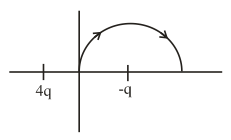
A two point charges $$4q$$ and $$-q$$ are fixed on the $$x$$-axis at $$x = \frac{-d}{2}$$ and $$x = \frac{d}{2}$$, respectively. If the third point charge 'q' is taken from the origin to $$x = d$$ along the semicircle as shown in the figure, the energy of the charge will:
Loading solution...
A battery of 3.0 V is connected to a resistor dissipating 0.5 W of power. If the terminal voltage of the battery is 2.5 V, the power dissipated within the internal resistance is:
Loading solution...
A small bar magnet is placed with its axis at 30° with an external magnetic field of 0.06 T experiences a torque of 0.018 Nm. The minimum work required to rotate it from its stable to unstable equilibrium position is:
Loading solution...
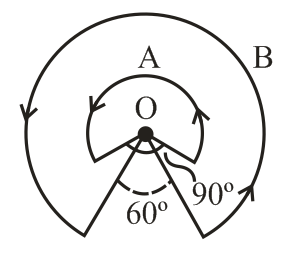
A wire A, bent in the shape of an arc of a circle, carrying a current of 2 A and having radius 2 cm and another wire B, also bent in the shape of an arc of a circle, carrying a current of 3 A and having radius of 4 cm, are placed as shown in the figure. The ratio of the magnetic fields due to the wires A and B at the common centre O is:
Loading solution...
A small bar magnet is moved through a coil at constant speed from one end to the other. Which of the following series of observations will be seen on the galvanometer G attached across the coil?
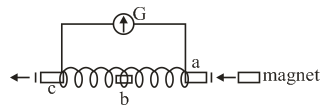
Three positions shown describe: (a) the magnet's entry (b) magnet is completely inside and (c) magnet's exit.
Loading solution...
Choose the correct option relating wavelengths of different parts of electromagnetic wave spectrum:
Loading solution...
A beam of plane polarized light of large cross-sectional area and uniform intensity of 3.3 W m$$^{-2}$$ falls normally on a polarizer (cross-sectional area $$3 \times 10^{-4}$$ m$$^2$$), which rotates about its axis with an angular speed of 31.4 rad s$$^{-1}$$. The energy of light passing through the polarizer per revolution, is close to:
Loading solution...
Particle A of mass $$m_A = \frac{m}{2}$$ moving along the x-axis with velocity $$v_0$$ collides elastically with another particle B at rest having mass $$m_B = \frac{m}{3}$$. If both particles move along the x-axis after the collision, the change $$\Delta\lambda$$ in the wavelength of particle A, in terms of its de-Broglie wavelength $$(\lambda_0)$$ before the collision is:
Loading solution...
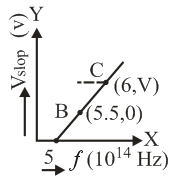
Given figure shows few data points in a photo-electric effect experiment for a certain metal. The minimum energy for ejection of electrons from its surface is: (Planck's constant h = 6.62 $$\times$$ 10$$^{-34}$$ J.s)
Loading solution...
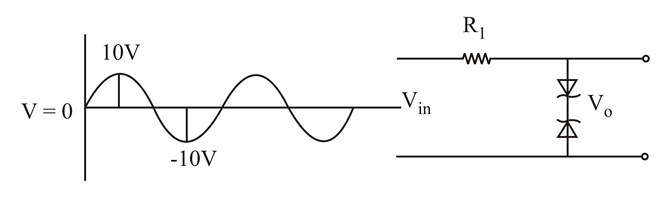
Take the breakdown voltage of the zener diode used in the given circuit as 6V. For the input voltage shown in the figure below, the time variation of the output voltage is: (Graphs drawn are schematic and not to the scale)
Loading solution...
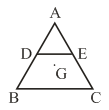
ABC is a plane lamina of the shape of an equilateral triangle. D, E are mid-points of AB, AC and G is the centroid of the lamina. Moment of inertia of the lamina about an axis passing through G and perpendicular to the plane ABC is $$I_0$$. If part ADE is removed, the moment of inertia of the remaining part about the same axis is $$\frac{NI_0}{16}$$ where N is an integer. Value of N is:
Loading solution...
A circular disc of mass M and radius R is rotating about its axis with angular speed $$\omega_1$$. If another stationary disc having radius $$\frac{R}{2}$$ and same mass M is dropped co-axially on to the rotating disc. Gradually both discs attain constant angular speed $$\omega_2$$. The energy lost in the process is p% of the initial energy. Value of p is
Loading solution...
A closed vessel contains 0.1 mole of a monoatomic ideal gas at 200 K. If 0.05 mole of the same gas at 400 K is added to it, the final equilibrium temperature (in K) of the gas in the vessel will be close to __________
Loading solution...
In a compound microscope, the magnified virtual image is formed at a distance of 25 cm from the eye-piece. The focal length of its objective lens is 1 cm. If the magnification is 100 and the tube length of the microscope is 20 cm, then the focal length of the eye-piece lens (in cm) is __________
Loading solution...
In the line spectra of hydrogen atom, difference between the largest and the shortest wavelengths of the Lyman series is 305 $$\mathring{A}$$. The corresponding difference for the Paschan series in $$\mathring{A}$$ is __________ (nearest integer)
Loading solution...
The region in the electromagnetic spectrum where the Balmer series lines appear is:
Loading solution...
The elements with atomic numbers 101 and 104 belong to, respectively:
Loading solution...
The ionic radii of $$O^{2-}$$, $$F^-$$, $$Na^+$$ and $$Mg^{2+}$$ are in the order:
Loading solution...
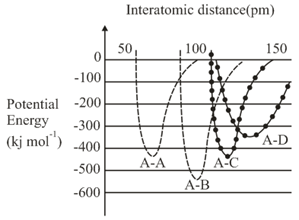
The intermolecular potential energy for the molecules A, B, C and D given below suggests that:
Loading solution...
For one mole of an ideal gas, which of these statements must be true?
(a) Internal energy (U) and enthalpy (H) each depends on temperature.
(b) Compressibility factor Z is not equal to 1
(c) $$C_{P,m} - C_{V,m} = R$$
(d) $$dU = C_v dT$$ for any process
Loading solution...
On combustion of Li, Na and K in excess of air, the major oxides formed, respectively, are:
Loading solution...
On heating, lead (II) nitrate gives a brown gas (A). The gas (A) on cooling changes to a colourless solid/liquid (B). (B) on heating with NO changes to a blue solid (C). The oxidation number of nitrogen in solid (C) is:
Loading solution...
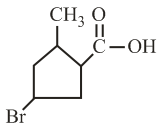
The IUPAC name of the following compound is:
Loading solution...
The decreasing order of reactivity of the following organic molecules towards AgNO$$_3$$ solution is:
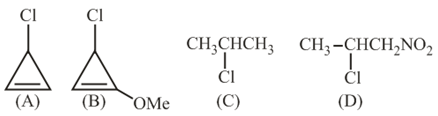
Loading solution...
Identify the incorrect statement from the options below for the above cell:
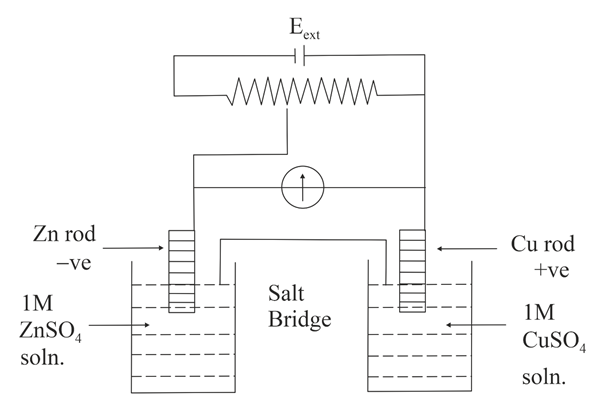
$$E^0_{Cu^{2+}|Cu} = +0.34$$ V,
$$E^0_{Zn^{2+}|Zn} = -0.76$$ V
Loading solution...
For the equilibrium $$A \rightleftharpoons B$$, the variation of the rate of the forward (a) and reverse (b) reaction with time is given by:
Loading solution...
Match the following:
(i) Foam (a) smoke
(ii) Gel (b) cell fluid
(iii) Aerosol (c) jellies
(iv) Emulsion (d) rubber
(e) froth
(f) milk
Loading solution...
Among statements (a) - (d), the correct ones are:
(a) Lime stone is decomposed to CaO during the extraction of iron from its oxides.
(b) In the extraction of silver, silver is extracted as an anionic complex.
(c) Nickel is purified by Mond's process.
(d) Zr and Ti are purified by Van Arkel method.
Loading solution...
The number of isomers possible for $$[Pt(en)(NO_2)_2]$$ is:
Loading solution...
The pair in which both the species have the same magnetic moment (spin only) is:
Loading solution...
An organic compound (A) (molecular formula $$C_6H_{12}O_2$$) was hydrolysed with dil. $$H_2SO_4$$ to give a carboxylic acid (B) and an alcohol (C). 'C' gives white turbidity immediately when treated with anhydrous $$ZnCl_2$$ and conc. HCl. The organic compound (A) is:
Loading solution...
When neopentyl alcohol is heated with an acid, it slowly converted into an 85:15 mixture of alkenes A and B, respectively. What are these alkenes?
Loading solution...
[P] on treatment with $$Br_2/FeBr_3$$ in $$CCl_4$$ produced a single isomer $$C_8H_7O_2Br$$ while heating [P] with sodalime gives toluene. The compound [P] is:
Loading solution...
Which of the following will react with $$CHCl_3$$ + alc. KOH?
Loading solution...
What are the functional groups present in the structure of maltose?
Loading solution...
The mass of ammonia in grams produced when 2.8 kg of dinitrogen quantitatively reacts with 1 kg of dihydrogen is __________
Loading solution...
A 20.0 mL solution containing 0.2 g impure $$H_2O_2$$ reacts completely with 0.316 g of $$KMnO_4$$ in acid solution. The purity of $$H_2O_2$$ (in %) is __________ (mol. wt. of $$H_2O_2$$ = 34; mol. wt. of $$KMnO_4$$ = 158)
Loading solution...
At 300 K, the vapour pressure of a solution containing 1 mole of n-hexane and 3 moles of n-heptane is 550 mm of Hg. At the same temperature, if one more mole of n-heptane is added to this solution, the vapour pressure of the solution increases by 10 mm of Hg. What is the vapour pressure in mmHg of n-heptane in its pure state?
Loading solution...
If 75% of a first order reaction was completed in 90 minutes, 60% of the same reaction would be completed in approximately (in minutes) __________ (Take: log 2 = 0.30; log 2.5 = 0.40)
Loading solution...
The number of chiral centres present in [B] is __________

Loading solution...
Let [t] denote the greatest integer $$\leq$$ t. Then the equation in x, $$[x]^2 + 2[x+2] - 7 = 0$$ has:
Loading solution...
Let $$\alpha$$ and $$\beta$$ be the roots of $$x^2 - 3x + p = 0$$ and $$\gamma$$ and $$\delta$$ be the roots of $$x^2 - 6x + q = 0$$. If $$\alpha, \beta, \gamma, \delta$$ form a geometric progression. Then ratio $$(2q + p) : (2q - p)$$ is
Loading solution...
Let $$u = \frac{2z+i}{z-ki}$$, $$z = x + iy$$ and $$k \gt 0$$. If the curve represented by Re(u) + Im(u) = 1 intersects the y-axis at points P and Q where PQ = 5 then the value of k is
Loading solution...
If $$1 + (1 - 2^2 \cdot 1) + (1 - 4^2 \cdot 3) + (1 - 6^2 \cdot 5) + \ldots + (1 - 20^2 \cdot 19) = \alpha - 220\beta$$, then an ordered pair $$(\alpha, \beta)$$ is equal to:
Loading solution...
The value of $$\sum_{r=0}^{20} {}^{50-r}C_6$$ is equal to:
Loading solution...
A triangle ABC lying in the first quadrant has two vertices as $$A(1, 2)$$ and $$B(3, 1)$$. If $$\angle BAC = 90°$$, and ar($$\triangle ABC$$) = $$5\sqrt{5}$$ sq. units, then the abscissa of the vertex C is:
Loading solution...
Let $$\frac{x^2}{a^2} + \frac{y^2}{b^2} = 1$$ $$(a > b)$$ be a given ellipse, length of whose latus rectum is 10. If its eccentricity is the maximum value of the function, $$\phi(t) = \frac{5}{12} + t - t^2$$, then $$a^2 + b^2$$ is equal to:
Loading solution...
Let $$P(3, 3)$$ be a point on the hyperbola, $$\frac{x^2}{a^2} - \frac{y^2}{b^2} = 1$$. If the normal to it at P intersects the $$x$$-axis at (9, 0) and $$e$$ is its eccentricity, then the ordered pair $$(a^2, e^2)$$ is equal to:
Loading solution...
Given the following two statements:
$$(S_1)$$ : $$(q \vee p) \to (p \leftrightarrow \sim q)$$ is a tautology
$$(S_2)$$ : $$\sim q \wedge (\sim p \leftrightarrow q)$$ is a fallacy. Then:
Loading solution...
The mean and variance of 8 observations are 10 and 13.5, respectively. If 6 of these observations are 5, 7, 10, 12, 14, 15, then the absolute difference of the remaining two observations is:
Loading solution...
Two vertical poles AB = 15 m and CD = 10 m are standing apart on a horizontal ground with points A and C on the ground. If P is the point of intersection of BC and AD, then the height of P (in m) above the line AC is:
Loading solution...
A survey shows that 63% of the people in a city read newspaper A whereas 76% read news paper B. If $$x$$% of the people read both the newspapers, then a possible value of $$x$$ can be:
Loading solution...
If $$A = \begin{bmatrix} \cos\theta & i\sin\theta \\ i\sin\theta & \cos\theta \end{bmatrix}$$, $$(\theta = \frac{\pi}{24})$$ and $$A^5 = \begin{bmatrix} a & b \\ c & d \end{bmatrix}$$, where $$i = \sqrt{-1}$$, then which one of the following is not true?
Loading solution...
If $$\left(a + \sqrt{2b}\cos x\right)\left(a - \sqrt{2b}\cos y\right) = a^2 - b^2$$, where $$a > b > 0$$, then $$\frac{dx}{dy}$$ at $$\left(\frac{\pi}{4}, \frac{\pi}{4}\right)$$ is:
Loading solution...
Let $$f$$ be a twice differentiable function on $$(1, 6)$$, If $$f(2) = 8$$, $$f'(2) = 5$$, $$f'(x) \geq 1$$ and $$f''(x) \geq 4$$, for all $$x \in (1, 6)$$, then:
Loading solution...
The integral $$\int \left(\frac{x}{x\sin x + \cos x}\right)^2 dx$$ is equal to, (where C is a constant of integration):
Loading solution...
Let $$f(x) = \int \frac{\sqrt{x}}{(1+x)^2} dx$$ $$(x \geq 0)$$. Then $$f(3) - f(1)$$ is equal to:
Loading solution...
Let $$f(x) = |x - 2|$$ and $$g(x) = f(f(x))$$, $$x \in [0, 4]$$. Then $$\int_0^3 (g(x) - f(x)) dx$$ is equal to
Loading solution...
Let $$y = y(x)$$ be the solution of the differential equation, $$xy' - y = x^2(x\cos x + \sin x)$$, $$x > 0$$. If $$y(\pi) = \pi$$, then $$y''\left(\frac{\pi}{2}\right) + y\left(\frac{\pi}{2}\right)$$ is equal to:
Loading solution...
Let $$x_0$$ be the point of local maxima of $$f(x) = \vec{a} \cdot (\vec{b} \times \vec{c})$$, where $$\vec{a} = x\hat{i} - 2\hat{j} + 3\hat{k}$$, $$\vec{b} = -2\hat{i} + x\hat{j} - \hat{k}$$ and $$\vec{c} = 7\hat{i} - 2\hat{j} + x\hat{k}$$. Then the value of $$\vec{a} \cdot \vec{b} + \vec{b} \cdot \vec{c} + \vec{c} \cdot \vec{a}$$ at $$x = x_0$$ is:
Loading solution...
Let $$(2x^2 + 3x + 4)^{10} = \sum_{r=0}^{20} a_r x^r$$. Then $$\frac{a_7}{a_{13}}$$ is equal to __________
Loading solution...
If the system of equations
$$x - 2y + 3z = 9$$
$$2x + y + z = b$$
$$x - 7y + az = 24$$
has infinitely many solutions, then $$a - b$$ is equal to __________
Loading solution...
Suppose a differentiable function $$f(x)$$ satisfies the identity $$f(x + y) = f(x) + f(y) + xy^2 + x^2y$$, for all real $$x$$ and $$y$$. If $$\lim_{x \to 0}\frac{f(x)}{x} = 1$$, then $$f'(3)$$ is equal to __________
Loading solution...
If the equation of a plane P, passing through the intersection of the planes, $$x + 4y - z + 7 = 0$$ and $$3x + y + 5z = 8$$ is $$ax + by + 6z = 15$$ for some $$a, b \in R$$, then the distance of the point (3, 2, -1) from the plane P is __________
Loading solution...
The probability of a man hitting a target is $$\frac{1}{10}$$. The least number of shots required, so that the probability of his hitting the target at least once is greater than $$\frac{1}{4}$$, is ____
Loading solution...
Educational materials for JEE preparation
 Share
Share