
Join Our JEE Preparation Group
Prep with like-minded aspirants; Get access to free daily tests and study material.
Sign in
Please select an account to continue using cracku.in
↓ →
Join Our JEE Preparation Group
Prep with like-minded aspirants; Get access to free daily tests and study material.
Starting from the origin at time t = 0, with initial velocity $$5\hat{j}$$ ms$$^{-1}$$, a particle moves in the $$x$$-$$y$$ plane with a constant acceleration of $$\left(10\hat{i} + 4\hat{j}\right)$$ ms$$^{-2}$$. At time t, its coordinates are (20 m, $$y_0$$ m). The values of t and $$y_0$$ are, respectively:
We are told that at the initial instant $$t = 0$$ the particle is at the origin, so its position vector is $$\vec r_0 = 0\hat i + 0\hat j$$. The initial velocity is given as $$\vec u = 0\hat i + 5\hat j\;{\rm m\,s^{-1}}$$. The acceleration is constant and equal to $$\vec a = 10\hat i + 4\hat j\;{\rm m\,s^{-2}}$$.
For motion with constant acceleration we use the kinematic equation for the position vector:
$$\vec r = \vec r_0 + \vec u\,t + \tfrac12 \vec a\,t^2.$$
Because the motion is in the plane, we treat the x and y components separately.
x-component
The initial $$x$$-coordinate is zero, and the initial $$x$$-velocity is also zero, so for the $$x$$-coordinate we have
$$x = 0 + 0\cdot t + \tfrac12(10)\,t^2.$$
Simplifying the right-hand side step by step,
$$x = \tfrac12 \times 10 \times t^2 = 5t^2.$$
The problem states that at time $$t$$ the particle is at $$x = 20\,{\rm m}$$. Hence
$$5t^2 = 20.$$
Dividing both sides by 5,
$$t^2 = 4.$$
Taking the positive square root (because time is positive),
$$t = 2\;{\rm s}.$$
y-component
Now we find the corresponding $$y$$-coordinate. The kinematic equation in the $$y$$ direction is
$$y = 0 + (5)\,t + \tfrac12(4)\,t^2.$$
First substitute the value $$t = 2\,{\rm s}$$ just obtained:
$$y = 5\,(2) + \tfrac12 \times 4 \times (2)^2.$$
Calculate each term carefully. The first term is
$$5 \times 2 = 10.$$
The second term involves several steps:
$$\tfrac12 \times 4 = 2,$$
and
$$(2)^2 = 4,$$
so
$$2 \times 4 = 8.$$
Adding the two contributions gives
$$y = 10 + 8 = 18\;{\rm m}.$$
Therefore $$y_0 = 18\;{\rm m}$$ when the particle is at $$x = 20\;{\rm m}$$.
We have now found both required quantities: $$t = 2\,{\rm s}$$ and $$y_0 = 18\,{\rm m}$$.
These match the first option in the list.
Hence, the correct answer is Option A.
Was this solution helpful?
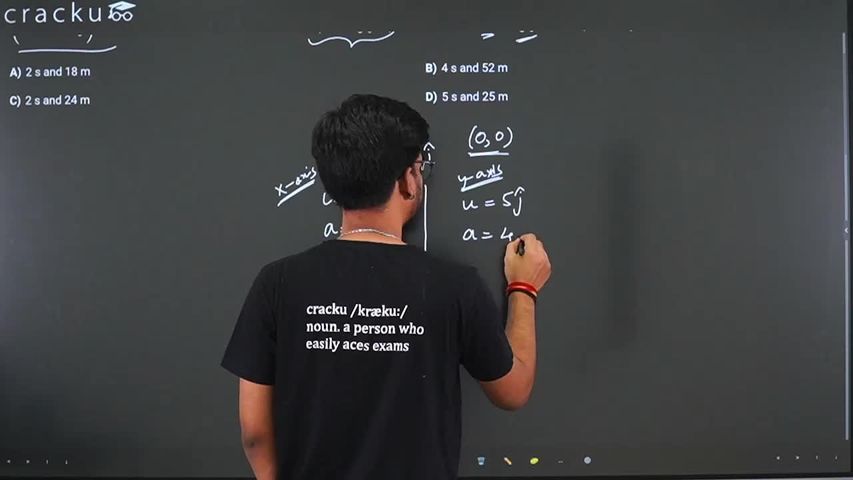
Click on the Email ☝️ to Watch the Video Solution
Create a FREE account and get:
_1.webp)

Educational materials for JEE preparation

Ask our AI anything

AI can make mistakes. Please verify important information.
AI can make mistakes. Please verify important information.
