
Join Our JEE Preparation Group
Prep with like-minded aspirants; Get access to free daily tests and study material.
Sign in
Please select an account to continue using cracku.in
↓ →
Join Our JEE Preparation Group
Prep with like-minded aspirants; Get access to free daily tests and study material.
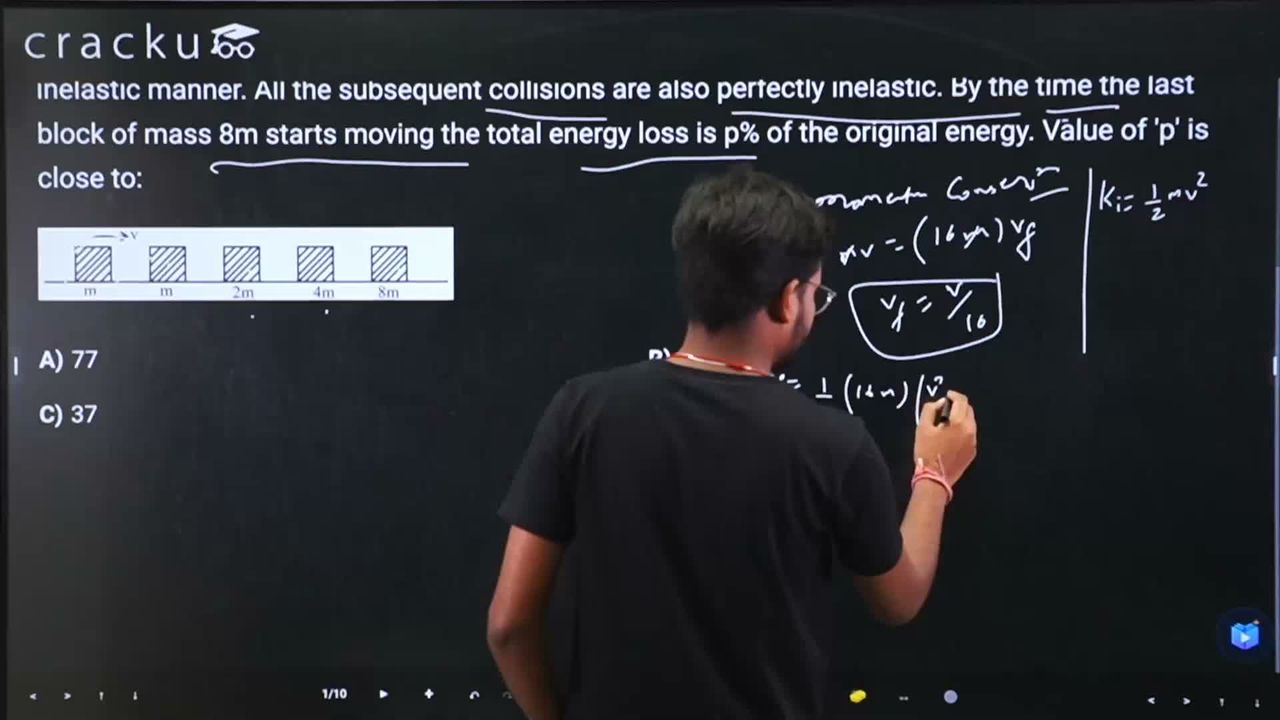
Blocks of masses m, 2m, 4m and 8m are arranged in a line of a frictionless floor. Another block of mass m, moving with speed v along the same line (see figure) collides with mass m in perfectly inelastic manner. All the subsequent collisions are also perfectly inelastic. By the time the last block of mass 8m starts moving the total energy loss is p% of the original energy. Value of 'p' is close to:

$$\text{Original kinetic energy of the incoming block: } E_i = \frac{1}{2}mv^2$$
$$\text{Total combined mass when all blocks are stuck together and moving: } M = m + m + 2m + 4m + 8m = 16m$$
$$\text{By conservation of linear momentum: } mv = M v_f \implies mv = 16m \cdot v_f \implies v_f = \frac{v}{16}$$
$$\text{Final kinetic energy of the combined system: } E_f = \frac{1}{2} M v_f^2 = \frac{1}{2} (16m) \left(\frac{v}{16}\right)^2 = \frac{1}{2} \cdot \frac{mv^2}{16} = \frac{E_i}{16}$$
$$\text{Percentage energy loss: } p\% = \frac{E_i - E_f}{E_i} \times 100\% = \left(1 - \frac{1}{16}\right) \times 100\% = \frac{15}{16} \times 100\% = 93.75\% \approx 94\%$$
Was this solution helpful?
Click on the Email ☝️ to Watch the Video Solution
Create a FREE account and get:
_1.webp)

Educational materials for JEE preparation

Ask our AI anything

AI can make mistakes. Please verify important information.
AI can make mistakes. Please verify important information.
