
Join Our JEE Preparation Group
Prep with like-minded aspirants; Get access to free daily tests and study material.
Sign in
Please select an account to continue using cracku.in
↓ →
Join Our JEE Preparation Group
Prep with like-minded aspirants; Get access to free daily tests and study material.
A two point charges $$4q$$ and $$-q$$ are fixed on the $$x$$-axis at $$x = \frac{-d}{2}$$ and $$x = \frac{d}{2}$$, respectively. If the third point charge 'q' is taken from the origin to $$x = d$$ along the semicircle as shown in the figure, the energy of the charge will:
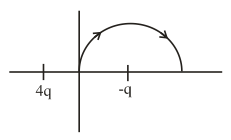
For electrostatic forces, the work done in moving a charge depends only on the initial and final positions because the electric field is conservative. Therefore, the change in energy of the moving charge equals its charge multiplied by the change in electric potential experienced during the displacement.
We have two fixed charges on the $$x$$-axis:
$$4q \text{ at } x=-\frac{d}{2},\qquad -q \text{ at } x=\frac{d}{2}.$$
A third charge $$q$$ is moved from the origin $$(0,0)$$ to the point $$(d,0)$$. Since potential is a state function, we only need the potentials at these two points.
The potential $$V$$ at a point due to a single point charge $$Q$$ located a distance $$r$$ away is given by the well-known formula
$$V=\frac{1}{4\pi\varepsilon_0}\,\frac{Q}{r}.$$
1. Potential at the origin, $$V_{\text{initial}}$$.
Distances from the origin to the two fixed charges:
$$r_1=\left|0-\!\Bigl(-\frac{d}{2}\Bigr)\right|=\frac{d}{2},\qquad r_2=\left|0-\!\Bigl(\frac{d}{2}\Bigr)\right|=\frac{d}{2}.$$
Hence
$$$ V_{\text{initial}}=\frac{1}{4\pi\varepsilon_0}\!\left( \frac{4q}{d/2}+\frac{-q}{d/2} \right) =\frac{1}{4\pi\varepsilon_0}\!\left( \frac{4q- q}{d/2} \right) =\frac{1}{4\pi\varepsilon_0}\,\frac{3q}{d/2} =\frac{1}{4\pi\varepsilon_0}\,\frac{6q}{d}. $$$
Thus
$$V_{\text{initial}}=\frac{6q}{4\pi\varepsilon_0 d}.$$
2. Potential at the final point $$(d,0)$$, $$V_{\text{final}}$$.
Distances from $$(d,0)$$ to the two fixed charges:
$$ R_1 = \left|d -\!\Bigl(-\frac{d}{2}\Bigr)\right| = \frac{3d}{2},\qquad R_2 = \left|d -\!\Bigl(\frac{d}{2}\Bigr)\right| = \frac{d}{2}. $$
Therefore
$$$ V_{\text{final}}=\frac{1}{4\pi\varepsilon_0}\!\left( \frac{4q}{3d/2}+\frac{-q}{d/2} \right) =\frac{1}{4\pi\varepsilon_0}\!\left( \frac{8q}{3d}-\frac{2q}{d} \right). $$$
We bring both fractions to a common denominator $$3d$$:
$$$ \frac{8q}{3d}-\frac{2q}{d} =\frac{8q}{3d}-\frac{6q}{3d} =\frac{2q}{3d}. $$$
Hence
$$V_{\text{final}}=\frac{1}{4\pi\varepsilon_0}\,\frac{2q}{3d} =\frac{q}{6\pi\varepsilon_0 d}.$$
3. Change in potential experienced by the moving charge.
$$\Delta V = V_{\text{final}}-V_{\text{initial}} =\frac{q}{6\pi\varepsilon_0 d}-\frac{6q}{4\pi\varepsilon_0 d}.$$
Writing both terms over the common denominator $$6\pi\varepsilon_0 d$$:
$$$ \Delta V =\frac{q}{6\pi\varepsilon_0 d}-\frac{9q}{6\pi\varepsilon_0 d} =-\frac{8q}{6\pi\varepsilon_0 d} =-\frac{4q}{3\pi\varepsilon_0 d}. $$$
4. Change in potential energy of the charge $$q$$.
The change in energy is simply $$q$$ times the change in potential:
$$$ \Delta U = q\,\Delta V =q\left(-\frac{4q}{3\pi\varepsilon_0 d}\right) =-\frac{4q^{2}}{3\pi\varepsilon_0 d}. $$$
The negative sign tells us that the energy decreases, and the magnitude of the decrease is $$\dfrac{4q^2}{3\pi\varepsilon_0 d}$$.
Hence, the correct answer is Option D.
Was this solution helpful?
Click on the Email ☝️ to Watch the Video Solution
Create a FREE account and get:
_1.webp)

Educational materials for JEE preparation

Ask our AI anything

AI can make mistakes. Please verify important information.
AI can make mistakes. Please verify important information.
