
Join Our JEE Preparation Group
Prep with like-minded aspirants; Get access to free daily tests and study material.
Sign in
Please select an account to continue using cracku.in
↓ →
Join Our JEE Preparation Group
Prep with like-minded aspirants; Get access to free daily tests and study material.
The probability of a man hitting a target is $$\frac{1}{10}$$. The least number of shots required, so that the probability of his hitting the target at least once is greater than $$\frac{1}{4}$$, is ____
Correct Answer: 3
First, we note that the probability of the man hitting the target in one shot is given as $$\dfrac{1}{10}$$. Therefore, the probability of his missing the target in a single shot is
$$1-\dfrac{1}{10}=\dfrac{9}{10}\,.$$
Now, assume he fires $$n$$ independent shots. Because the shots are independent, the probability that he misses every one of the $$n$$ shots is the product of the individual miss-probabilities. Hence, the required probability of missing all $$n$$ shots is
$$\left(\dfrac{9}{10}\right)^n\,.$$
We are interested in the complementary event, namely, the event that he hits the target at least once in those $$n$$ shots. For any two complementary events $$A$$ and $$\overline{A}$$, we have the basic rule
$$P(A)=1-P(\overline{A}).$$
Applying this rule with $$A$$ = “at least one hit” and $$\overline{A}$$ = “no hit at all,” we obtain
$$P(\text{at least one hit}) = 1-\left(\dfrac{9}{10}\right)^n.$$
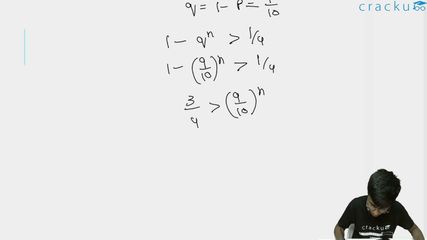
The question demands that this probability be greater than $$\dfrac{1}{4}$$. Therefore, we set up the inequality
$$1-\left(\dfrac{9}{10}\right)^n > \dfrac{1}{4}.$$
Subtracting $$1$$ from both sides (and remembering to change the sign), we get
$$-\left(\dfrac{9}{10}\right)^n > -\dfrac{3}{4}.$$
Multiplying both sides by $$-1$$ reverses the inequality sign, giving
$$\left(\dfrac{9}{10}\right)^n < \dfrac{3}{4}.$$
To isolate $$n$$ we take natural logarithms (or common logarithms; any positive base other than 1 works). Writing with natural logs, we have
$$\ln\!\left(\dfrac{9}{10}\right)^n < \ln\!\left(\dfrac{3}{4}\right).$$
Using the power rule for logarithms, $$\ln(a^b)=b\ln a$$, we get
$$n\;\ln\!\left(\dfrac{9}{10}\right) < \ln\!\left(\dfrac{3}{4}\right).$$
Observe that $$\dfrac{9}{10}=0.9$$ and $$\dfrac{3}{4}=0.75,$$ both of which lie between 0 and 1. Hence their natural logarithms are negative. When dividing by a negative number, the direction of the inequality reverses. Therefore, dividing both sides by $$\ln(0.9)$$ gives
$$n > \dfrac{\ln\!\left(\dfrac{3}{4}\right)}{\ln\!\left(\dfrac{9}{10}\right)}.$$
We now compute the numerical value:
$$\ln\!\left(\dfrac{3}{4}\right)=\ln(0.75)\approx -0.287682072,$$
$$\ln\!\left(\dfrac{9}{10}\right)=\ln(0.9)\approx -0.105360516.$$
Substituting these into the inequality, we get
$$n > \dfrac{-0.287682072}{-0.105360516}\approx 2.731.$$ Since $$n$$ must be a whole number (the man cannot fire a fractional shot), we choose the least integer greater than $$2.731$$, which is $$3$$.
So, the answer is $$3$$.
Was this solution helpful?
Click on the Email ☝️ to Watch the Video Solution
Create a FREE account and get:
_1.webp)

Educational materials for JEE preparation

Ask our AI anything

AI can make mistakes. Please verify important information.
AI can make mistakes. Please verify important information.
