
Join Our JEE Preparation Group
Prep with like-minded aspirants; Get access to free daily tests and study material.
Sign in
Please select an account to continue using cracku.in
↓ →
Join Our JEE Preparation Group
Prep with like-minded aspirants; Get access to free daily tests and study material.
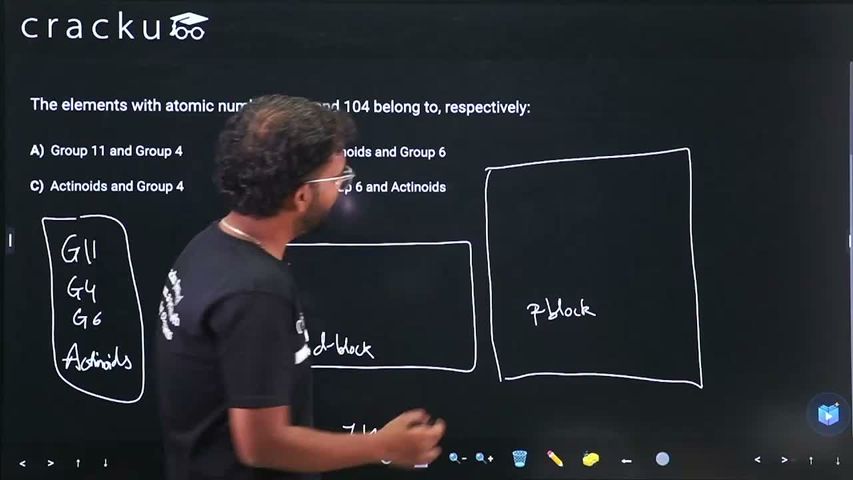
We begin by identifying the element whose atomic number is $$101$$. Consulting the extended periodic table, we find that atomic number $$101$$ corresponds to the element Mendelevium whose symbol is $$\text{Md}$$. This element lies in the series of fourteen elements that follow actinium ($$Z=89$$) and extend from thorium ($$Z=90$$) to lawrencium ($$Z=103$$). This horizontal block is known as the actinoid (actinide) series. So, the element with $$Z=101$$ is an actinoid.
Next, we locate the element whose atomic number is $$104$$. Atomic number $$104$$ corresponds to Rutherfordium with symbol $$\text{Rf}$$. After the completion of the actinoid series at lawrencium ($$Z=103$$), the periodic table resumes its normal long-form layout. Rutherfordium therefore occupies the position directly below hafnium ($$Z=72$$) and zirconium ($$Z=40$$). All three elements belong to the vertical column that, in modern IUPAC numbering, is called Group 4 of the periodic table. Group 4 contains the general configuration $$[ \text{noble gas} ]\,n s^2 (n-1)d^2$$ and is part of the $$d$$-block transition metals.
Hence, the element with atomic number $$101$$ is an actinoid, while the element with atomic number $$104$$ lies in Group 4.
Comparing with the given options, we see that Option C states “Actinoids and Group 4,” which matches our deduction.
Hence, the correct answer is Option C.
Was this solution helpful?
Click on the Email ☝️ to Watch the Video Solution
Create a FREE account and get:
_1.webp)

Educational materials for JEE preparation

Ask our AI anything

AI can make mistakes. Please verify important information.
AI can make mistakes. Please verify important information.
