
Join Our JEE Preparation Group
Prep with like-minded aspirants; Get access to free daily tests and study material.
Sign in
Please select an account to continue using cracku.in
↓ →
Join Our JEE Preparation Group
Prep with like-minded aspirants; Get access to free daily tests and study material.
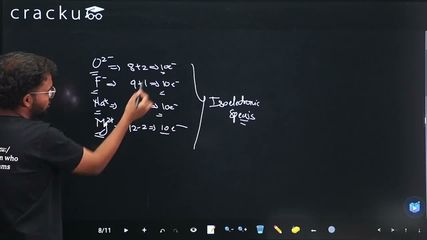
We first observe that the ions $$O^{2-},\;F^- ,\;Na^+$$ and $$Mg^{2+}$$ all possess exactly ten electrons. This is because
$$O^{2-}: 8\text{ (protons)}+2\text{ (extra electrons)}=10\text{ e}^-$$
$$F^-: 9+1=10\text{ e}^-$$
$$Na^+: 11-1=10\text{ e}^-$$
$$Mg^{2+}: 12-2=10\text{ e}^-$$
Species having the same number of electrons are called isoelectronic. For an isoelectronic series the principal factor governing ionic radius is the magnitude of the nuclear charge $$Z$$: the larger the value of $$Z$$, the stronger the electrostatic attraction exerted on the electron cloud, and hence the smaller the ionic radius.
Let us therefore list the nuclear charges explicitly:
$$\begin{aligned} O^{2-}:&\; Z=8,\\[2pt] F^-:&\; Z=9,\\[2pt] Na^+:&\; Z=11,\\[2pt] Mg^{2+}:&\; Z=12. \end{aligned}$$
Because ionic radius $$r$$ varies inversely with $$Z$$ within an isoelectronic sequence, we write symbolically
$$r\propto\frac1Z.$$
Hence a smaller nuclear charge gives a larger radius. Sorting the ions from the smallest nuclear charge to the largest nuclear charge gives
$$8\;(O^{2-}) < 9\;(F^-) < 11\;(Na^+) < 12\;(Mg^{2+}).$$
Correspondingly, the ionic radii follow the reverse order:
$$r(O^{2-}) > r(F^-) > r(Na^+) > r(Mg^{2+}).$$
Comparing with the options, this sequence matches Option B.
Hence, the correct answer is Option B.
Was this solution helpful?
Click on the Email ☝️ to Watch the Video Solution
Create a FREE account and get:
_1.webp)

Educational materials for JEE preparation

Ask our AI anything

AI can make mistakes. Please verify important information.
AI can make mistakes. Please verify important information.
