
Join Our JEE Preparation Group
Prep with like-minded aspirants; Get access to free daily tests and study material.
Sign in
Please select an account to continue using cracku.in
↓ →
Join Our JEE Preparation Group
Prep with like-minded aspirants; Get access to free daily tests and study material.
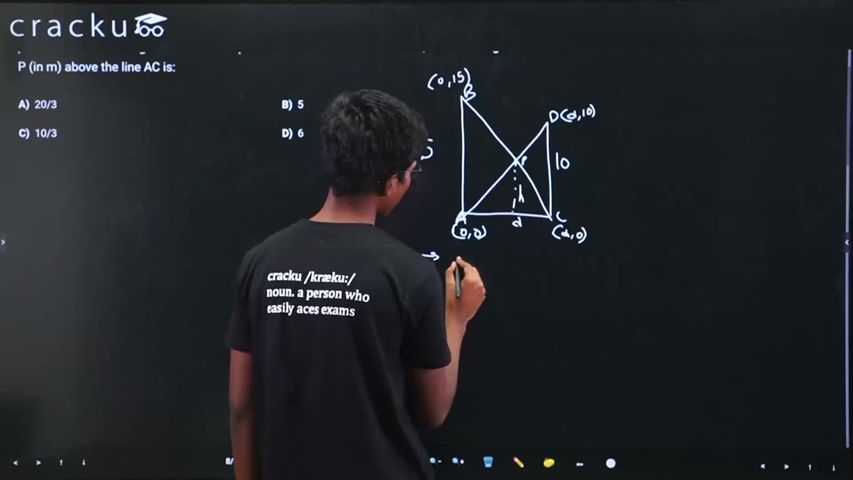
Two vertical poles AB = 15 m and CD = 10 m are standing apart on a horizontal ground with points A and C on the ground. If P is the point of intersection of BC and AD, then the height of P (in m) above the line AC is:
Let us begin by choosing a convenient Cartesian coordinate system so that every calculation can be carried out algebraically.
We place the origin on the ground at the foot of the taller pole A. Thus we take
$$A=(0,0).$$
The line AC is the horizontal ground, so the x-axis is along AC. Let the horizontal distance between the two poles be $$d\;{\rm m}$$ (its actual value will not matter; we shall soon see it cancels out). Hence the foot of the shorter pole is
$$C=(d,0).$$
The poles are vertical, therefore their tops have the same x-coordinates as their feet. Using the given heights, we write
$$B=(0,15) \quad\text{and}\quad D=(d,10).$$
Now we require the coordinates of the intersection $$P$$ of the two straight lines $$BC$$ and $$AD$$ and, finally, its y-coordinate (the height above the ground).
First we find a parametric equation for the line $$BC$$. Starting at $$B$$ and moving a fraction $$t$$ of the way toward $$C$$, we have
$$\bigl(x,y\bigr)=B+t(C-B) =(0,15)+t\bigl(d,0-15\bigr) =(td,\;15-15t).$$
So every point of $$BC$$ can be written as
$$\bigl(x,y\bigr)=\bigl(td,\;15(1-t)\bigr),\qquad 0\le t\le1.$$
Next we write a parametric equation for the line $$AD$$. Starting at $$A$$ and moving a fraction $$s$$ of the way toward $$D$$, we get
$$\bigl(x,y\bigr)=A+s(D-A) =(0,0)+s\bigl(d,10\bigr) =(sd,\;10s).$$
Thus every point of $$AD$$ can be expressed as
$$\bigl(x,y\bigr)=\bigl(sd,\;10s\bigr),\qquad 0\le s\le1.$$
At the point $$P$$ the coordinates coming from the two descriptions are equal; hence we equate them:
$$td = sd \quad\text{and}\quad 15(1-t) = 10s.$$
From the first equality (the x-coordinates) we have
$$td = sd \implies t = s,$$
because $$d\neq0$$. Substituting $$s=t$$ into the second equality (the y-coordinates) gives
$$15(1-t) = 10t.$$
Expanding and gathering like terms:
$$15 - 15t = 10t \\ \Rightarrow 15 = 25t \\ \Rightarrow t = \frac{15}{25} = \frac{3}{5}.$$
Because $$s=t$$, we also have
$$s=\frac{3}{5}.$$
Now we obtain the height of $$P$$ by inserting this value into the y-coordinate formula of either line (both give the same result). Using the expression from $$AD$$,
$$y = 10s = 10\left(\frac{3}{5}\right) = 6.$$
Thus the intersection point $$P$$ is $$6\;{\rm m}$$ above the ground line $$AC$$. Notice that the horizontal distance $$d$$ indeed cancelled out, confirming that the answer is independent of how far apart the poles stand.
Hence, the correct answer is Option D.
Was this solution helpful?
Click on the Email ☝️ to Watch the Video Solution
Create a FREE account and get:
_1.webp)

Educational materials for JEE preparation

Ask our AI anything

AI can make mistakes. Please verify important information.
AI can make mistakes. Please verify important information.
