
Join Our JEE Preparation Group
Prep with like-minded aspirants; Get access to free daily tests and study material.
Sign in
Please select an account to continue using cracku.in
↓ →
Join Our JEE Preparation Group
Prep with like-minded aspirants; Get access to free daily tests and study material.
The mean and variance of 8 observations are 10 and 13.5, respectively. If 6 of these observations are 5, 7, 10, 12, 14, 15, then the absolute difference of the remaining two observations is:
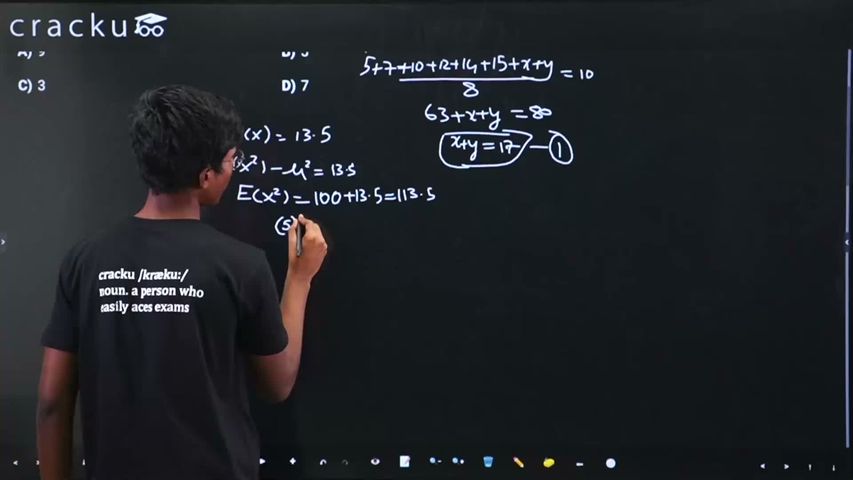
We have a total of 8 observations whose mean is given as $$\mu = 10$$. The definition of mean states
$$\text{Mean }(\mu)=\dfrac{\text{Sum of all observations}}{\text{Number of observations}}.$$
So
$$10=\dfrac{\text{Sum of all 8 observations}}{8}.$$
Multiplying both sides by 8, we get
$$\text{Sum of all 8 observations}=10 \times 8 = 80.$$
Out of these 8 observations, six are already known: $$5,\,7,\,10,\,12,\,14,\,15.$$ Let us add them:
$$5+7+10+12+14+15 = 63.$$
Hence the sum of the remaining two unknown observations, say $$a$$ and $$b$$, must satisfy
$$a + b = 80 - 63 = 17.$$
Now we use the information about variance. The variance of the 8 observations is given as $$\sigma^{2}=13.5.$$ For an entire population (which is the usual convention in such questions) the variance formula is
$$\sigma^{2}=\dfrac{1}{n}\sum_{i=1}^{n}x_i^{2}-\mu^{2},$$
where $$n=8$$ and $$\mu=10.$$ Substituting, we have
$$13.5=\dfrac{1}{8}\sum_{i=1}^{8}x_i^{2}-10^{2}.$$
First move $$10^{2}=100$$ to the left:
$$13.5 + 100 = \dfrac{1}{8}\sum_{i=1}^{8}x_i^{2}.$$
So
$$113.5 = \dfrac{1}{8}\sum_{i=1}^{8}x_i^{2}.$$
Multiplying by 8 gives
$$\sum_{i=1}^{8}x_i^{2} = 113.5 \times 8 = 908.$$
Next we find the sum of squares of the six known observations:
$$5^{2}+7^{2}+10^{2}+12^{2}+14^{2}+15^{2} = 25+49+100+144+196+225 = 739.$$
Therefore the sum of squares of the remaining two observations must be
$$a^{2}+b^{2}=908-739=169.$$
We now have the simultaneous relations
$$a + b = 17, \qquad a^{2}+b^{2}=169.$$
To find $$|a-b|$$ we use the algebraic identity
$$(a+b)^{2}=a^{2}+b^{2}+2ab.$$
Substituting the known values, we get
$$17^{2}=169+2ab.$$
Since $$17^{2}=289,$$ this becomes
$$289 = 169 + 2ab \;\Longrightarrow\; 2ab = 289 - 169 = 120 \;\Longrightarrow\; ab = 60.$$
Now we apply another standard identity:
$$(a-b)^{2} = (a+b)^{2} - 4ab.$$
Substituting $$a+b = 17$$ and $$ab = 60$$ yields
$$(a-b)^{2} = 17^{2} - 4 \times 60 = 289 - 240 = 49.$$
Taking the positive square root (because absolute value is always non-negative), we obtain
$$|a-b| = \sqrt{49} = 7.$$
Hence, the correct answer is Option D.
Was this solution helpful?
Click on the Email ☝️ to Watch the Video Solution
Create a FREE account and get:
_1.webp)

Educational materials for JEE preparation

Ask our AI anything

AI can make mistakes. Please verify important information.
AI can make mistakes. Please verify important information.
