
Join Our JEE Preparation Group
Prep with like-minded aspirants; Get access to free daily tests and study material.
Sign in
Please select an account to continue using cracku.in
↓ →
Join Our JEE Preparation Group
Prep with like-minded aspirants; Get access to free daily tests and study material.
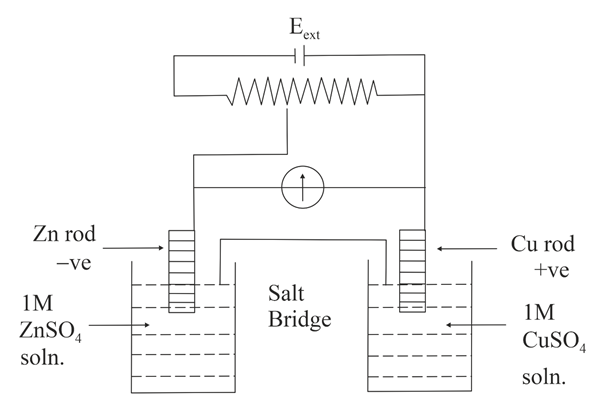
Identify the incorrect statement from the options below for the above cell:
$$E^0_{Cu^{2+}|Cu} = +0.34$$ V,
$$E^0_{Zn^{2+}|Zn} = -0.76$$ V
The cell under discussion is the Daniell cell
$$\text{Zn} \,|\, \text{Zn}^{2+}(aq) \;||\; \text{Cu}^{2+}(aq) \,|\, \text{Cu}$$
Standard electrode potentials (all in volts) are
$$E^{0}_{\text{Cu}^{2+}|\text{Cu}} = +0.34,$$ $$E^{0}_{\text{Zn}^{2+}|\text{Zn}} = -0.76$$
Standard cell emf
$$E^{0}_{\text{cell}} = E^{0}_{\text{cathode}} - E^{0}_{\text{anode}} = 0.34 -(-0.76) = 1.10 \text{ V}$$
In the spontaneous (galvanic) mode:
• Zn is oxidised: $$\text{Zn} \rightarrow \text{Zn}^{2+} + 2e^-$$ (anode).
• Cu2+ is reduced: $$\text{Cu}^{2+} + 2e^- \rightarrow \text{Cu}$$ (cathode).
• Electrons flow from Zn to Cu through the external circuit.
Now an external opposing voltage $$E_{\text{ext}}$$ is applied across the cell. Three situations arise:
Case 1:$$E_{\text{ext}} \lt 1.10 \text{ V}$$ — The applied voltage is too small to overcome the cell’s own emf, so the spontaneous galvanic action continues.
• Zn keeps dissolving (anode).
• Cu keeps depositing (cathode).
• Electrons still move from Zn to Cu.
This matches statement C, so C is correct.
$$E_{\text{ext}} = 1.10 \text{ V}$$ — The external voltage exactly balances the cell emf; net emf becomes zero.
• No current flows, no redox change occurs.
This matches statement D, so D is correct.
$$E_{\text{ext}} \gt 1.10 \text{ V}$$ — The applied voltage now exceeds the cell emf and forces the reverse (electrolytic) reaction.
• Cu is oxidised: $$\text{Cu} \rightarrow \text{Cu}^{2+} + 2e^-$$ at the Cu electrode (now the anode).
• Zn2+ is reduced: $$\text{Zn}^{2+} + 2e^- \rightarrow \text{Zn}$$ at the Zn electrode (now the cathode).
• Electrons are driven from Cu to Zn in the external circuit.
Hence for $$E_{\text{ext}} \gt 1.10 \text{ V}$$ we have “Cu dissolves and Zn deposits,” not the reverse.
Let us test each option:
Option A: “If $$E_{\text{ext}} \gt 1.1$$ V, $$e^-$$ flow from Cu to Zn.” — True (see Case 3).
Option B: “If $$E_{\text{ext}} \gt 1.1$$ V, Zn dissolves at Zn electrode and Cu deposits at Cu electrode.” — False; the opposite happens (Zn is deposited, Cu dissolves).
Option C: “If $$E_{\text{ext}} \lt 1.1$$ V, Zn dissolves at anode and Cu deposits at cathode.” — True (see Case 1).
Option D: “If $$E_{\text{ext}} = 1.1$$ V, no flow of $$e^-$$ or current occurs.” — True (see Case 2).
Therefore the incorrect statement is
Option B which is: If $$E_{\text{ext}} \gt 1.1$$ V, Zn dissolves at Zn electrode and Cu deposits at Cu electrode.
Was this solution helpful?
Create a FREE account and get:
_1.webp)

Educational materials for JEE preparation

Ask our AI anything

AI can make mistakes. Please verify important information.
AI can make mistakes. Please verify important information.
