
Join Our JEE Preparation Group
Prep with like-minded aspirants; Get access to free daily tests and study material.
Sign in
Please select an account to continue using cracku.in
↓ →
Join Our JEE Preparation Group
Prep with like-minded aspirants; Get access to free daily tests and study material.
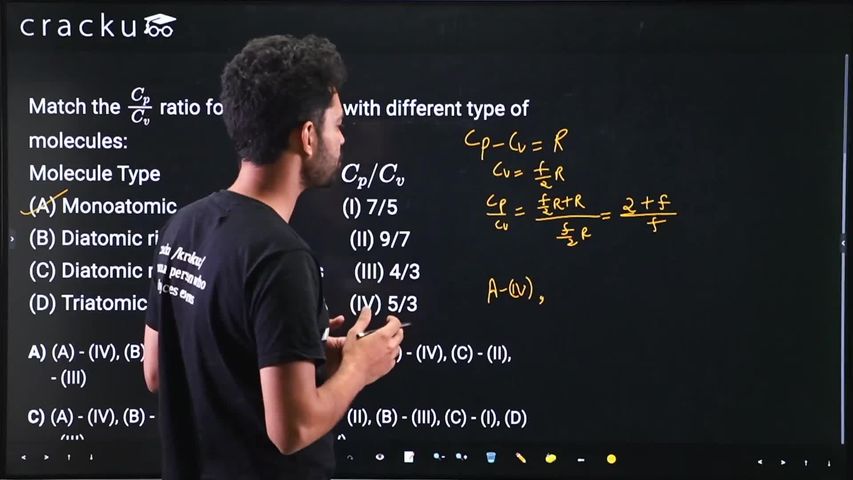
Match the $$\frac{C_p}{C_v}$$ ratio for ideal gases with different type of molecules:
Molecule Type $$C_p/C_v$$
(A) Monoatomic (I) 7/5
(B) Diatomic rigid molecules (II) 9/7
(C) Diatomic non-rigid molecules (III) 4/3
(D) Triatomic rigid molecules (IV) 5/3
For an ideal gas, the relation between the molar specific heats at constant pressure and volume is written first:
$$C_p = C_v + R$$
Here $$R$$ is the universal gas constant. To convert this into the required ratio, we recall the expression of $$C_v$$ in terms of the number of degrees of freedom $$f$$ of a single molecule:
$$C_v=\dfrac{f}{2}\,R$$
Substituting this value of $$C_v$$ in the earlier relation gives
$$C_p = \dfrac{f}{2}R + R = \left(\dfrac{f}{2}+1\right)R = \dfrac{f+2}{2}\,R$$
Now we build the desired ratio $$\dfrac{C_p}{C_v}$$, usually denoted by $$\gamma$$:
$$\gamma \;=\; \dfrac{C_p}{C_v} \;=\; \dfrac{\dfrac{f+2}{2}R}{\dfrac{f}{2}R} \;=\; \dfrac{f+2}{f} \;=\; 1 + \dfrac{2}{f}$$
Therefore, once we know the degrees of freedom $$f$$ of each type of molecule, we can obtain its $$\gamma$$ value directly.
We list the customary degrees of freedom for various molecular models:
• A monoatomic gas possesses only three translational degrees of freedom, so $$f=3$$.
• A diatomic rigid molecule (rotations allowed about two perpendicular axes) has five degrees of freedom, so $$f=5$$.
• A diatomic non-rigid molecule includes two additional vibrational degrees of freedom, making $$f=7$$.
• A triatomic rigid molecule (linear or planar but counted rigid) enjoys six degrees of freedom, so $$f=6$$.
Now we place each value of $$f$$ into $$\gamma = 1+\dfrac{2}{f}$$ and simplify step by step.
Monoatomic gas ($$f=3$$)
$$\gamma_{\text{mono}} = 1 + \dfrac{2}{3} = \dfrac{3}{3} + \dfrac{2}{3} = \dfrac{5}{3}$$
Diatomic rigid gas ($$f=5$$)
$$\gamma_{\text{dia, rigid}} = 1 + \dfrac{2}{5} = \dfrac{5}{5} + \dfrac{2}{5} = \dfrac{7}{5}$$
Diatomic non-rigid gas ($$f=7$$)
$$\gamma_{\text{dia, non-rigid}} = 1 + \dfrac{2}{7} = \dfrac{7}{7} + \dfrac{2}{7} = \dfrac{9}{7}$$
Triatomic rigid gas ($$f=6$$)
$$\gamma_{\text{tria, rigid}} = 1 + \dfrac{2}{6} = 1 + \dfrac{1}{3} = \dfrac{4}{3}$$
We now match each molecule category with its calculated $$\gamma$$ ratio:
$$\begin{aligned} \text{Monoatomic} &\longrightarrow \dfrac{5}{3}\;(\text{IV})\\[4pt] \text{Diatomic rigid} &\longrightarrow \dfrac{7}{5}\;(\text{I})\\[4pt] \text{Diatomic non-rigid} &\longrightarrow \dfrac{9}{7}\;(\text{II})\\[4pt] \text{Triatomic rigid} &\longrightarrow \dfrac{4}{3}\;(\text{III}) \end{aligned}$$
Reading these links against the options supplied, we obtain the correspondence
(A) - (IV), (B) - (I), (C) - (II), (D) - (III), which is exactly the content of Option C in the list.
Hence, the correct answer is Option 3.
Was this solution helpful?
Click on the Email ☝️ to Watch the Video Solution
Create a FREE account and get:
_1.webp)

Educational materials for JEE preparation

Ask our AI anything

AI can make mistakes. Please verify important information.
AI can make mistakes. Please verify important information.
