
Join Our JEE Preparation Group
Prep with like-minded aspirants; Get access to free daily tests and study material.
Sign in
Please select an account to continue using cracku.in
↓ →
Join Our JEE Preparation Group
Prep with like-minded aspirants; Get access to free daily tests and study material.
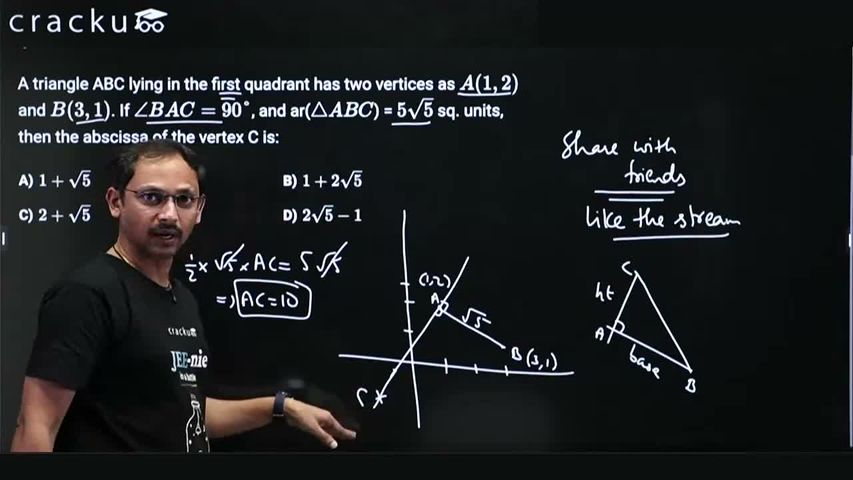
A triangle ABC lying in the first quadrant has two vertices as $$A(1, 2)$$ and $$B(3, 1)$$. If $$\angle BAC = 90°$$, and ar($$\triangle ABC$$) = $$5\sqrt{5}$$ sq. units, then the abscissa of the vertex C is:
We have a right-angled triangle $$\triangle ABC$$ such that the right angle is at vertex $$A$$, that is, $$\angle BAC = 90^{\circ}$$. The coordinates of the fixed vertices are $$A(1,2)$$ and $$B(3,1)$$, while the coordinates of vertex $$C$$ are unknown and may be written as $$C(x,\;y)$$. Because the triangle lies in the first quadrant, both $$x$$ and $$y$$ must be positive.
First we use the fact that the vectors $$\overrightarrow{AB}$$ and $$\overrightarrow{AC}$$ are perpendicular (since the angle between them is $$90^{\circ}$$). The dot-product criterion for perpendicularity is: two vectors $$\mathbf{u}(u_{1},u_{2})$$ and $$\mathbf{v}(v_{1},v_{2})$$ are perpendicular iff $$u_{1}v_{1}+u_{2}v_{2}=0$$.
We calculate the components of the required vectors:
$$\overrightarrow{AB} = (3-1,\;1-2) = (2,\,-1)$$
$$\overrightarrow{AC} = (x-1,\;y-2)$$
Now we impose the dot-product condition:
$$\overrightarrow{AB}\cdot\overrightarrow{AC}=0$$
$$\Rightarrow 2\,(x-1)+(-1)\,(y-2)=0$$
$$\Rightarrow 2x-2-y+2=0$$
$$\Rightarrow 2x-y=0$$
$$\Rightarrow y = 2x$$
Thus, the coordinates of vertex $$C$$ must lie on the straight line $$y=2x$$.
Next we use the given area. For a right-angled triangle with the right angle at $$A$$, the two perpendicular sides are $$AB$$ and $$AC$$. The area formula for a right-angled triangle is
$$\text{Area} = \dfrac{1}{2}\,(\text{length of }AB)\,(\text{length of }AC).$$
The length of $$AB$$ is found by the distance formula:
$$|AB| = \sqrt{(3-1)^{2} + (1-2)^{2}} = \sqrt{2^{2}+(-1)^{2}} = \sqrt{4+1} = \sqrt{5}.$$
The area is given to be $$5\sqrt{5}$$ square units, so we write
$$5\sqrt{5} = \dfrac{1}{2}\,|AB|\,|AC|.$$
Substituting $$|AB|=\sqrt{5}$$, we get
$$5\sqrt{5} = \dfrac{1}{2}\,(\sqrt{5})\,|AC|.$$
Multiplying both sides by $$2$$ and dividing by $$\sqrt{5}$$ gives
$$|AC| = \dfrac{2\,(5\sqrt{5})}{\sqrt{5}} = 10.$$
Thus the distance from $$A(1,2)$$ to $$C(x,2x)$$ must be exactly $$10$$. Applying the distance formula again:
$$|AC|^{2} = (x-1)^{2} + (2x-2)^{2}.$$
Because $$|AC|=10$$, we have
$$10^{2} = (x-1)^{2} + (2x-2)^{2}.$$
Expanding the right side:
$$100 = (x-1)^{2} + 4(x-1)^{2}$$
$$\;= 5(x-1)^{2}.$$
Therefore,
$$(x-1)^{2} = \dfrac{100}{5} = 20.$$
Taking square roots,
$$x - 1 = \pm\sqrt{20} = \pm\,2\sqrt{5}.$$
This gives two possible values:
$$x = 1 + 2\sqrt{5}\quad \text{or}\quad x = 1 - 2\sqrt{5}.$$
Since the triangle lies in the first quadrant, $$x$$ must be positive. The second choice yields a negative number (because $$2\sqrt{5}\approx4.472$$), so it is inadmissible. Hence, the only viable abscissa is
$$x = 1 + 2\sqrt{5}.$$
Looking at the given options, this value corresponds to Option B.
Hence, the correct answer is Option B.
Was this solution helpful?
Click on the Email ☝️ to Watch the Video Solution
Create a FREE account and get:
_1.webp)

Educational materials for JEE preparation

Ask our AI anything

AI can make mistakes. Please verify important information.
AI can make mistakes. Please verify important information.
