
Join Our JEE Preparation Group
Prep with like-minded aspirants; Get access to free daily tests and study material.
Sign in
Please select an account to continue using cracku.in
↓ →
Join Our JEE Preparation Group
Prep with like-minded aspirants; Get access to free daily tests and study material.
On heating, lead (II) nitrate gives a brown gas (A). The gas (A) on cooling changes to a colourless solid/liquid (B). (B) on heating with NO changes to a blue solid (C). The oxidation number of nitrogen in solid (C) is:
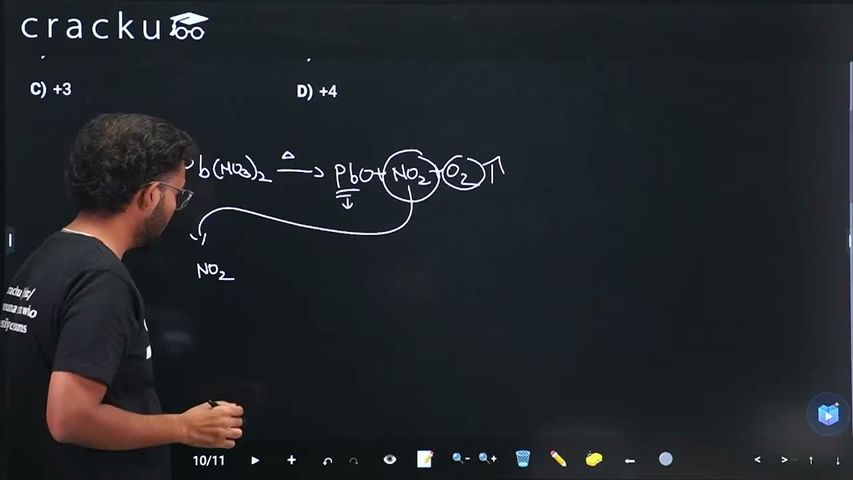
We have lead(II) nitrate $$\text{Pb(NO}_3)_2$$. A well-known rule for the thermal decomposition of the nitrate of any divalent metal (except the very light alkali metals) is
$$2\,M(NO_3)_2 \;\longrightarrow\; 2\,MO \;+\; 4\,NO_2 \;+\; O_2$$
where $$M$$ represents the divalent metal. Substituting $$M = \text{Pb}$$ gives
$$2\,\text{Pb(NO}_3)_2 \;\longrightarrow\; 2\,\text{PbO} \;+\; 4\,NO_2 \;+\; O_2$$
The gas set free is $$NO_2$$, which is brown in colour, so
$$(A) = NO_2$$.
When this brown gas is cooled, the well-known equilibrium
$$2\,NO_2 \;\rightleftharpoons\; N_2O_4$$
shifts to the right (because lowering the temperature favours the dimer), producing colourless liquid/solid $$N_2O_4$$. Hence
$$(B) = N_2O_4$$.
Now $$(B)$$ is heated in the presence of nitric oxide $$NO$$. The reaction that takes place is
$$N_2O_4 + NO \;\longrightarrow\; N_2O_3$$
The product $$N_2O_3$$ is a blue solid at sufficiently low temperatures, so
$$(C) = N_2O_3$$.
We must now find the oxidation number of nitrogen in $$N_2O_3$$. Let the oxidation number of a single nitrogen atom be $$x$$. Using the rule “the sum of oxidation numbers in a neutral molecule is zero”, we write
$$2x + 3(-2) = 0$$
because oxygen has the fixed oxidation number $$-2$$. Simplifying step by step,
$$2x - 6 = 0$$
$$2x = +6$$
$$x = +3$$.
So, in the blue solid $$N_2O_3$$, each nitrogen atom is in the $$+3$$ oxidation state.
Hence, the correct answer is Option C.
Was this solution helpful?
Click on the Email ☝️ to Watch the Video Solution
Create a FREE account and get:
_1.webp)

Educational materials for JEE preparation

Ask our AI anything

AI can make mistakes. Please verify important information.
AI can make mistakes. Please verify important information.
