
Join Our JEE Preparation Group
Prep with like-minded aspirants; Get access to free daily tests and study material.
Sign in
Please select an account to continue using cracku.in
↓ →
Join Our JEE Preparation Group
Prep with like-minded aspirants; Get access to free daily tests and study material.
On combustion of Li, Na and K in excess of air, the major oxides formed, respectively, are:
When an alkali metal is burnt in excess of air, the nature of the oxide obtained depends strongly on the size of the metal cation $$M^+$$ and on the particular oxide anion that can be stabilised by that cation. The sequence of possible oxide anions is:
$$O^{2-}\;(oxide)\;,$$ $$O_2^{2-}\;(peroxide)\;,$$ $$O_2^{-}\;(superoxide)$$
As the cation becomes larger down the group, its ability to stabilise the bigger and less charge-dense anions increases. Mathematically, lattice energy $$U_L$$ is roughly proportional to $$\dfrac{Z^{+}\,Z^{-}}{r^{+}+r^{-}}$$, where $$r^{+}$$ and $$r^{-}$$ are the ionic radii and $$Z^{+},Z^{-}$$ are the ionic charges. A small $$M^+$$ gives a high lattice energy only with the small $$O^{2-}$$ ion; a larger $$M^+$$ gives sufficient lattice energy even with the bulkier $$O_2^{2-}$$ or $$O_2^{-}$$ ions.
We now examine each metal one by one.
For lithium we have the smallest cation $$Li^+$$. Its high polarising power favours the compact oxide ion $$O^{2-}$$. Thus the dominant reaction in excess air is
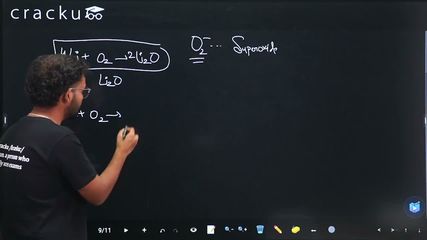
$$4\,Li\;+\;O_2\;\longrightarrow\;2\,Li_2O$$
so the principal oxide is $$Li_2O$$.
For sodium the cation $$Na^+$$ is larger. It can still form $$Na_2O$$ in limited oxygen, but in excess oxygen it preferentially forms the peroxide:
$$2\,Na\;+\;O_2\;\longrightarrow\;Na_2O_2$$
Therefore, the major product under the stated conditions is $$Na_2O_2$$.
For potassium the cation $$K^+$$ is even larger. It is able to stabilise the still larger superoxide ion $$O_2^{-}$$. In excess oxygen we have
$$K\;+\;O_2\;\longrightarrow\;KO_2$$
So the principal oxide here is $$KO_2$$.
Collecting the three results, the major oxides obtained are
$$Li_2O,\qquad Na_2O_2,\qquad KO_2.$$
Comparing with the given options, we see that Option B lists exactly this sequence.
Hence, the correct answer is Option B.
Was this solution helpful?
Click on the Email ☝️ to Watch the Video Solution
Create a FREE account and get:
_1.webp)

Educational materials for JEE preparation

Ask our AI anything

AI can make mistakes. Please verify important information.
AI can make mistakes. Please verify important information.
