
Join Our JEE Preparation Group
Prep with like-minded aspirants; Get access to free daily tests and study material.
Sign in
Please select an account to continue using cracku.in
↓ →
Join Our JEE Preparation Group
Prep with like-minded aspirants; Get access to free daily tests and study material.
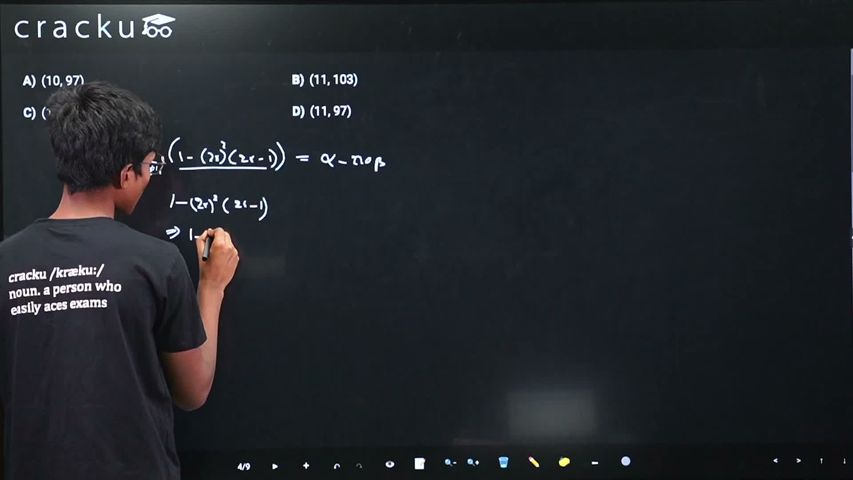
If $$1 + (1 - 2^2 \cdot 1) + (1 - 4^2 \cdot 3) + (1 - 6^2 \cdot 5) + \ldots + (1 - 20^2 \cdot 19) = \alpha - 220\beta$$, then an ordered pair $$(\alpha, \beta)$$ is equal to:
We have to evaluate the whole expression
$$1+\bigl(1-2^{2}\cdot1\bigr)+\bigl(1-4^{2}\cdot3\bigr)+\bigl(1-6^{2}\cdot5\bigr)+\ldots+\bigl(1-20^{2}\cdot19\bigr).$$
Let us denote the required sum by $$S.$$ The first term is the isolated $$1.$$ After that, every term is of the form $$1-(2n)^{2}\,(2n-1)$$ where $$n=1,2,3,\ldots,10,$$ because $$2n$$ runs through $$2,4,6,\ldots,20$$ and the corresponding $$2n-1$$ then runs through $$1,3,5,\ldots,19.$$
So we write
$$S \;=\;1+\sum_{n=1}^{10}\Bigl[\,1-(2n)^{2}(2n-1)\Bigr].$$
Next we expand the bracket inside the summation. First, observe
$$(2n)^{2}(2n-1)=4n^{2}\,(2n-1)=8n^{3}-4n^{2}.$$
Hence
$$1-(2n)^{2}(2n-1)=1-\bigl(8n^{3}-4n^{2}\bigr)=1+4n^{2}-8n^{3}.$$
Substituting this back, we have
$$S=1+\sum_{n=1}^{10}\bigl(1+4n^{2}-8n^{3}\bigr).$$
Now we separate the sum term-by-term:
$$S=1+\Bigl[\sum_{n=1}^{10}1+4\sum_{n=1}^{10}n^{2}-8\sum_{n=1}^{10}n^{3}\Bigr].$$
The first summation is simply the count of numbers from 1 to 10:
$$\sum_{n=1}^{10}1=10.$$
For the second summation we recall the standard formula
$$\sum_{n=1}^{m}n^{2}=\frac{m(m+1)(2m+1)}{6}.$$
Putting $$m=10$$ gives
$$\sum_{n=1}^{10}n^{2}=\frac{10\cdot11\cdot21}{6}= \frac{2310}{6}=385.$$
For the third summation we use the well-known identity
$$\sum_{n=1}^{m}n^{3}=\Bigl[\frac{m(m+1)}{2}\Bigr]^{2}.$$
Taking again $$m=10$$ gives
$$\sum_{n=1}^{10}n^{3}= \Bigl[\frac{10\cdot11}{2}\Bigr]^{2}=55^{2}=3025.$$
Substituting every value inside $$S$$ we get
$$S=1+\Bigl[10+4\times385-8\times3025\Bigr].$$
Now we carry out the arithmetic step by step:
$$4\times385=1540,$$
$$8\times3025=24200.$$
Hence the bracket equals
$$10+1540-24200=1550-24200=-22650.$$
Finally, adding the leading $$1$$ outside the bracket,
$$S=1+(-22650)=-22649.$$
The question states that the same number can be written in the form $$\alpha-220\beta.$$ Therefore we must have
$$\alpha-220\beta=-22649.$$
We search among the options for integers $$\alpha,\beta$$ that satisfy this equation. Trying the given pairs:
Option A: $$10-220\cdot97=10-21340=-21330\neq-22649,$$
Option B: $$11-220\cdot103=11-22660=-22649\;(\text{matches}),$$
Option C: $$10-220\cdot103=10-22660=-22650\neq-22649,$$
Option D: $$11-220\cdot97=11-21340=-21329\neq-22649.$$
So the only pair that works is $$\bigl(11,\,103\bigr).$$
Hence, the correct answer is Option 2.
Was this solution helpful?
Click on the Email ☝️ to Watch the Video Solution
Create a FREE account and get:
_1.webp)

Educational materials for JEE preparation

Ask our AI anything

AI can make mistakes. Please verify important information.
AI can make mistakes. Please verify important information.
