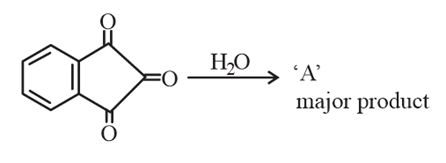
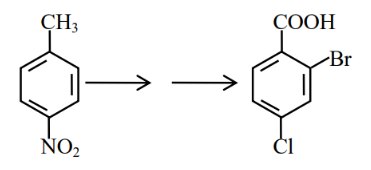
For the following questions answer them individually
A vector in $$x - y$$ plane makes an angle of $$30°$$ with $$y$$-axis. The magnitude of $$y$$-component of vector is $$2\sqrt{3}$$. The magnitude of $$x$$-component of the vector will be :
The speed of a wave produced in water is given by $$v = \lambda^a g^b \rho^c$$. Where $$\lambda$$, $$g$$ and $$\rho$$ are wavelength of wave, acceleration due to gravity and density of water respectively. The values of $$a$$, $$b$$ and $$c$$ respectively, are
The position of a particle related to time is given by $$x = (5t^2 - 4t + 5)$$ m. The magnitude of velocity of the particle at $$t = 2$$ s will be :
The position vector of a particle related to time $$t$$ is given by $$\vec{r} = (10t\hat{i} + 15t^2\hat{j} + 7\hat{k})$$ m. The direction of net force experienced by the particle is :
A body is released from a height equal to the radius $$(R)$$ of the earth. The velocity of the body when it strikes the surface of the earth will be: (Given $$g$$ = acceleration due to gravity on the earth.)
Two identical particles each of mass $$m$$ go round a circle of radius $$a$$ under the action of their mutual gravitational attraction. The angular speed of each particle will be :
A wire of length $$L$$ and radius $$r$$ is clamped rigidly at one end. When the other end of the wire is pulled by a force $$f$$, its length increases by $$l$$. Another wire of same material of length $$2L$$ and radius $$2r$$ is pulled by a force $$2f$$. Then the increase in its length will be:
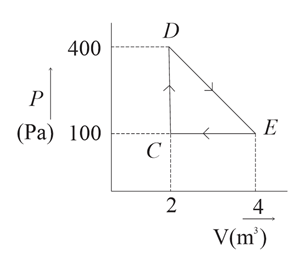
A thermodynamic system is taken through cyclic process. The total work done in the process is :
A flask contains Hydrogen and Argon in the ratio $$2 : 1$$ by mass. The temperature of the mixture is $$30°$$C. The ratio of average kinetic energy per molecule of the two gases $$\left(\frac{K_{argon}}{K_{hydrogen}}\right)$$ is: (Given : Atomic Weight of Ar $$= 39.9$$)
In a linear Simple Harmonic Motion (SHM)
(A) Restoring force is directly proportional to the displacement.
(B) The acceleration and displacement are opposite in direction.
(C) The velocity is maximum at mean position.
(D) The acceleration is minimum at extreme points.
Choose the correct answer from the options given below: