
Join Our JEE Preparation Group
Prep with like-minded aspirants; Get access to free daily tests and study material.
Sign in
Please select an account to continue using cracku.in
↓ →
Join Our JEE Preparation Group
Prep with like-minded aspirants; Get access to free daily tests and study material.
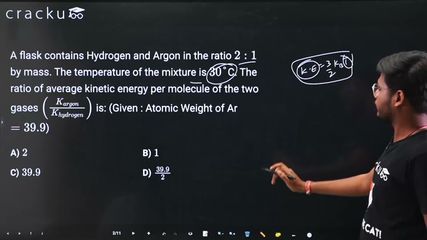
A flask contains Hydrogen and Argon in the ratio $$2 : 1$$ by mass. The temperature of the mixture is $$30°$$C. The ratio of average kinetic energy per molecule of the two gases $$\left(\frac{K_{argon}}{K_{hydrogen}}\right)$$ is: (Given : Atomic Weight of Ar $$= 39.9$$)
A flask contains H$$_2$$ and Ar in the ratio 2:1 by mass at 30 degrees C. We need the ratio of average kinetic energy per molecule.
We start by noting that
The average translational kinetic energy per molecule of any ideal gas is given by:
$$ KE = \frac{3}{2}k_B T $$
where $$k_B$$ is Boltzmann's constant and $$T$$ is the absolute temperature. This is a fundamental result of the kinetic theory of gases.
Next,
The formula $$KE = \frac{3}{2}k_B T$$ depends only on the temperature and is completely independent of:
- The type of gas (whether monatomic Ar or diatomic H$$_2$$)
- The molecular mass of the gas
- The mass ratio in the mixture
This is because the kinetic energy distribution depends only on temperature (Maxwell-Boltzmann distribution).
From this,
Since both gases are at the same temperature (30 degrees C = 303 K):
$$ \frac{K_{Ar}}{K_{H_2}} = \frac{\frac{3}{2}k_B T}{\frac{3}{2}k_B T} = 1 $$
The ratio is 1.
The correct answer is Option 2: 1.
Was this solution helpful?
Click on the Email ☝️ to Watch the Video Solution
Create a FREE account and get:
_1.webp)

Educational materials for JEE preparation

Ask our AI anything

AI can make mistakes. Please verify important information.
AI can make mistakes. Please verify important information.
