
Join Our JEE Preparation Group
Prep with like-minded aspirants; Get access to free daily tests and study material.
Sign in
Please select an account to continue using cracku.in
↓ →
Join Our JEE Preparation Group
Prep with like-minded aspirants; Get access to free daily tests and study material.
The number of correct statements from the following is _____
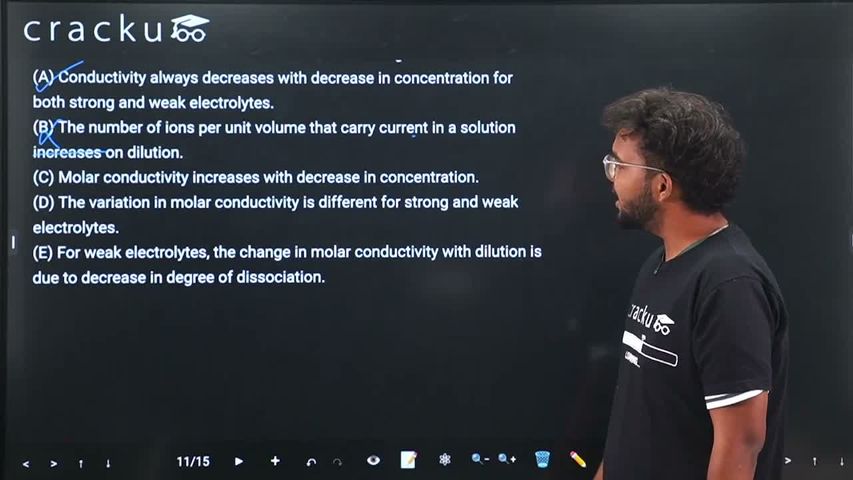
(A) Conductivity always decreases with decrease in concentration for both strong and weak electrolytes.
(B) The number of ions per unit volume that carry current in a solution increases on dilution.
(C) Molar conductivity increases with decrease in concentration.
(D) The variation in molar conductivity is different for strong and weak electrolytes.
(E) For weak electrolytes, the change in molar conductivity with dilution is due to decrease in degree of dissociation.
Correct Answer: 3
Analyzing each statement:
(A) "Conductivity always decreases with decrease in concentration for both strong and weak electrolytes." - TRUE. Conductivity (κ) decreases with dilution because fewer ions are available per unit volume.
(B) "The number of ions per unit volume increases on dilution." - FALSE. On dilution, concentration decreases, so the number of ions per unit volume decreases (for strong electrolytes). For weak electrolytes, degree of dissociation increases but overall number of ions per unit volume still decreases.
(C) "Molar conductivity increases with decrease in concentration." - TRUE. Molar conductivity increases on dilution for both strong and weak electrolytes.
(D) "The variation in molar conductivity is different for strong and weak electrolytes." - TRUE. Strong electrolytes show slight increase (Debye-Hückel-Onsager theory), while weak electrolytes show dramatic increase due to increased dissociation.
(E) "For weak electrolytes, the change in molar conductivity with dilution is due to decrease in degree of dissociation." - FALSE. The change is due to INCREASE in degree of dissociation (not decrease).
Correct statements: A, C, D → 3 correct statements.
The answer is $$\mathbf{3}$$.
Click on the Email ☝️ to Watch the Video Solution
Create a FREE account and get:
_1.webp)

Educational materials for JEE preparation

Ask our AI anything

AI can make mistakes. Please verify important information.
AI can make mistakes. Please verify important information.


