
Join Our JEE Preparation Group
Prep with like-minded aspirants; Get access to free daily tests and study material.
Sign in
Please select an account to continue using cracku.in
↓ →
Join Our JEE Preparation Group
Prep with like-minded aspirants; Get access to free daily tests and study material.
Decreasing order of reactivity towards electrophilic substitution for the following compounds is:
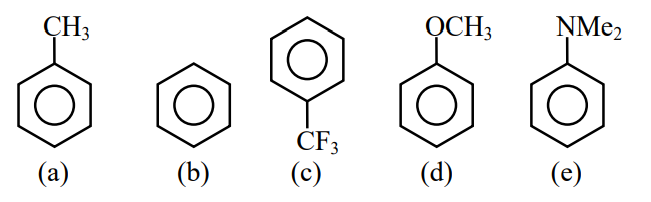
In electrophilic aromatic substitution, the reactivity of the benzene ring depends on the electron density present in the aromatic system. Electron-donating groups increase the electron density of the ring and activate it toward electrophilic attack, whereas electron-withdrawing groups decrease the electron density and deactivate the ring.
The $$-NMe_2$$ group contains a lone pair on nitrogen that is strongly donated to the aromatic ring through resonance. Since nitrogen is less electronegative than oxygen, this donation is very effective, making $$-NMe_2$$ the strongest activating group among the given substituents.
The $$-OCH_3$$ group also donates electron density through resonance using the lone pairs present on oxygen. However, oxygen is more electronegative than nitrogen, so its electron-donating ability is slightly weaker than that of $$-NMe_2$$. Therefore, it is strongly activating but less activating than $$-NMe_2$$.
The $$-CH_3$$ group increases electron density through hyperconjugation and the $$+I$$ effect. Since it does not possess lone pairs for resonance donation, its activating effect is weaker than that of $$-NMe_2$$ and $$-OCH_3$$.
Unsubstituted benzene serves as the reference compound and is neither activated nor deactivated.
The $$-CF_3$$ group exerts a very strong $$-I$$ effect because of the presence of three highly electronegative fluorine atoms. It withdraws electron density from the aromatic ring and strongly deactivates it toward electrophilic substitution.
Therefore, the decreasing order of reactivity is
$$-NMe_2>-OCH_3>-CH_3>H>-CF_3$$
Using the given labels,
$$e>d>a>b>c$$
Hence, the correct answer is
$$e>d>a>b>c$$
Was this solution helpful?
Click on the Email ☝️ to Watch the Video Solution
Create a FREE account and get:
_1.webp)

Educational materials for JEE preparation

Ask our AI anything

AI can make mistakes. Please verify important information.
AI can make mistakes. Please verify important information.
